
Kubota Operator Manual
Kubota KTH4815-2 Operator Manual
Document number TOB-0070747 · English PDF edition · 213 pages
About this manual
Kubota published this Operator Manual for KTH4815-2. It is intended for safe operation, controls, routine checks, and source-supported maintenance, where those subjects appear in the source publication.
Use the Manual Contents below to check that the exact operating, safety, adjustment, or routine-maintenance topic you need is included in this publication.
Manual details
- Manufacturer
- Kubota
- Manual type
- Operator Manual
- Models
- KTH4815-2
- Document number
- TOB-0070747
- Publication year
- 2023
- Language
- English
- Page count
- 213
Product highlights
Maintenance
The manual includes a maintenance schedule and a lubrication chart.
Manual contents
Use these source headings to locate the task or system you need in the PDF.
- Preface — p. 3
- Applicable machines — p. 3
- Language — p. 4
- Manual storage — p. 4
- Icons and signal words used in the document — p. 4
- Illustrations — p. 5
- Recommissioning — p. 6
- Version history — p. 6
- Typographical conventions — p. 7
- EC DECLARATION OF CONFORMITY — p. 8
- 1 Introduction — p. 15
- 1.1 Exclusions — p. 15
- 2 Description — p. 17
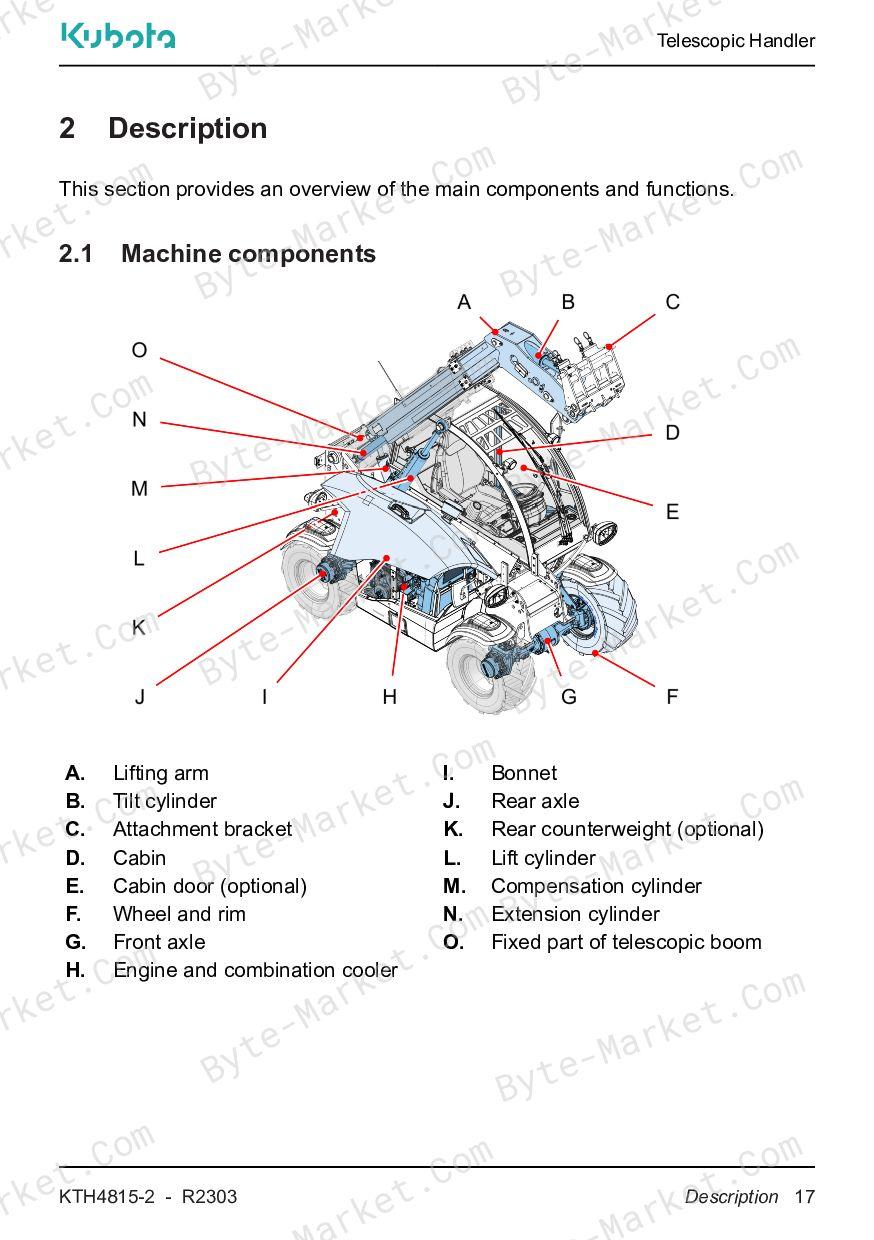
- 2.1 Machine components — p. 17
- 2.2 Auxiliary connections — p. 18
- 2.2.1 Front — p. 18
- 2.2.1.1 Standard hydraulic configuration — p. 18
- 2.2.1.2 Hydraulic configuration option 1 — p. 19
- 2.2.1.3 Hydraulic configuration option 2 — p. 20
- 2.2.1.4 Hydraulic configuration option 3 — p. 21
- 2.2.1.5 Hydraulic configuration option 4 — p. 22
- 2.2.1.6 Hydraulic configuration option 5 — p. 23
- 2.2.2 Rear — p. 24
- 2.2.2.1 Hydraulic configuration rear — p. 24
- 2.2.1 Front — p. 18
- 2.3 Electrical components — p. 25
- 2.3.1 Jump-start connections (Optional) — p. 27
- 2.4 Load Moment Indicator (LMI) — p. 27
- 2.5 Cabin — p. 29
- 2.6 ROPS and FOPS — p. 29
- 2.6.1 Available options — p. 30
- 2.7 Dashboard — p. 31
- 2.8 DCU (Display Control Unit) — p. 32
- 2.8.1 Controlling the DCU — p. 33
- 2.8.2 Description — p. 34
- 2.8.2.1 Main Screen — p. 34
- 2.8.2.2 Menu Screen — p. 39
- 2.9 Switch panels — p. 47
- 2.9.1 Switch panel steering column — p. 47
- 2.9.2 Right-hand switch panel — p. 49
- 2.9.3 Lower switch panel — p. 51
- 2.10 Seat heating (Optional) — p. 52
- 2.11 Combination switch (Optional) — p. 52
- 2.12 FCM (Function Control Module) — p. 53
- 2.13 Radio (Optional) — p. 54
- 2.14 Back up alarm (Optional) — p. 54
- 3 Applications — p. 55
- 3.1 Public road — p. 55
- 3.2 Trailer — p. 56
- 3.3 Working surface and environment — p. 56
- 3.4 Attachments — p. 57
- 4 Technical data — p. 59
- 4.1 General — p. 59
- 4.2 Diesel engine — p. 60
- 4.3 Tyres — p. 61
- 4.3.1 Tyre specifications — p. 61
- 4.4 Tipping loads — p. 62
- 4.5 Dimensions — p. 64
- 4.6 Maximum slope angle — p. 65
- 5 Safety — p. 67
- 5.1 Liability — p. 67
- 5.2 Intended use of the machine — p. 68
- 5.3 Approved operator — p. 69
- 5.4 General safety rules — p. 69
- 5.5 Jump-starting the machine — p. 70
- 5.6 Before starting machine — p. 70
- 5.7 During operation — p. 71
- 5.8 Instability — p. 73
- 5.9 Slopes — p. 74
- 5.10 Public road — p. 75
- 5.11 Attachment bracket — p. 76
- 5.12 Approved attachments — p. 76
- 5.13 Danger zone — p. 77
- 5.13.1 Towing the machine out of a danger zone — p. 77
- 5.14 Terrain — p. 78
- 5.15 Hydraulic system — p. 78
- 5.16 Operation with loads — p. 79
- 5.17 Fire and burn hazards — p. 80
- 5.18 Batteries — p. 80
- 5.19 Location of the safety labels — p. 81
- 5.20 Description of the safety labels — p. 83
- 6 Transport and storage — p. 89
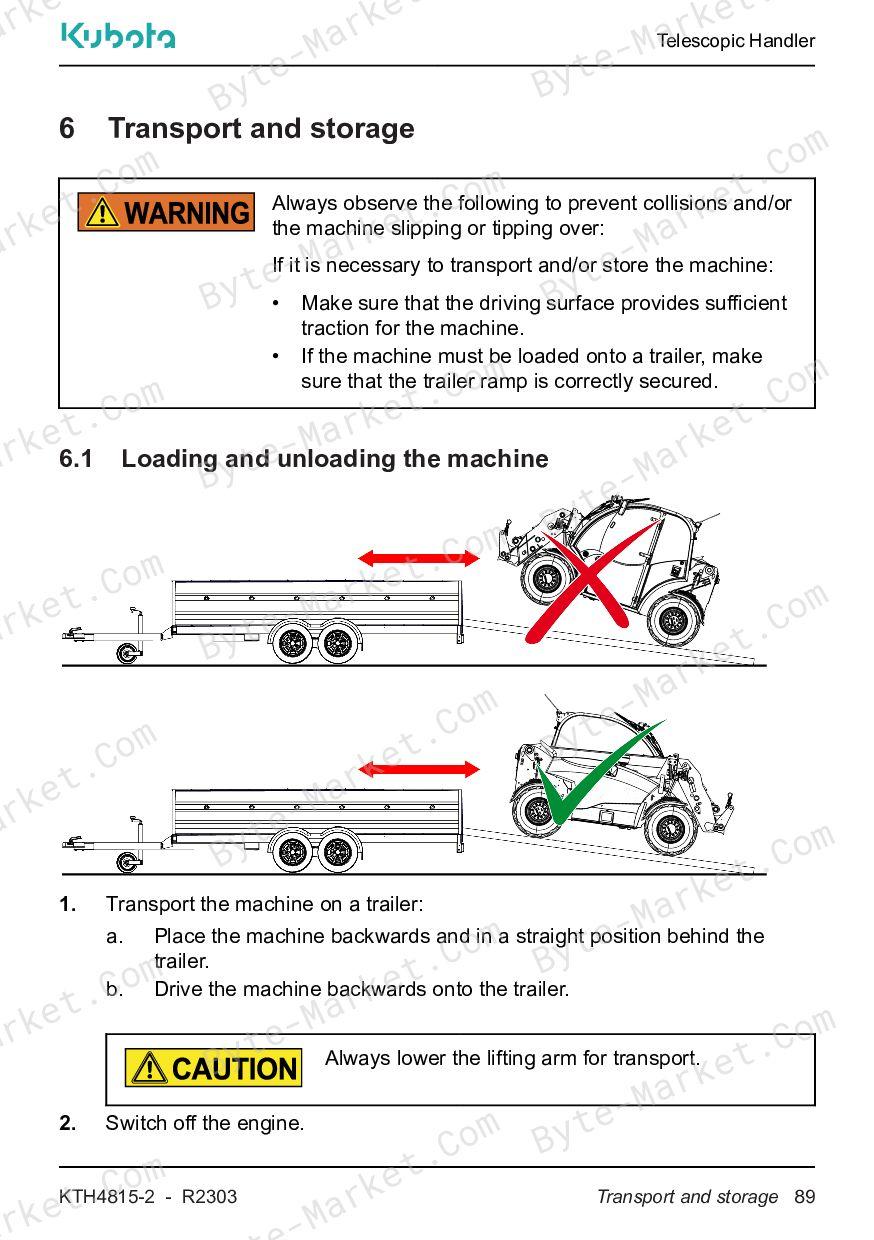
- 6.1 Loading and unloading the machine — p. 89
- 6.2 Lifting the machine — p. 91
- 6.3 Towing the machine — p. 92
- 6.3.1 Preparing — p. 92
- 6.3.2 Towing — p. 93
- 6.4 Storing the machine — p. 93
- 7 Commissioning — p. 95
- 8 Operation — p. 97
- 8.1 Entering and leaving the cabin — p. 97
- 8.1.1 Entering — p. 97
- 8.1.2 Leaving — p. 98
- 8.2 Adjusting the driver's seat — p. 98
- 8.3 Adjusting the steering column — p. 99
- 8.4 Starting the machine — p. 100
- 8.4.1 Preparing — p. 100
- 8.4.2 Starting — p. 101
- 8.4.3 Access code (Optional) — p. 102
- 8.5 Switching the machine off — p. 103
- 8.6 Driving the machine — p. 104
- 8.6.1 Inching pedal — p. 105
- 8.6.2 Hand-inching and hand-throttle (Optional) — p. 106
- 8.6.3 Electronic Performance Control (EPC) (Optional) — p. 107
- 8.6.3.1 Pro-Inching® (Optional) — p. 107
- 8.6.3.2 Speed Lock (If applicable) — p. 109
- 8.7 Steering — p. 110
- 8.7.1 2-/4-wheel steering (Optional) — p. 110
- 8.7.2 Crab-steering (Optional) — p. 111
- 8.7.3 Aligning the axles — p. 112
- 8.8 Using the joystick — p. 113
- 8.8.1 Driving — p. 113
- 8.8.2 Tilting attachments — p. 114
- 8.8.3 Lifting arm — p. 115
- 8.8.4 Extending the boom — p. 116
- 8.9 Switching on the automotive lights (Optional) — p. 116
- 8.9.1 Using the automotive lights — p. 117
- 8.10 Using the cabin air-conditioning unit (Optional) — p. 117
- 8.11 Coupling and uncoupling the attachment — p. 118
- 8.11.1 Preparing — p. 118
- 8.11.2 Coupling — p. 119
- 8.11.3 Uncoupling — p. 119
- 8.12 Memory/Hold-function for auxiliary functions — p. 120
- 8.13 [Override]-switch — p. 121
- 8.14 Pump dump/Joystick lock — p. 121
- 8.15 De-pressurizing hydraulic connections — p. 122
- 8.15.1 With mechanical levers — p. 122
- 8.15.2 Without mechanical levers — p. 123
- 8.15.3 With "De-pressurize"-button (Optional) — p. 124
- 8.16 Engaging and disengaging the differential lock — p. 125
- 8.16.1 Engaging — p. 125
- 8.16.2 Disengaging — p. 126
- 8.17 Fuel — p. 126
- 8.17.1 Adding fuel — p. 126
- 8.18 Regeneration — p. 127
- 8.18.1 6 levels of regeneration — p. 128
- 8.18.2 Activating parked regeneration — p. 133
- 8.1 Entering and leaving the cabin — p. 97
- 9 Maintenance — p. 137
- 9.1 Installing the safety bracket — p. 137
- 9.1.1 Installing the safety bracket on the KTH4815-2 — p. 138
- 9.2 Opening and closing the bonnet — p. 139
- 9.2.1 Opening — p. 139
- 9.2.2 Closing — p. 140
- 9.3 Panolin synthetic hydraulic oil (Optional) — p. 140
- 9.3.1 Requirements — p. 140
- 9.3.2 Test intervals — p. 141
- 9.3.3 Sample method — p. 142
- 9.4 Preventive maintenance schedules — p. 142
- 9.4.1 Operator maintenance — p. 143
- 9.4.1.1 Daily maintenance — p. 143
- 9.4.1.2 Maintenance every 100 hours — p. 146
- 9.4.2 Dealer maintenance schedules — p. 146
- 9.4.2.1 Maintenance before delivery — p. 146
- 9.4.2.2 Maintenance after the first 50 hours — p. 151
- 9.4.2.3 Maintenance every 500 hours — p. 152
- 9.4.2.4 Maintenance every 1000 hours — p. 155
- 9.4.2.5 Maintenance every 1500 hours — p. 157
- 9.4.2.6 Maintenance every 3000 hours — p. 157
- 9.4.2.7 Maintenance every 6000 hours — p. 157
- 9.4.2.8 Maintenance every 1 year — p. 158
- 9.4.2.9 Maintenance every 2 years — p. 160
- production date — p. 161
- 9.4.3 Dealer maintenance tasks — p. 161
- 9.4.3.1 Engine — p. 162
- 9.4.3.2 Cooling system — p. 164
- 9.4.3.3 Fuel system — p. 164
- 9.4.3.4 Hydraulic system — p. 165
- 9.4.3.5 Electrical system — p. 166
- 9.4.3.6 Cabin and controls — p. 167
- 9.4.3.7 Transmission and wheels — p. 170
- 9.4.3.8 Frame — p. 172
- 9.4.1 Operator maintenance — p. 143
- 9.5 Fluid specifications — p. 173
- 9.6 Electricity — p. 175
- 9.6.1 Overview fuses — p. 175
- 9.6.1.1 PCB (Printed Circuit Board) — p. 175
- 9.6.1 Overview fuses — p. 175
- 9.7 Frame maintenance — p. 178
- 9.7.1 Lubrication points — p. 179
- 9.7.2 Checking tyres and wheels — p. 182
- 9.7.2.1 Tightening torques of wheel nuts — p. 183
- 9.8 Engine maintenance — p. 184
- 9.8.1 Checking the oil level and adding oil — p. 184
- 9.8.2 Checking the coolant level and adding coolant — p. 186
- 9.8.3 Checking and cleaning the combination cooler — p. 187
- 9.8.4 Checking the cooling system for leaks — p. 188
- 9.8.5 Checking and cleaning the air intake system — p. 188
- 9.8.5.1 Checking and cleaning the air filter — p. 188
- 9.8.5.2 Checking intake air lines — p. 191
- 9.9 Hydraulic system maintenance — p. 192
- 9.9.1 Checking the hydraulic oil level and adding hydraulic oil — p. 192
- 9.9.2 Checking for leaks, wear, cracks and damage — p. 193
- 9.9.3 Checking the cylinders — p. 194
- 9.9.4 Checking the dust-caps on the couplers — p. 194
- 9.10 Transmission maintenance — p. 194
- 9.10.1 Checking the brake fluid level — p. 194
- 9.11 Ventilation system maintenance — p. 195
- 9.11.1 Checking and cleaning the pre- and main filter — p. 195
- conditioning unit) — p. 196
- 9.11.3 Checking and cleaning the cyclone pre-filter — p. 197
- 9.11.1 Checking and cleaning the pre- and main filter — p. 195
- 9.1 Installing the safety bracket — p. 137
- 10 Troubleshooting — p. 199
- 10.1 Troubleshooting procedure — p. 199
- 10.2 Complete machine — p. 199
- 10.3 Hydraulic system — p. 202
- 10.4 Cabin and controls — p. 202
- 11 Environment — p. 205
- 11.1 Waste disposal — p. 205
- 11.2 Safe disassembly — p. 205
- 12 Terms of warranty — p. 207
- 13 Appendix — p. 209
- 13.1 Dealer details — p. 209
- 13.2 Machine-specific information — p. 209
- 13.3 Pre-delivery checks — p. 209
- 13.4 Maintenance Log — p. 211
Capabilities
The source outline indexes controls, safety, operation, checking and adjustment, maintenance, and troubleshooting. Use these source-backed headings to locate the applicable operating or maintenance topic in the source PDF, then confirm model-specific notes, specifications, illustrations, and operating conditions at the relevant page before carrying out operation or routine maintenance.
Keep the source's safety sequence, prerequisite steps, labels, units, configuration notes, and footnotes with the selected task; do not apply an isolated value outside the conditions stated in the manual.
Delivery
This manual is supplied as a digital PDF file and is available for instant download after purchase. No physical media is shipped.
References
Kubota Operator Manual for Telescopic Handler, document code TOB-0070747, PDF edition.


No questions found.