
Kubota Operator, Safety, Maintenance and Service Manual
Kubota KC70 Operator, Safety, Maintenance and Service Manual
Document number MUKC70021801 · English PDF edition · 172 pages
About this manual
Kubota published this Operator, Safety, Maintenance and Service Manual for KC70. It is intended for safe operation, controls, routine checks, and source-supported maintenance, where those subjects appear in the source publication.
Use the Manual Contents below to check that the exact operating, safety, adjustment, or routine-maintenance topic you need is included in this publication.
Manual details
- Manufacturer
- Kubota
- Manual type
- Operator, Safety, Maintenance and Service Manual
- Models
- KC70
- Document number
- MUKC70021801
- Publication year
- 2018
- Language
- English
- Page count
- 172
Product highlights
Maintenance
The manual includes a maintenance schedule.
Manual contents
Use these source headings to locate the task or system you need in the PDF.
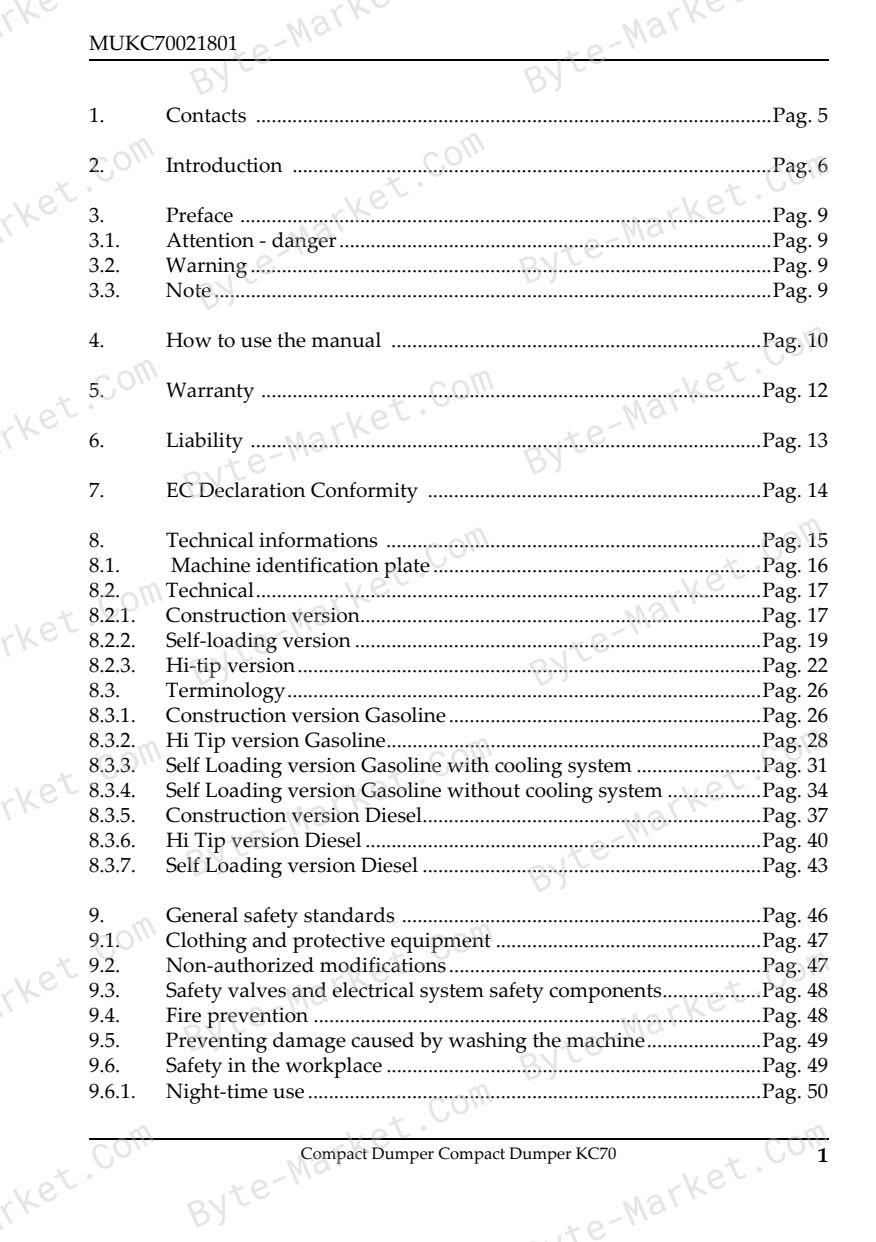
- 1. Contacts — p. 7
- 2. Introduction — p. 8
- 3. Preface — p. 11
- 3.1. Attention - danger — p. 11
- 3.2. Warning — p. 11
- 3.3. Note — p. 11
- 4. How to use the manual — p. 12
- 5. Warranty — p. 14
- 6. Liability — p. 15
- 7. EC Declaration Conformity — p. 16
- 8. Technical informations — p. 17
- 8.1. Machine identification plate — p. 18
- 8.2. Technical — p. 19
- 8.2.1. Construction version — p. 19
- 8.2.2. Self-loading version — p. 21
- 8.2.3. Hi-tip version — p. 24
- 8.3. Terminology — p. 28
- 8.3.1. Construction version Gasoline — p. 28
- 8.3.2. Hi Tip version Gasoline — p. 30
- 8.3.3. Self Loading version Gasoline with cooling system — p. 33
- 8.3.4. Self Loading version Gasoline without cooling system — p. 36
- 8.3.5. Construction version Diesel — p. 39
- 8.3.6. Hi Tip version Diesel — p. 42
- 8.3.7. Self Loading version Diesel — p. 45
- 9. General safety standards — p. 48
- 9.1. Clothing and protective equipment — p. 49
- 9.2. Non-authorized modifications — p. 49
- 9.3. Safety valves and electrical system safety components — p. 50
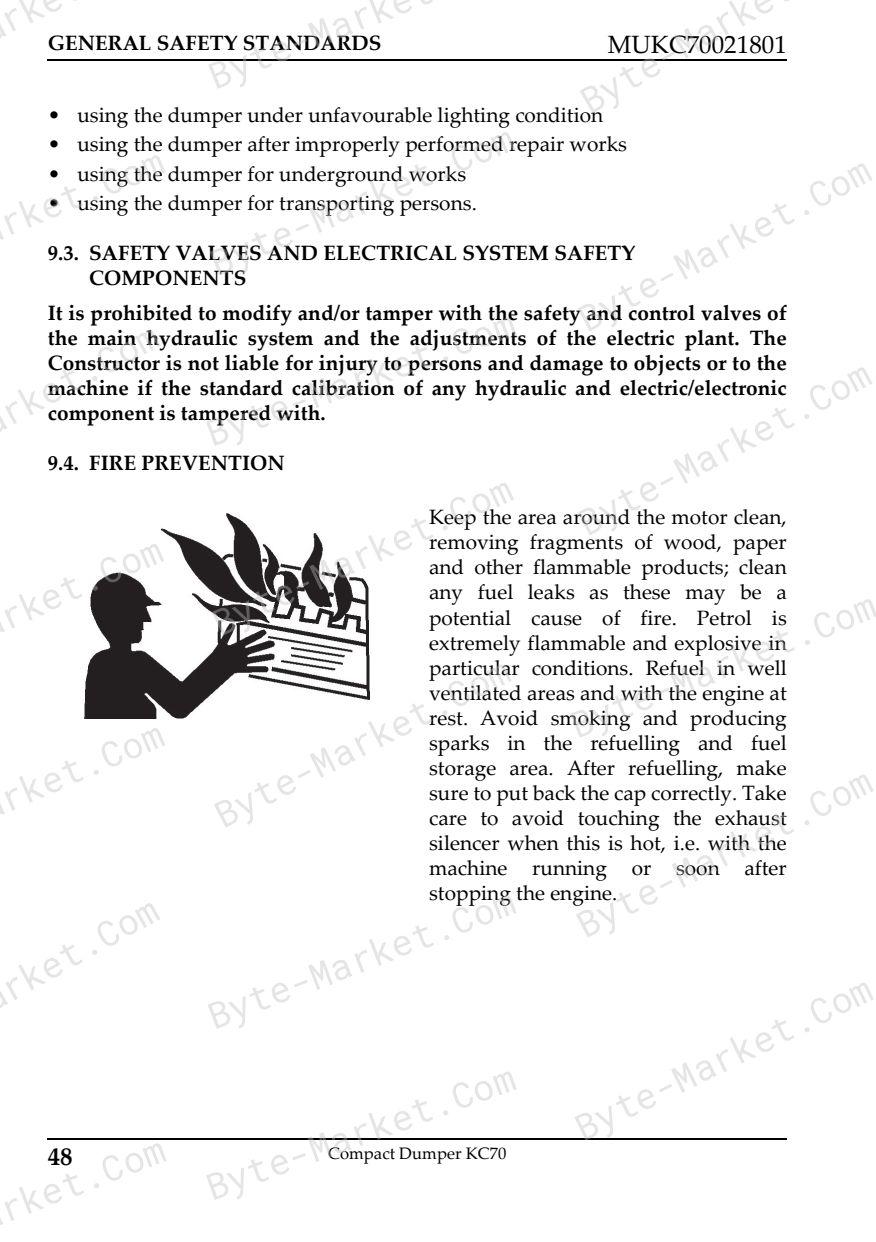
- 9.4. Fire prevention — p. 50
- 9.5. Preventing damage caused by washing the machine — p. 51
- 9.6. Safety in the workplace — p. 51
- 9.6.1. Night‑time use — p. 52
- 9.6.2. Underground use — p. 52
- 9.6.3. Use in an explosive atmosphere — p. 52
- 9.6.4. Preventions against exhaust fumes — p. 52
- 9.6.5. Risk of electrocution — p. 52
- 9.7. Safety warnings — p. 54
- 9.7.1. Generalities — p. 54
- 9.7.2. Noise and Vibration — p. 54
- 9.7.3. Decals on the machine — p. 55
- 10. Safety device — p. 75
- 10.1. Skip cylinder safety lock — p. 76
- 10.2. Safety lock with skip support in reised position — p. 77
- 10.3. Beeper — p. 78
- 10.4. Emergency lever to switch‑off engine — p. 78
- 11. Instruments and controls — p. 80
- 11.1. Controls station — p. 81
- 11.2. Throttle — p. 82
- 11.3. Choke control — p. 83
- 11.4. Starter handle — p. 83
- 11.5. Control pannel — p. 84
- 11.5.1. Control pannel Gasoline version — p. 84
- 11.5.2. Control pannel Diesel version — p. 85
- 11.6. Control levers — p. 89
- 11.6.1. Undercarriage drive — p. 89
- 11.6.2. Undercarriage extension — p. 91
- 11.6.3. Skip actuation — p. 93
- 11.6.4. Skip support lift — p. 96
- 11.6.5. Move the bucket - Dumper self‑load — p. 96
- 11.6.6. Operating the 2nd drive speed and the undercarriage system — p. 97
- 12. Use and precautions to adopt when working with the machine — p. 99
- 12.1. Checks before starting the engine — p. 99
- 12.2. Engine controls — p. 99
- 12.2.1. Running-in of the engine — p. 99
- 12.2.2. Precautions when starting the engine — p. 99
- 12.2.3. Starting the engine — p. 100
- 12.2.4. Starting the engine — p. 100
- 12.2.5. Starting the engine — p. 103
- 12.2.6. Start the engine with low battery voltage — p. 104
- 12.2.7. Engine stop — p. 106
- 12.3. Checks while driving — p. 106
- 12.4. Battery switch — p. 108
- 12.5. Precautions while driving — p. 109
- 12.5.1. Drive — p. 110
- 12.5.2. Safety warning for drive on slopes — p. 110
- 12.5.3. Maneuvers on soft soil — p. 112
- 12.6. Skip roll-over — p. 112
- 12.7. Lift the skip — p. 112
- 12.8. Using the self-loading bucket — p. 113
- 12.10. Precautions to adopt when transporting a load — p. 114
- 12.11. Parking and stopping the machine on slopes — p. 115
- 12.12. Machine towing — p. 115
- 12.13. Loading/unloading the machine on/off a transport vehicle — p. 116
- 12.14. Precautions when transporting the machine — p. 118
- 12.15. Lifting the machine — p. 119
- 12.15.1. Lifting points — p. 119
- 12.16. Use of undercarriage with rubber tracks — p. 120
- 12.17. Preliminary checks before starting work — p. 121
- 12.18. Engine emergency stop — p. 122
- 13. Maintenance — p. 123
- 13.1. Safety instructions to carry out maintenance work — p. 123
- 13.2. Table of recommended fluids — p. 124
- 13.2.1. Motor oil for petrol version machines — p. 124
- 13.2.2. Motor oil for Diesel version machines — p. 125
- 13.2.3. Idraulic oil — p. 125
- 13.2.4. Fuel for petrol version machines — p. 126
- 13.2.5. Fuel for Diesel version machines — p. 126
- 13.2.6. Cooling liquid — p. 127
- 13.2.7. Grease — p. 127
- 13.3. Engine maintenance — p. 127
- 13.3.1. Engine maintenance Gasoline — p. 127
- 13.3.2. Engine maintenance Diesel — p. 128
- 13.3.3. Refuelling fuel — p. 128
- 13.3.4. Diesel filter maintenance — p. 131
- 13.3.5. Engine oil — p. 132
- 13.3.6. Engine air filter maintenance — p. 136
- 13.3.7. Spark plug maintenance(for Gasoline engine only) — p. 138
- 13.3.8. Clean oil cooler (for Gasoline engine only) — p. 140
- 13.4. Hydraulic system — p. 140
- 13.4.1. Hydraulic oil — p. 141
- 13.4.2. Hydraulic oil filter — p. 142
- 13.4.3. Gearbox oil — p. 143
- 13.5. Grease point — p. 144
- 13.6. Maintenance on the lifting mechanisms — p. 145
- 13.7. Electric system — p. 146
- 13.7.1. Battery (if present) — p. 146
- 13.7.2. Battery replacement (if present) — p. 147
- 13.7.3. Fuses and relays — p. 147
- 13.7.4. Tilt indicator — p. 149
- 13.7.5. Contact sensing — p. 150
- 13.7.6. How to check the correct operation of the buzzer — p. 151
- 13.8. Rubber tracks maintenance — p. 151
- 13.8.1. Checking track tension — p. 151
- 13.8.2. Tensioning rubber tracks — p. 152
- 13.8.3. Removing rubber tracks — p. 152
- 13.8.4. Installing rubber tracks — p. 153
- 13.9. Tightening bolts and nuts — p. 154
- 13.10. Storage of the machine — p. 155
- 13.11. Hydraulic system diagram — p. 157
- 13.11.1. Construction version with fixed carriage — p. 157
- 13.11.2. Construction version with widening carriage — p. 158
- 13.11.3. Self-loading version with cooling and expandable wagon — p. 159
- 13.11.4. Self-loading version without cooling and expandable wagon — p. 160
- 13.11.5. Self-loading version with cooling and fixed wagon — p. 161
- 13.11.6. Self-loading version without cooling and fixed wagon — p. 162
- 13.11.7. Hi-Tip version with fixed undercarriage — p. 163
- 13.11.8. Hi-Tip version with extendable undercarriage — p. 164
- 14. Register of inspections and repairs — p. 165
Capabilities
The source outline indexes safety, controls, operation, maintenance, and checking and adjustment. Use these source-backed headings to locate the applicable operating or maintenance topic in the source PDF, then confirm model-specific notes, specifications, illustrations, and operating conditions at the relevant page before carrying out operation or routine maintenance.
Keep the source's safety sequence, prerequisite steps, labels, units, configuration notes, and footnotes with the selected task; do not apply an isolated value outside the conditions stated in the manual.
Delivery
This manual is supplied as a digital PDF file and is available for instant download after purchase. No physical media is shipped.
References
Kubota Operator, Safety, Maintenance and Service Manual for Dumper, document code MUKC70021801, PDF edition.


No questions found.