Kubota 50-Hour Service Checklist: What to Change and What to Check
Kubota 50-Hour Service Checklist: What to Change and What to Check
At 50 hours, a Kubota tractor may need oil and filter changes as well as inspections, lubrication and adjustments. The expensive mistake is assuming that every fluid must be replaced, or that a box of filters contains everything the first service requires.
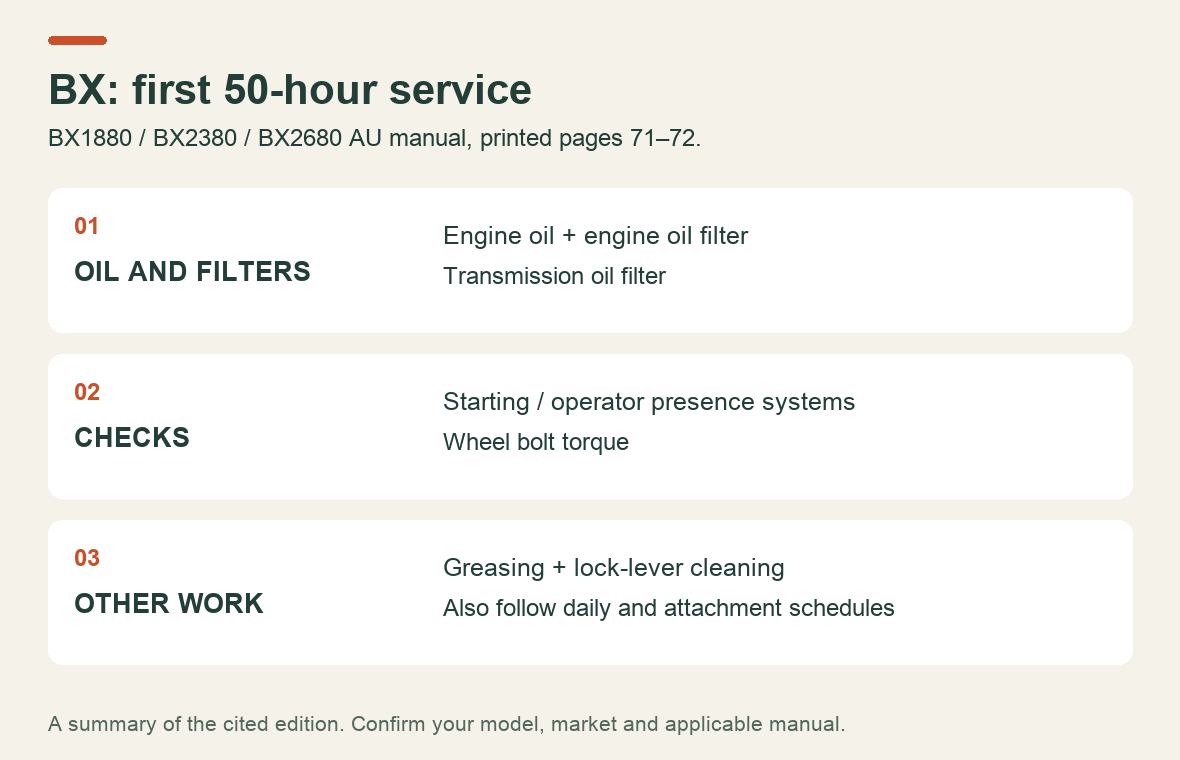
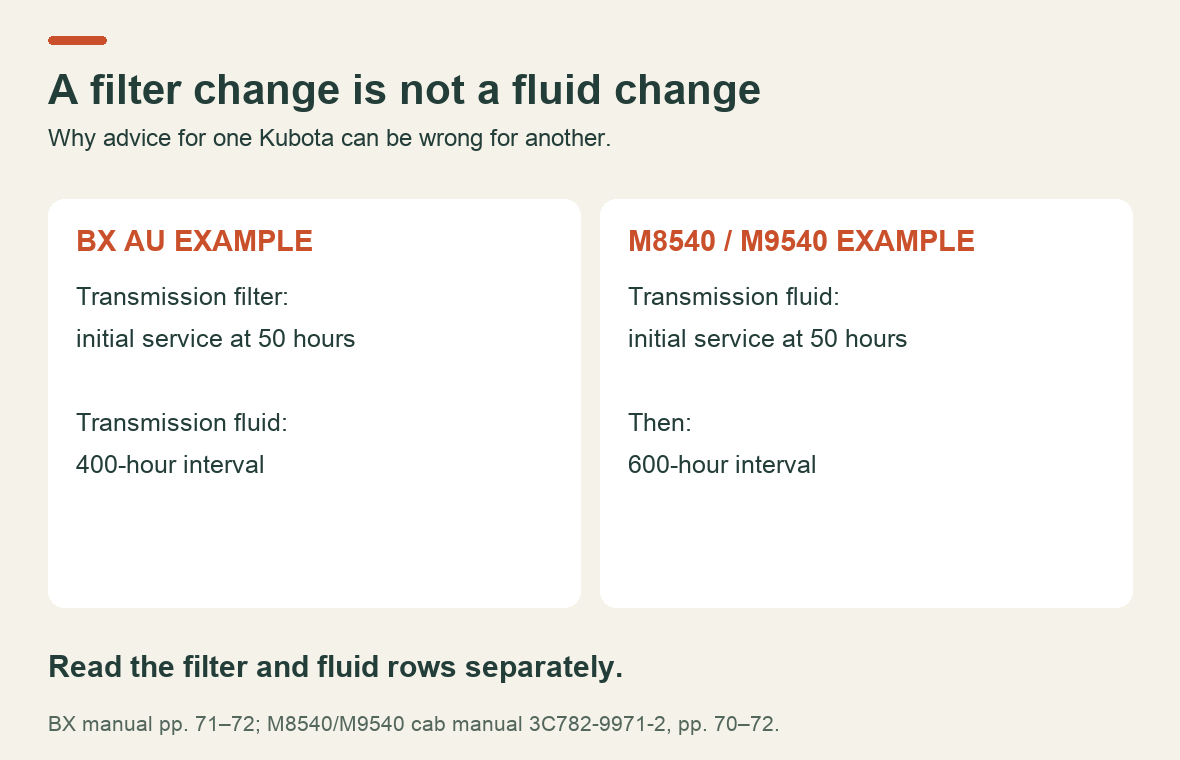
For the BX1880, BX2380 and BX2680 AU models in the operator's manual below, the initial 50-hour service includes engine oil, the engine oil filter and the transmission oil filter. The transmission fluid itself is scheduled at 400 hours, not 50. Other Kubota models have different requirements. Start with the model-specific checklist, then buy the parts.
A worked example: BX1880, BX2380 and BX2680
The following summary comes from the maintenance table on printed pages 71–72 of the Kubota BX1880/BX2380/BX2680 AU operator's manual. It applies to that edition; verify the manual supplied for your tractor's market and configuration.
| At the first 50 hours | Action in this BX schedule |
|---|---|
| Engine oil | Change |
| Engine oil filter | Replace |
| Transmission oil filter | Replace |
| Engine starting and operator presence systems | Check |
| Grease points | Lubricate |
| Wheel bolt torque | Check |
| Lock lever | Clean as described in the manual |
This is a summary of the 50-hour rows, not a substitute for daily checks or separate attachment schedules. The table marks the first service separately from recurring intervals. In this edition, the three initial oil/filter tasks above subsequently follow 200-hour intervals; the transmission fluid and strainer tasks are at 400 hours. Replacing a filter at 50 hours does not turn it into a task repeated every 50 hours.
Do you change the transmission fluid at 50 hours?
There is no single answer for all Kubota tractors. The BX example above separates transmission filter replacement from transmission fluid replacement. That distinction matters when pricing the job: an oil filter and a full transmission fill are very different purchases.
An older Kubota M8540/M9540 cab operator's manual, code 3C782-9971-2, illustrates why owners give conflicting advice. Its service table on printed pages 70–72 specifies an initial transmission fluid change at 50 hours, followed by a 600-hour interval. That is evidence of a different schedule, not a correction to the BX schedule.
When a forum post says “mine needed all the oil changed,” ask which tractor and which manual the owner used. A procedure can be right for their machine and an unnecessary purchase for yours.
What should a 50-hour service kit contain?
Build a shopping list from the tasks that are actually due. Then compare the kit against that list, line by line. “50-hour kit” is a seller's description; the contents and applicable part numbers are what you need to verify.
| Check before ordering | What to ask the seller |
|---|---|
| Machine identification | Does this kit cover my exact model and serial range? |
| Filters | Which part numbers and quantities are included? |
| Oil | Is oil included, and does its specification match my manual? |
| Service quantity | Is there enough for this particular service, including a filter change where applicable? |
| Small parts | Does the procedure require seals or other items not included? |
Do not add an air filter, fuel filter or another fluid change merely because a larger bundle contains it. Check whether that item is due by hours, age or condition. Conversely, do not skip an inspection because there is no replacement part for it in the box.
Kubota's general maintenance check points are useful for routine observations such as fluid levels and leaks. They also direct owners to the applicable operator's manual for the actual schedule.
Before you drain anything
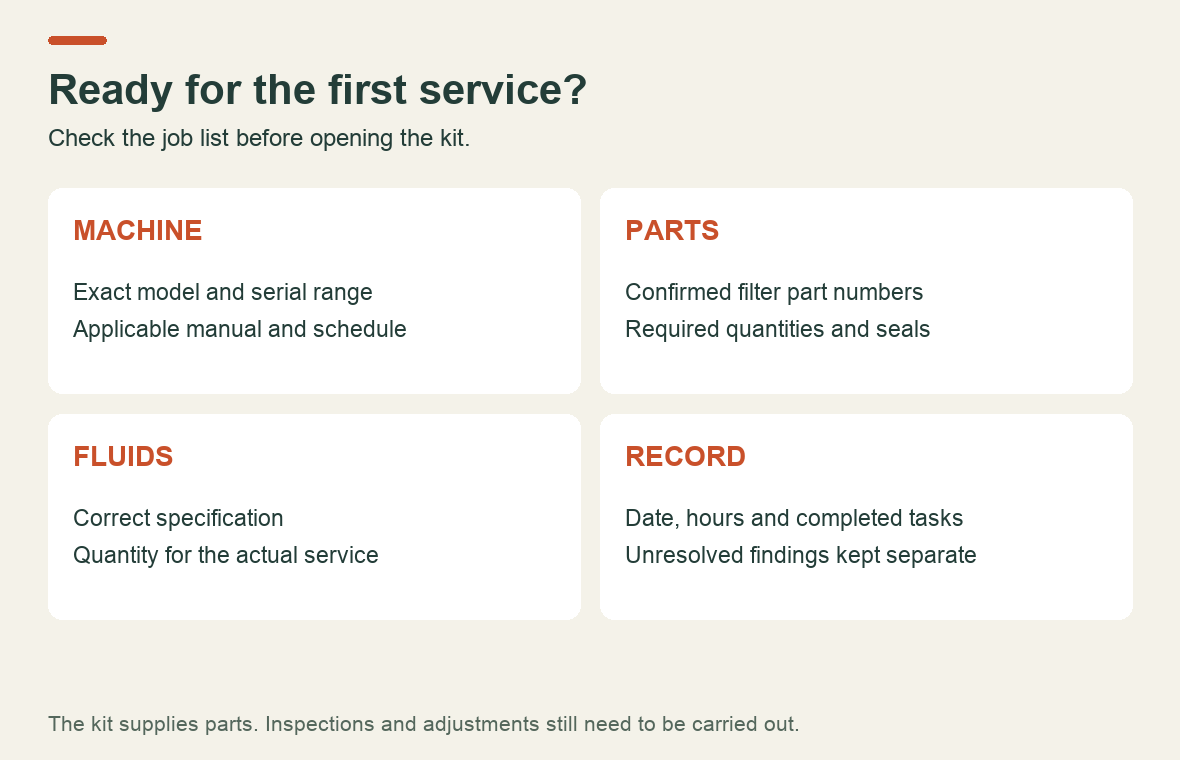
Find the procedure as well as the schedule. A service-table row tells you when a task is due; the procedure explains access, the correct check conditions, filling and the final level check. Put the required tools, collection containers and confirmed supplies beside the tractor before starting.
Write down the date, hour reading and manual reference. Photograph an unfamiliar component or label before removing it. That gives you something specific to discuss with a dealer if the part on the tractor differs from the one you bought.
Use the prescribed shutdown and support arrangements. A raised loader is not a convenient substitute for proper access. If a required safety-system check fails, record it as unresolved work rather than marking the whole service complete.
How much should the first service cost?
A useful quote separates filters, fluids, labour and any additional work. Ask whether it includes the inspections and adjustments in your schedule, the loader or mower, travel charges and disposal charges. Comparing two totals without comparing that scope can make a complete service look unnecessarily expensive.
For a used tractor without reliable records, 50 hours on a handwritten note is not proof that every first-service task was done. Keep confirmed work and unknown work separate, and agree a catch-up plan using the machine's current hours, age and condition.
Which manual helps with the job?
Use the operator's manual to establish the service schedule and routine owner procedures. A workshop manual becomes useful when a check reveals a fault or a procedure requires further inspection or adjustment.
Byte Market lists the BX1880/BX2380/BX2680 workshop manual and the M8540/M9540 workshop manual. Check the listing's model coverage before ordering. A workshop manual supports the job; it does not make one model's maintenance schedule apply to another.
Recent Post
-
Why a Kubota Manual May N...
16 Sep, 2026
-

Kubota Tractor Won’t Star...
16 Sep, 2026
-

Kubota DPF Light Flashing...
18 Sep, 2026
-

Kubota Tractor Overheatin...
21 Sep, 2026
-
Kubota Hydraulic Couplers...
22 Sep, 2026
-

Kubota UDT vs Super UDT2:...
23 Sep, 2026
-

Kubota 3-Point Hitch Won'...
24 Sep, 2026
-

Kubota Excavator Track Te...
25 Sep, 2026
-

New Holland 540 vs 540E P...
28 Sep, 2026
-

Kubota BX Mower Cutting U...
29 Sep, 2026
-

Kubota Excavator Controls...
30 Sep, 2026
-

New Holland DEF Storage:...
01 Oct, 2026
-
Kubota Air Filter: When t...
02 Oct, 2026
-

Kubota SVL Standard vs Hi...
06 Oct, 2026
-

New Holland Water in Fuel...
07 Oct, 2026
-

Kubota Loader Float: What...
08 Oct, 2026
-
Kubota HST Tractor Won't...
09 Oct, 2026
-
Kubota 50-Hour Service Ch...
12 Oct, 2026
-
Kubota 4WD Won't Disengag...
13 Oct, 2026