Kubota SVL Standard vs High Flow: Will Your Attachment Match?
Kubota SVL Standard vs High Flow: Will Your Attachment Match?
A used hydraulic attachment looks right for your Kubota SVL. The mounting plate fits, and the seller says it is a “high-flow model.” That still leaves several questions unanswered: which motor is installed, how much flow does it accept, and what connections does it require?
Match the attachment's specified flow range to the loader's installed auxiliary-hydraulic configuration. Then check pressure, connections and the remaining carrier requirements. A high-flow option is useful when the attachment needs it; it is not a setting to select automatically for every powered tool.
What standard and high flow mean on an SVL75-3
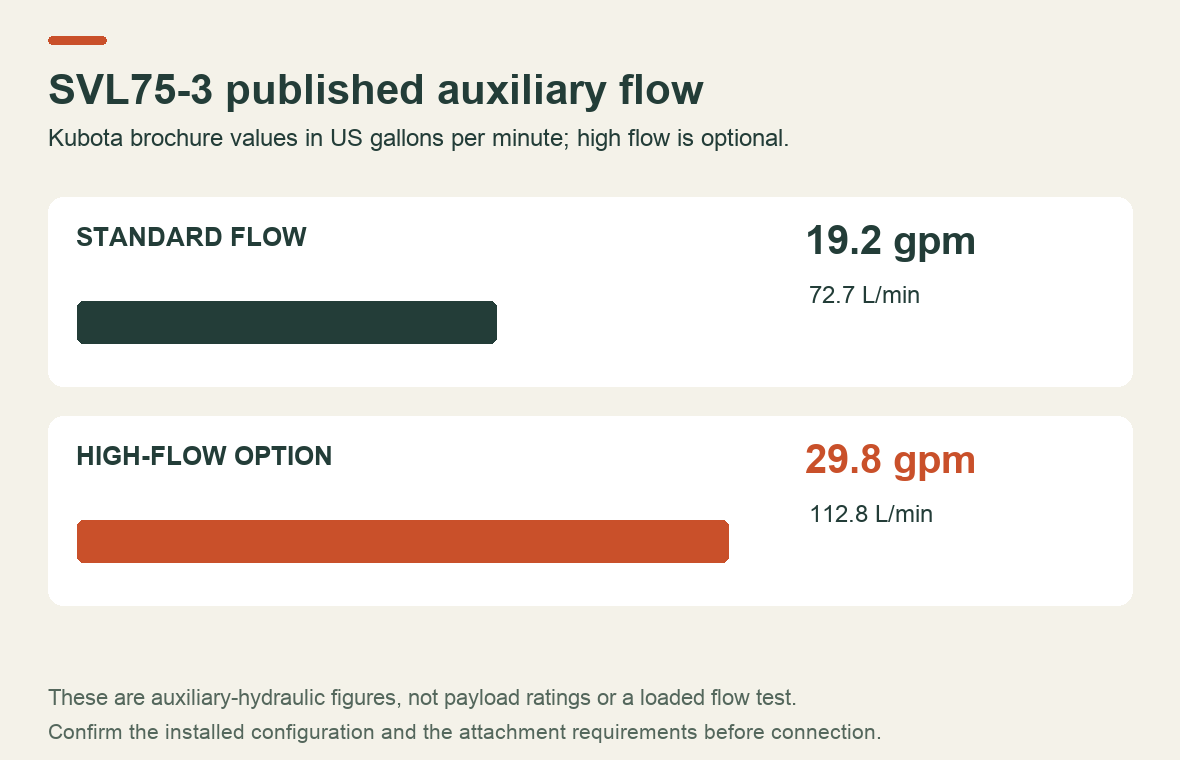
Kubota's SVL75-3 brochure lists 19.2 US gpm standard auxiliary flow and 29.8 US gpm with the high-flow option, approximately 72.7 and 112.8 L/min. It identifies high flow as optional equipment.
That means an SVL75-3 model badge alone does not confirm which configuration a used machine has. Establish the installed equipment from the machine's records and applicable instructions before making a purchase decision.
These are published auxiliary-flow specifications, not a guarantee of flow measured at an attachment under every operating condition. They also describe a different capability from rated lifting capacity. The brochure lists hydraulic and loader-performance specifications separately; “high flow” is not a higher payload rating.
A real attachment example: the motor version changes the answer
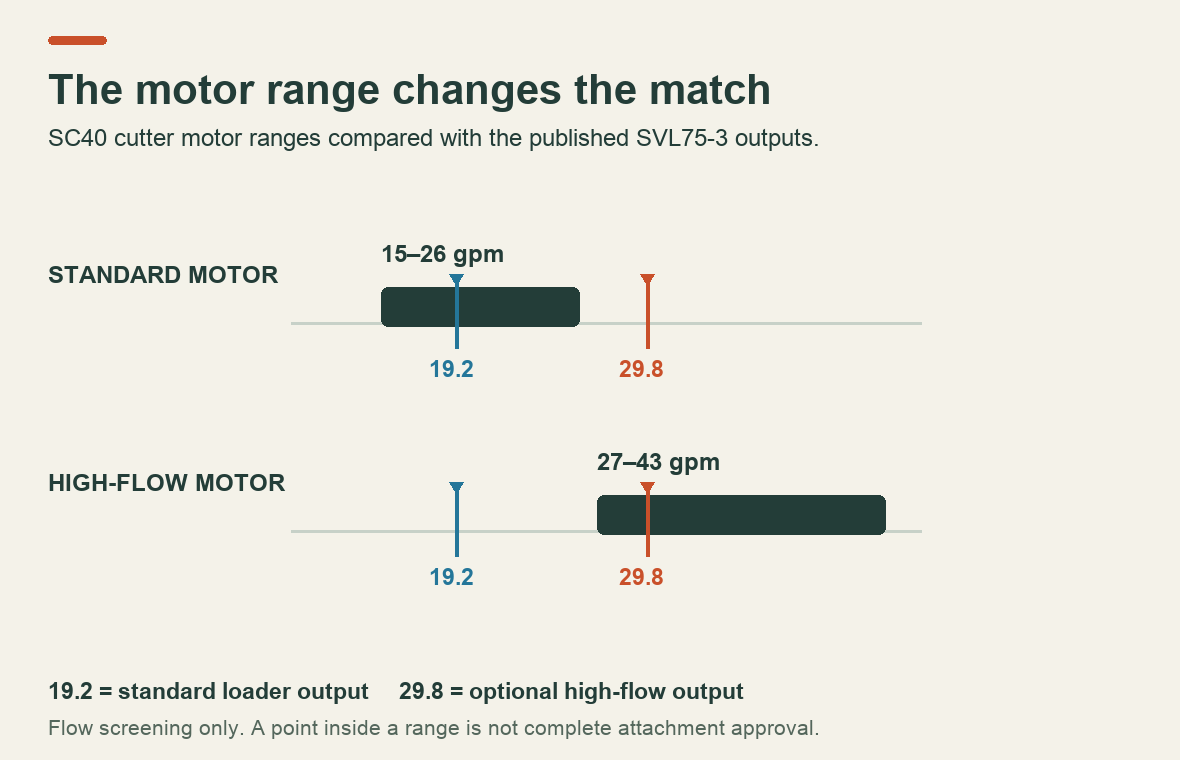
The Kubota by Land Pride AP-SC4060/AP-SC4072 operator's manual, 326-765MK, lists two motor ranges: 15–26 gpm for the standard motor and 27–43 gpm for the high-flow motor. The SC40 product page also distinguishes those ranges.
Comparing those figures with the SVL75-3 brochure gives the following first screening. This is a comparison of published flow numbers, not approval of a complete loader-and-cutter combination.
| Published loader flow | SC40 standard motor, 15–26 gpm | SC40 high-flow motor, 27–43 gpm |
|---|---|---|
| SVL75-3 standard: 19.2 gpm | Within the stated flow range | Below the stated minimum |
| SVL75-3 high flow: 29.8 gpm | Above the stated maximum | Within the stated flow range |
The useful observation is that 29.8 gpm falls within one motor's range and outside the other's. A cutter's model name or width does not identify which motor is fitted. Ask for its identification and the applicable manual, especially if a previous owner changed the motor.
The chart compares the brochure's listed outputs. It does not assume that every available flow adjustment is approved for a particular motor. Follow both manufacturers' instructions for the actual setting and operating conditions.
Flow is only the first compatibility check
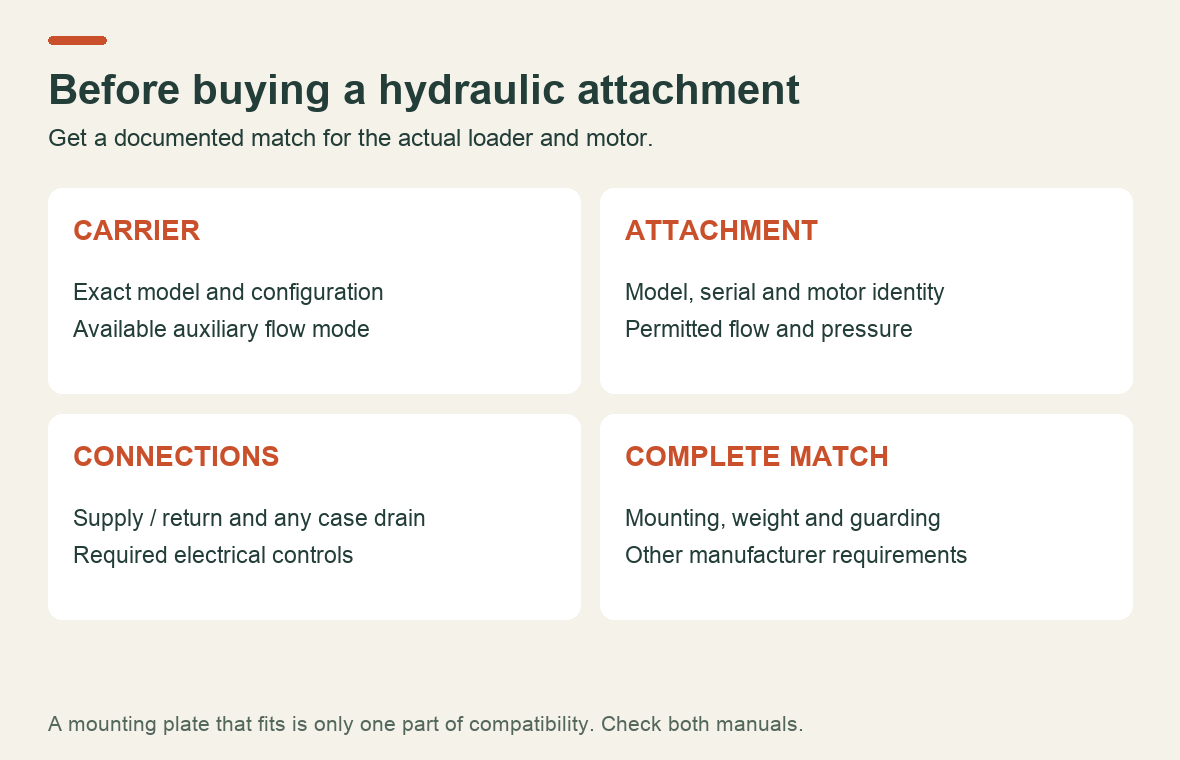
An attachment purchase should leave you with written answers to four practical questions. The table below is a suggested buying checklist, not a substitute for either manufacturer's requirements.
| Check | Information to obtain before connection |
|---|---|
| Flow | Exact motor version, permitted range and intended machine setting |
| Pressure | Attachment's operating limits and the loader configuration to be used |
| Hydraulic and electrical connections | Supply/return arrangement, any case drain, couplers and any required controls |
| Carrier suitability | Mounting compatibility, attachment weight, guarding and other stated carrier requirements |
Send both equipment identities when asking a dealer to confirm compatibility. “Will a brush cutter work on my Kubota?” leaves too much unstated. “This SVL75-3 configuration, this cutter serial number and this motor label” is a question that can be checked.
For a used attachment, request photographs before it is shipped. A readable motor label, hose connections and any electrical connector are more useful for this purpose than a photograph of the cutting deck alone.
What about the third hydraulic line?
A third line deserves identification, not a guess based on its size. In its case-drain FAQ for the SC25 cutter series, Land Pride recommends using the case-drain line. The SC40 manual separately describes an optional case-drain assembly. These are model-specific instructions; they do not establish one rule for every attachment.
Confirm the required port, connection and limits in the attachment and loader documentation. Do not cap an unidentified line or assume that a case-drain connection can go into any available return port. If the hose arrangement differs from the manual, have it identified before operation.
If the attachment performs poorly after matching
Stop and record the conditions instead of assuming more flow will solve the problem. Note the selected mode, engine operating condition, display messages, exact attachment and whether the problem appears immediately or after working. These observations help distinguish a setup question from a fault that needs testing.
Use the prescribed safe shutdown and pressure-release procedures before inspection or connection work. Do not loosen a hose to “see how much oil comes out,” or search for a pressurized leak with your hand. Leave hydraulic testing to someone equipped and qualified for it.
For that stage, Byte Market's Kubota SVL75-3 Workshop Manual, RY911-31065 lists hydraulic testing material plus AUX-operation and high-flow electrical circuit diagrams. Check the edition and machine applicability before buying. It can support a service investigation; it cannot establish an attachment's requirements without the attachment manual.
Recent Post
-
Why a Kubota Manual May N...
16 Sep, 2026
-
Kubota Tractor Won’t Star...
16 Sep, 2026
-
Kubota DPF Light Flashing...
18 Sep, 2026
-
Kubota Tractor Overheatin...
21 Sep, 2026
-
Kubota Hydraulic Couplers...
22 Sep, 2026
-

Kubota UDT vs Super UDT2:...
23 Sep, 2026
-
Kubota 3-Point Hitch Won'...
24 Sep, 2026
-
Kubota Excavator Track Te...
25 Sep, 2026
-
New Holland 540 vs 540E P...
28 Sep, 2026
-
Kubota BX Mower Cutting U...
29 Sep, 2026
-
Kubota Excavator Controls...
30 Sep, 2026
-
New Holland DEF Storage:...
01 Oct, 2026
-
Kubota Air Filter: When t...
02 Oct, 2026
-
Kubota SVL Standard vs Hi...
06 Oct, 2026