Kubota Loader Float: What It Does and When to Use It
Kubota Loader Float: What It Does and When to Use It
A loader bucket can scrape up the driveway when all you wanted was to clear loose material. Holding the joystick in the lowering position may make that worse. Float is a separate lift-control function that allows the bucket to follow the working surface instead of being continually pushed down by the lift circuit.
Float can help with surface work, but it does not choose the bucket angle or make every technique suitable for every loader. A Kubota tractor loader and an SVL track loader can have different controls and operating restrictions. Identify the machine before copying a joystick movement from a video.
Float, lowering and bucket tilt are different actions
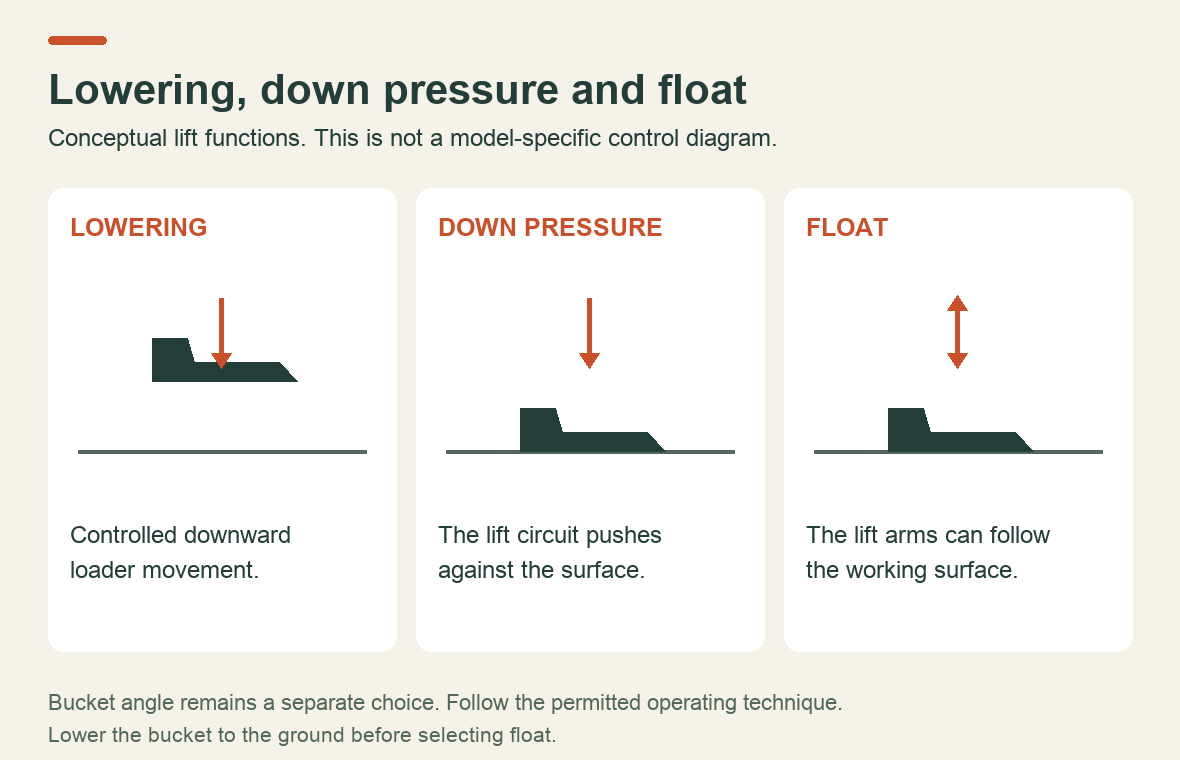
The useful distinction is what you want the loader to do. Are you positioning it, pressing it down, or letting it follow the surface? Bucket tilt is another decision: the cutting edge can still be set at an unsuitable angle even when lift-arm float is selected.
| Action | What you are asking for | What to watch |
|---|---|---|
| Lowering | Move the loader down under control | Contact with the ground and nearby objects |
| Applying down pressure | Push against the surface using the lift circuit | Digging into material you meant to leave in place |
| Float | Let the lift arms follow the surface | Bucket angle, surface conditions and the permitted travel direction |
| Bucket rollback or dump | Change the bucket's angle | Whether the cutting edge will skim or dig |
This comparison explains the functions; it is not a control diagram for a particular machine. Lower the bucket to the ground before engaging float. Never try it with a raised bucket to see how quickly the arms drop.
A documented use: keeping surface material out of the load
Kubota's B26TL operator's manual, printed page 30 describes using a level bucket and float on hard surfaces. It warns that hydraulic down pressure increases bucket wear. The same section explains that float helps avoid mixing the underlying surface with stockpiled material and reduces the chance of gouging when removing snow or other material.
Think about what is below the material you want to move. Loose stone on a firm base presents a different job from compacted material that must be excavated. Decide whether you want to preserve the surface or cut into it before choosing the loader technique. Float is not an automatic grading system, and a rough result does not by itself show a hydraulic fault.
For snow work, inspect the route before it is covered. A hidden edge or obstacle is still there when the lift arms are floating. Use the equipment's instructions for the attachment, surface and direction of travel; do not treat this article as permission to push into unseen obstructions.
Why “push the joystick forward” is incomplete advice
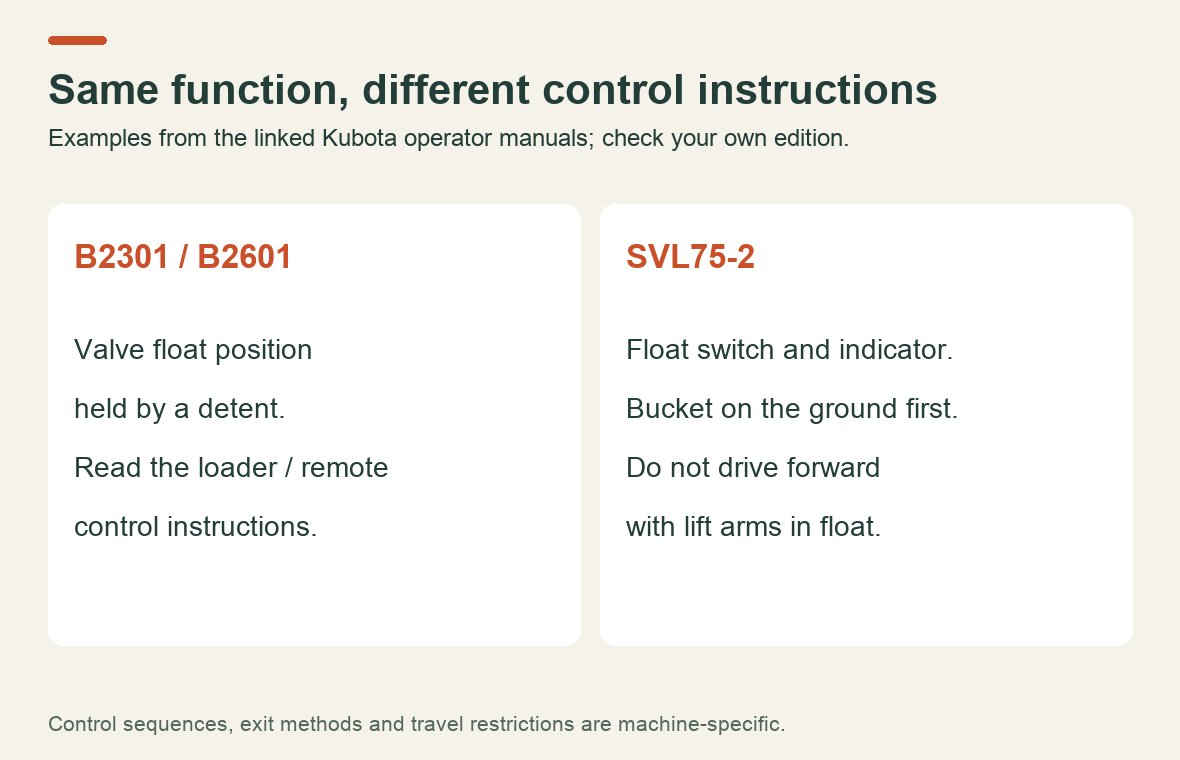
The B2301/B2601 operator's manual, printed page 37 describes a float position held by a detent on the loader/remote-control valve. It also distinguishes the valve lock from a support: that lock is not intended to prevent an implement leaking down during storage or to secure it for maintenance.
The SVL75-2 operator's manual, printed page 13 describes a float switch used with the lift-arm control and a panel indication. It requires the bucket to be on the ground before activation and explicitly prohibits driving forward with the lift arms in float. Its exit procedure is also specified. Those restrictions matter more than a generic tip about where to push a lever.
Use the complete entry and exit instructions for your machine. Do not assume that a detent, switch, dashboard symbol or permitted travel direction is shared across Kubota loaders.
If the bucket still digs in, describe the result before changing anything
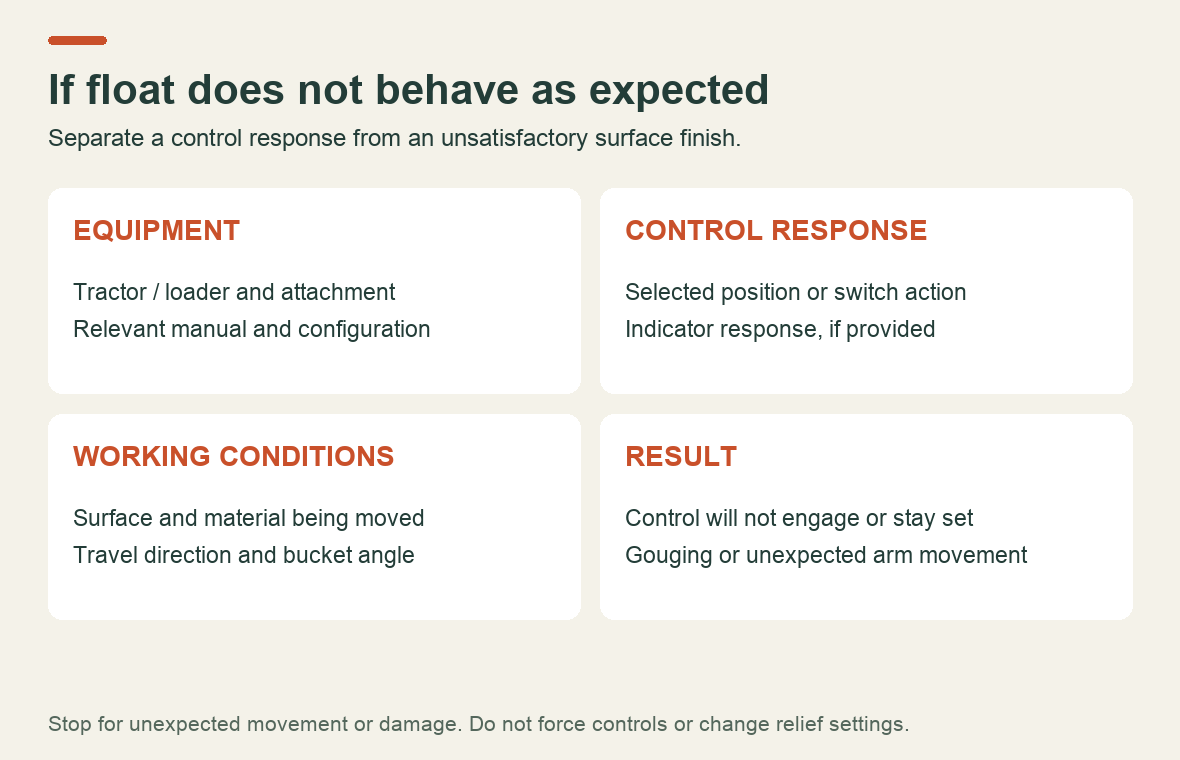
First establish whether float was actually selected according to the manual. Then separate the complaint into something a technician or experienced operator can assess: the control will not enter float; float will not stay selected; the bucket scrapes too aggressively; or a loader arm moves unexpectedly.
A short record is more useful than “the float is broken.” Note the loader and attachment models, the surface, the direction of travel and the bucket position. If an indicator is provided, record what it displayed. Take photographs of the parked machine and work area, rather than trying to film the controls while operating.
Do not compensate for an unexplained fault by forcing the joystick, defeating a lock or changing a relief setting. Unexpected movement, visible damage or a significant leak calls for stopping work and arranging inspection. If access beneath raised equipment is needed, the specified mechanical support and isolation procedure must be in place; float and a control lock are not substitutes.
Which manual helps with a float problem?
For learning the control sequence, start with the operator's manual for the tractor or loader and the fitted attachment. For a control or hydraulic fault, use workshop information that actually covers that assembly.
Byte Market lists the B2301/B2601 Workshop Manual, 9Y111-11560, including a hydraulic-system section, and the SVL75-2 Workshop Manual, RY911-30550. Check the contents and configuration before purchase. A tractor workshop manual should not be assumed to include every separately fitted loader or attachment.
Recent Post
-
Why a Kubota Manual May N...
16 Sep, 2026
-
Kubota Tractor Won’t Star...
16 Sep, 2026
-
Kubota DPF Light Flashing...
18 Sep, 2026
-
Kubota Tractor Overheatin...
21 Sep, 2026
-
Kubota Hydraulic Couplers...
22 Sep, 2026
-

Kubota UDT vs Super UDT2:...
23 Sep, 2026
-
Kubota 3-Point Hitch Won'...
24 Sep, 2026
-
Kubota Excavator Track Te...
25 Sep, 2026
-
New Holland 540 vs 540E P...
28 Sep, 2026
-
Kubota BX Mower Cutting U...
29 Sep, 2026
-
Kubota Excavator Controls...
30 Sep, 2026
-

New Holland DEF Storage:...
01 Oct, 2026
-
Kubota Air Filter: When t...
02 Oct, 2026
-
Kubota SVL Standard vs Hi...
06 Oct, 2026
-

New Holland Water in Fuel...
07 Oct, 2026
-
Kubota Loader Float: What...
08 Oct, 2026