Kubota Hydraulic Couplers Won't Connect? What to Check First
Kubota Hydraulic Couplers Won't Connect? What to Check First
The attachment came off without a fight yesterday. Today the hydraulic couplers stop short, however carefully you line them up. Before deciding that the connector is worn out, separate three possibilities: trapped pressure, a dirty or damaged connection, and parts that do not belong together.
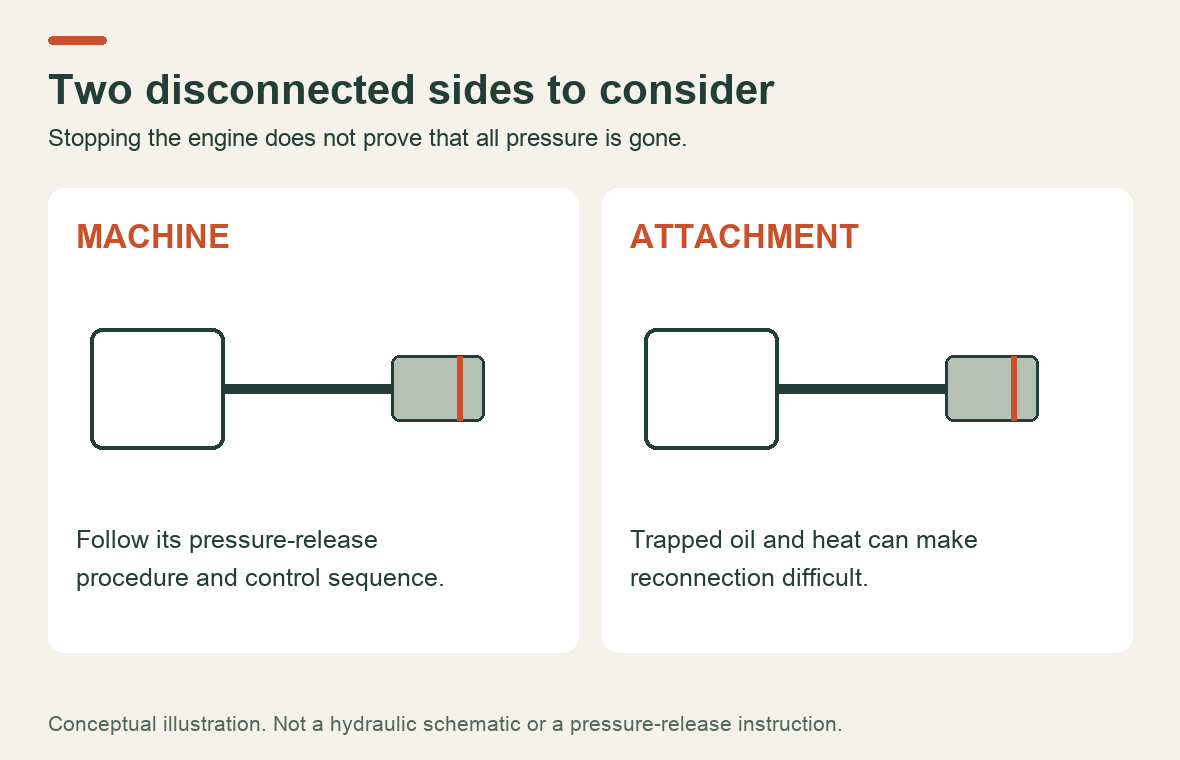
A stopped engine does not prove that both sides of the connection are depressurized. The machine and the disconnected attachment need to be considered separately. Use the pressure-release instructions for your machine and attachment; there is no universal joystick sequence for every Kubota tractor, loader and excavator.
Why a disconnected attachment can still hold pressure
Oil can remain trapped behind closed coupler valves. Heat absorbed by a disconnected attachment can increase that pressure, making reconnection difficult. Loads on hydraulic components can also matter. Coupler manufacturer Stucchi explains these mechanisms in its guide to connecting with residual pressure.
Consider an attachment disconnected early in the morning and left in direct sun. If it is difficult to reconnect later, the change in storage conditions is useful evidence. It is not proof that the coupler has failed, nor a reason to force it together.
Start with a safe setup
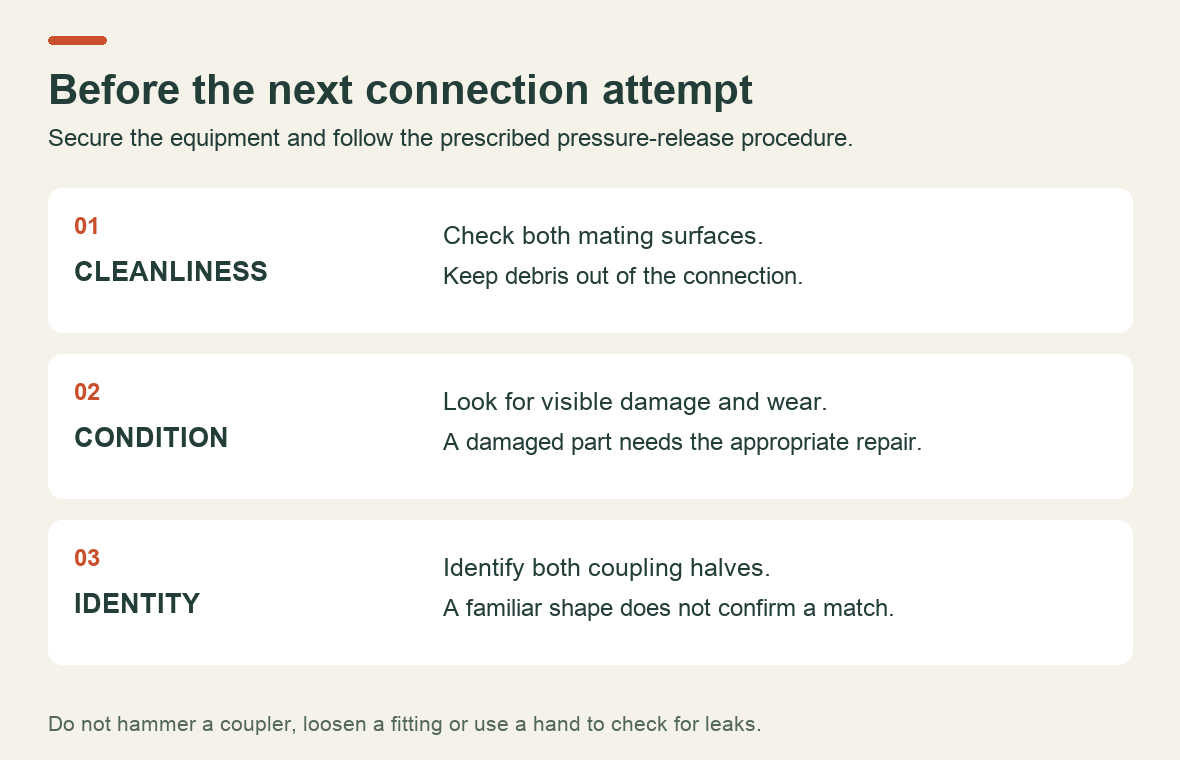
Park and secure the machine and attachment using their manuals. Lower or support equipment as specified before working at a connection. Keep people clear of possible movement. Stop the engine and follow the prescribed pressure-release procedure before connecting or disconnecting hydraulic lines.
Kubota's SVL75-3 operator's manual, auxiliary hydraulic section, printed page 128 requires stopping the engine and relieving pressure, and warns against checking leaks with a hand. Those are essential precautions, but the control sequence and coupler arrangement must still match your machine.
Do not loosen a hose fitting, strike the coupler or use an improvised tool to force a valve open. Stucchi identifies oil release, contamination and injury among the risks of those shortcuts. If the prescribed method does not resolve the resistance, stop and obtain the appropriate service procedure.
Look closely before blaming pressure
With the equipment safely secured, inspect the connection externally. Kubota's SVL75-3 instructions call for cleaning both mating surfaces and the male coupler's outside diameter, then checking for corrosion, cracks, damage and excessive wear. The manual also cautions against hose arrangements that impose side loads on the couplers.
| What you notice | What it helps you investigate |
|---|---|
| Dirt around the mating face or sleeve | Whether cleaning and inspection were completed before the attempt |
| Visible damage or a deformed connection | Whether the component needs replacement rather than another connection attempt |
| Trouble began after replacing one half | Whether the replacement actually matches the other half |
| Trouble follows one attachment | Its couplers, storage conditions and pressure-release provisions |
| Trouble occurs with several attachments | The machine-side connection and the procedure used there |
The last two rows are ways to organize observations, not fault verdicts. Do not connect an unsafe or mismatched attachment merely to test a theory.
Similar-looking couplers may need different procedures
The SVL75-3 manual provides a useful model-specific example. Its pressure-relief instructions identify particular small couplers in the accompanying drawing. The high-flow arrangement also distinguishes other connections, including a case-drain coupler. That is a reason to use the drawing, not to assume that any connector on another Kubota works the same way.
Do not transfer the manual's push-and-hold method to an unidentified coupler. First establish that your machine has the specified arrangement and follow the complete instructions. A connector's flat face alone does not establish its ability to connect against residual pressure; that is a feature of particular coupling designs.
Check compatibility before ordering a replacement
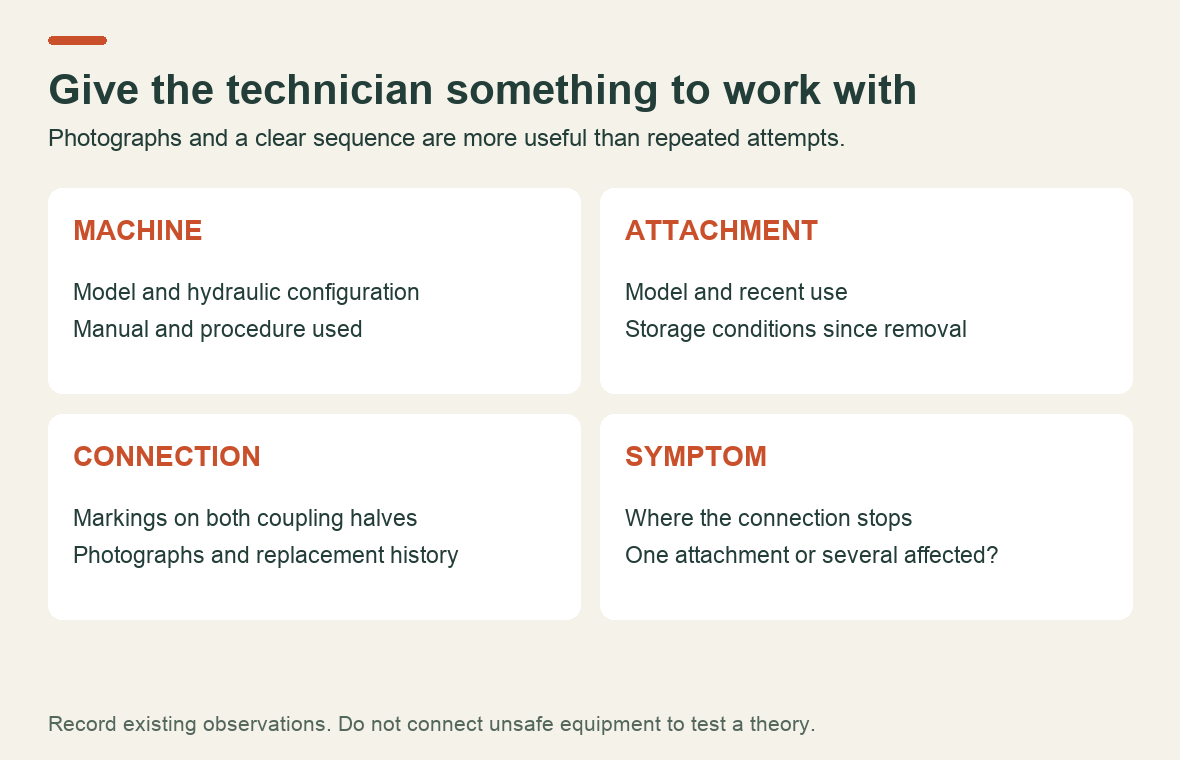
Photograph the markings and both halves. Record the coupler series if it is known, the attachment model and the machine's hydraulic configuration. Keep the hose-thread size separate from the coupling identification: the thread that joins a fitting to a hose is not the mating interface between the two quick-coupler halves.
The Parker hydraulic quick-coupling catalog is a useful manufacturer reference for coupling selection and operating limitations. Size, pressure capability and flow requirements belong in that selection; a pair that physically mates still needs to be suitable for the application.
If identification is unclear, send those details to a hydraulic supplier. Stucchi's technical help desk is one example of a manufacturer providing identification support. Ask for a confirmed matching combination, not simply “a coupler for a Kubota.”
When the manual becomes the next useful tool
A helpful service request might read: “The same attachment connected yesterday. Today it stops before the sleeve locks. It was stored outside. I followed the pressure-release section in this operator's manual. Here are photographs of both couplers.” That is an illustrative report, not a documented repair case, but it shows the detail a technician can work with.
For the SVL75-3, the workshop manual listing on Byte Market includes quick-coupling procedures and hydraulic diagnostic material. Check the listed model and publication number before ordering. The operator's manual remains the reference for everyday attachment changes; workshop instructions help when inspection and the correct operating procedure do not resolve the problem.
Can I fit connect-under-pressure couplers instead?
Possibly, if the selected system is suitable for the machine and attachment. Treat that as a component-selection job with a hydraulic specialist. Check its stated connection-pressure limits and operating instructions, as well as normal working pressure and flow. The name does not mean unlimited pressure or permission to skip securing the equipment.
Once the issue is resolved, record the correct coupler identification and the applicable connection procedure with the attachment. The next operator should not have to rediscover either of them.
Recent Post
-
Why a Kubota Manual May N...
16 Sep, 2026
-
Kubota Tractor Won’t Star...
16 Sep, 2026
-
Kubota DPF Light Flashing...
18 Sep, 2026
-
Kubota Tractor Overheatin...
21 Sep, 2026
-
Kubota Hydraulic Couplers...
22 Sep, 2026