Kubota Air Filter: When to Clean It and When to Replace It
Kubota Air Filter: When to Clean It and When to Replace It
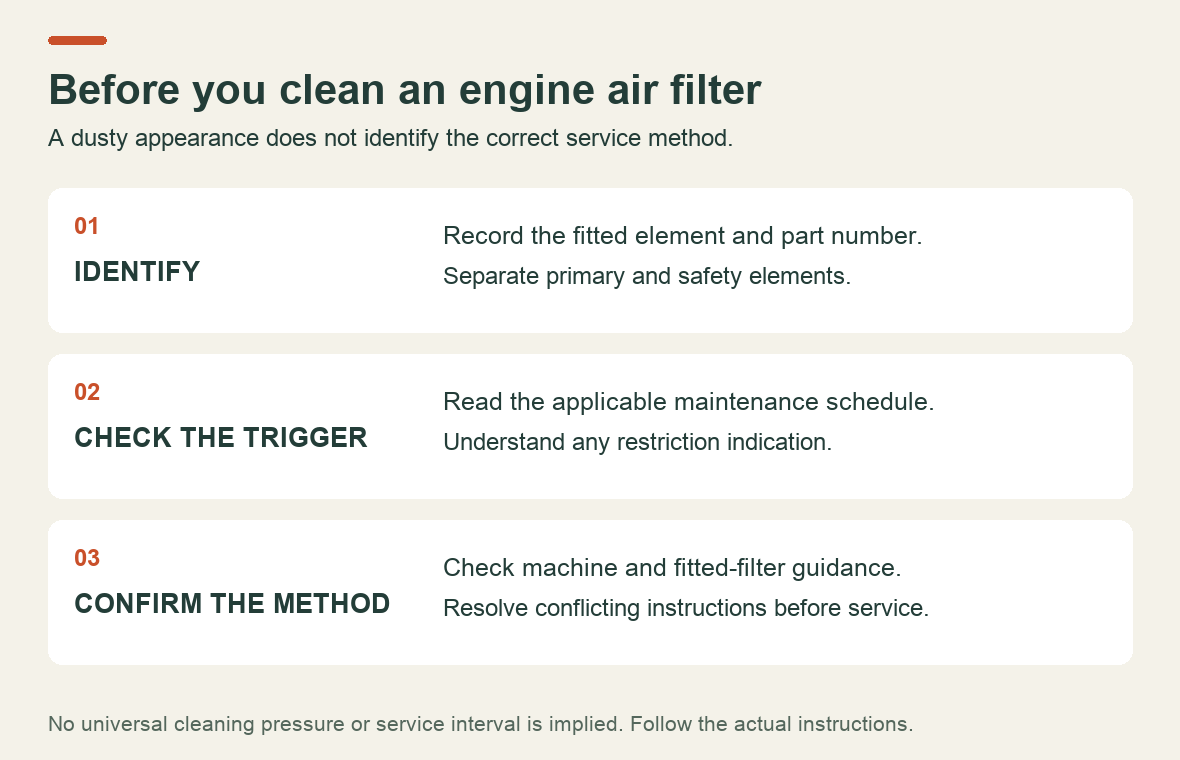
The air filter looks dusty, and the compressor is already running in the workshop. Blowing it out seems like a five-minute job. But is the element designed to be cleaned, and is it the outer filter or the smaller safety element inside?
There is no single cleaning rule for every Kubota air filter. Identify the engine air cleaner and the element fitted, then check the applicable instructions. Some Kubota manuals permit cleaning a particular primary element. That permission does not automatically extend to a replacement filter from another manufacturer, or to the inner safety element.
This article concerns engine intake filters. A cab filter, radiator screen and engine air filter have different jobs and service instructions.
Start with the service requirement, not the color
A dark filter and a filter that has reached its airflow restriction limit are not necessarily the same thing. Donaldson's guide to servicing by restriction explains that restriction measures the resistance to airflow through the intake system. It also warns that unnecessarily opening the housing creates opportunities for contamination and incorrect refitting.
Where the machine uses a restriction indicator, understand its service point and checking conditions. Donaldson notes that a reading at operating rpm need not equal one taken under full load. A reading without its conditions is not a useful comparison.
Follow Kubota's maintenance schedule and warning instructions for your machine, including dusty-service requirements. General filter advice is not permission to extend a manufacturer interval or ignore a warning. If the indicator's meaning is unclear, identify it in the manual before resetting it.
A documented Kubota example
The M8540/M9540 cab tractor operator's manual, printed page 85, permits cleaning its primary element. For dry dust, it specifies air directed from inside the element, with pressure below 205 kPa, approximately 30 psi. It calls for primary-element replacement annually or after the sixth cleaning, whichever comes first.
The same page says not to oil the dry element, not to run the engine with the filter removed, and not to disturb the secondary element except for replacement. It also identifies the cover's upright arrow as important to evacuator-valve operation.
These details belong to that manual and filter arrangement. They are not a universal compressed-air setting or replacement interval for all Kubota tractors. Read the entire procedure and applicable safety instructions before service; shut the machine down as prescribed.
Why the replacement-filter instructions may differ
Donaldson's air-intake product guide, Air Filter Service — Best Practices takes a different approach to its heavy-duty elements: it advises replacement rather than cleaning. It identifies damage and contamination risks from washing, tapping or compressed air, and says its filter warranty no longer applies after cleaning.
That apparent disagreement is a reason to identify the part, not to choose the instruction you prefer. A replacement element can fit the same housing without having the same permitted service method.
| What you have established | Sensible next step |
|---|---|
| The applicable machine instructions and fitted-element guidance permit cleaning | Use that complete procedure, its limits and replacement criteria |
| The fitted filter manufacturer prohibits cleaning | Replace it when service is required; do not apply an older element's cleaning permission |
| Element identity or instructions are uncertain | Resolve the part number and applicability with the supplier or dealer before cleaning |
| Media, seal or body is damaged | Do not try to make the element serviceable by cleaning it |
Keep the old part number and packaging information in the service record. “Fits M9540” is a compatibility claim; it does not describe what maintenance that particular element allows.
The inner safety element is not a spare outer filter
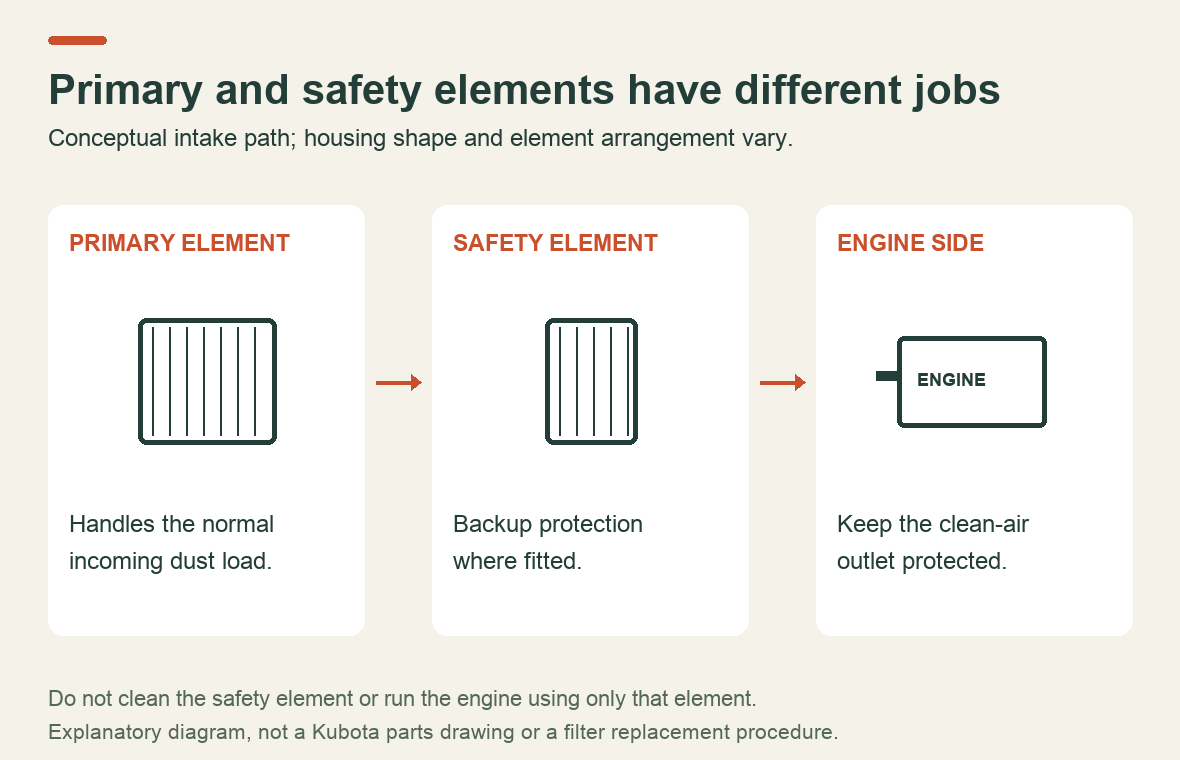
Donaldson's explanation of safety filters gives them two roles: protecting the clean-air outlet during primary-filter service, and providing backup if the primary filter is damaged or installed incorrectly. They are not intended to carry the normal dust load on their own.
Do not clean the safety element or run the engine using only that element. Donaldson also treats dust loading on the safety filter as a reason to replace it and investigate why contamination passed the primary filter. Simply fitting another inner element leaves that question unanswered.
Use the replacement schedule for the actual Kubota installation. Do not borrow a primary-to-safety replacement ratio from a different housing or fleet application.
What to record if the problem returns quickly
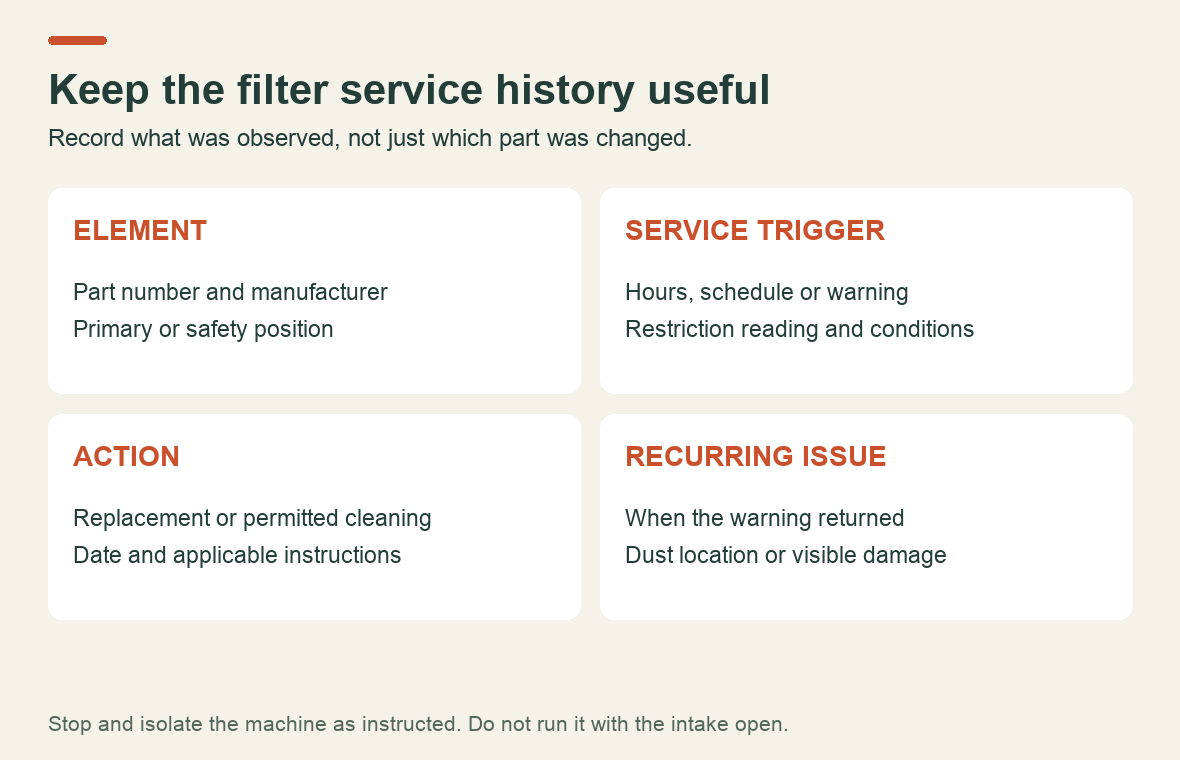
Record the engine hours, work conditions, warning or restriction reading, element part numbers, and what was done at the last service. Add photographs of any damaged seal or unusual dust location while the machine is safely shut down. Do not run the engine with the intake open to demonstrate the problem.
For example, “restriction warning returned six hours after replacement during dry loader work” gives a workshop a timeline. “The new filter is bad” is already a conclusion. A quick return of the complaint deserves an inspection of the installation and intake system, not another unrecorded cleaning.
Choose documentation for the job you are doing
The operator's manual supplies routine service instructions. If damage, recurring warnings or an intake-system fault requires further investigation, check the workshop documentation for the exact tractor.
Byte Market lists a Kubota M8540/M9540 Workshop Manual with maintenance, engine and electrical material. Check the contents and model applicability before purchasing. Keep the instructions for the fitted filter with it: the tractor manual and the replacement part's service guidance answer different parts of the same question.
Recent Post
-

Why a Kubota Manual May N...
16 Sep, 2026
-
Kubota Tractor Won’t Star...
16 Sep, 2026
-

Kubota DPF Light Flashing...
18 Sep, 2026
-

Kubota Tractor Overheatin...
21 Sep, 2026
-
Kubota Hydraulic Couplers...
22 Sep, 2026
-

Kubota UDT vs Super UDT2:...
23 Sep, 2026
-

Kubota 3-Point Hitch Won'...
24 Sep, 2026
-
Kubota Excavator Track Te...
25 Sep, 2026
-
New Holland 540 vs 540E P...
28 Sep, 2026
-
Kubota BX Mower Cutting U...
29 Sep, 2026
-

Kubota Excavator Controls...
30 Sep, 2026
-
New Holland DEF Storage:...
01 Oct, 2026
-
Kubota Air Filter: When t...
02 Oct, 2026