Kubota Tractor Won’t Start? What to Check Before Replacing Parts
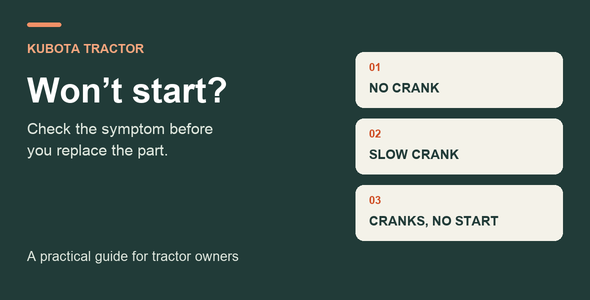
Kubota Tractor Won’t Start? What to Check Before Replacing Parts
The tractor worked yesterday. Today you turn the key and get a click—or several seconds of cranking with no sign of it firing. Before ordering a battery, starter or fuel pump, describe what actually happens when you try to start it.
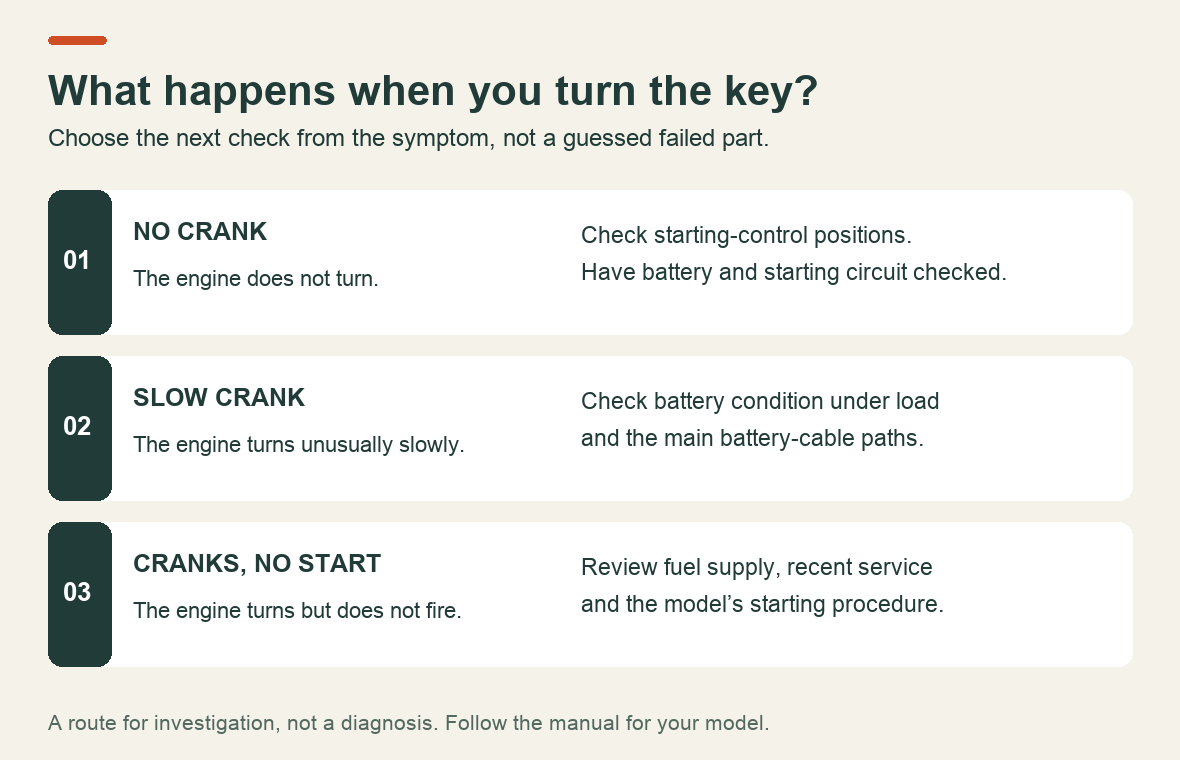
First, separate a no-crank problem from a crank-but-no-start problem. A silent starter, a slowly turning engine and an engine that turns normally but will not fire need different checks. “Won’t start” is too broad to choose a replacement part.
This guide helps you collect useful evidence and decide what to check next. The examples identify their models; they are not a single starting procedure for every Kubota tractor, excavator or loader.
Start with what you can hear
“Cranking” means the starter is turning the engine. Listen from the operator’s seat; do not reach into the engine compartment during a starting attempt.
| What happens when you turn the key? | Which path to follow |
|---|---|
| Nothing turns, with or without a click | Check the prescribed starting-control positions and battery/cable condition; then investigate the starting circuit |
| The engine turns unusually slowly | Have the battery and main cables checked before condemning the starter |
| The engine turns at its usual speed but never fires | Review fuel supply, recent service and the model’s starting instructions |
These are routes for investigation, not diagnoses. Starter manufacturer Delco Remy likewise separates no-crank complaints from slow cranking and puts battery and cable checks ahead of starter replacement. Its advice explains the electrical principle; use Kubota’s specifications for your tractor. Delco Remy: diagnosing starter cranking problems.
Make the tractor safe before checking anything
Park on firm, level ground, lower attachments, apply the parking brake and follow the manual’s neutral-position instructions. Remove the key for hands-on inspection. Attempt a start only from the seat, with people clear and adequate ventilation. Kubota’s M5-091/M5-111 manual specifies these preparation precautions and warns against bridging starter terminals or bypassing the safety-start circuit: the tractor could move unexpectedly. Kubota M5 operator’s manual, Safe Operation sections; manufacturer document hosted by Device.report.
If it will not crank, reset the controls before blaming a switch
Return each starting control to the position specified in your operator’s manual. Check PTO engagement, transmission or shuttle position, and any clutch or travel-pedal requirement for that model. Do this deliberately, rather than holding the key over while moving levers around.
There is a useful, specific example in the BX1880/BX2380/BX2680 manual: its starting interlock requires the travel pedal at neutral and the PTO clutch lever off. Its engine-start-system tests check those two conditions separately. This does not establish the switch arrangement on an MX, M5 or M6. Kubota BX operator’s manual, “Starting the engine” and “Checking the engine start system”.
If the tractor starts after you correct a control position, record what changed. If it starts intermittently despite the controls being correctly positioned, have the relevant circuit tested. That observation is more useful than ordering a seat switch on the strength of someone else’s symptoms.
If it clicks or cranks slowly, check the power supply first
A click alone does not identify a failed starter. Delco Remy recommends inspecting and load-testing the battery, followed by testing voltage drop in the main cables. For a click/no-crank complaint, the control circuit may also need investigation. Delco Remy’s diagnostic sequence.
With the key removed, look for obvious corrosion, damaged cable insulation or visibly loose connections. If you find damage, stop and arrange the appropriate repair before another attempt. A photograph gives the technician a useful starting point.
Ask for battery condition under load and cable voltage-drop results, rather than only a resting voltage reading. Fluke explains that a voltage-drop test during cranking can locate resistance in connections or cables; both the positive supply and ground return matter. Have a competent technician perform tests around live starter terminals and moving parts. Fluke: starter-circuit voltage-drop testing.
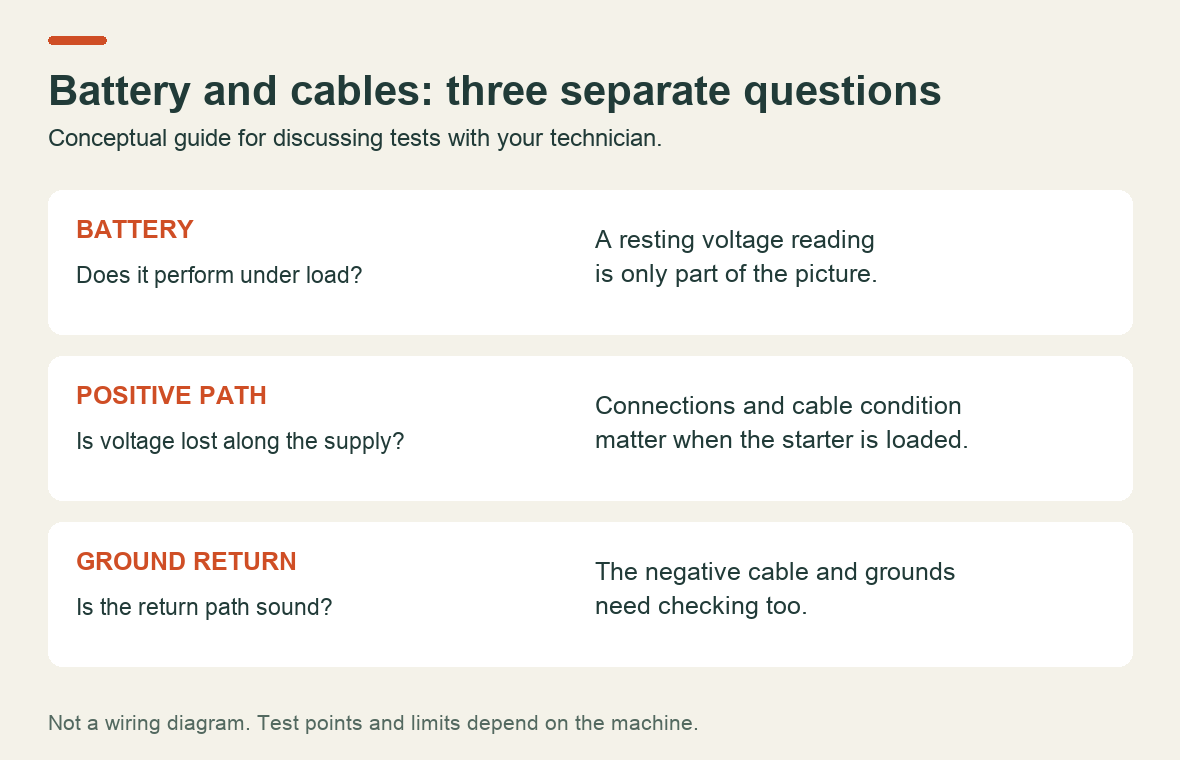
Conceptual illustration, not a wiring diagram or probe-placement instruction. Test points and limits must come from the applicable service information.
If it cranks normally, ask what changed since the last successful start
Did the tank run empty? Was a fuel filter changed? Did the problem begin after storage? Write down the event before touching anything else.
Kubota’s M6040 operator’s manual lists fuel-flow problems and air or water in the fuel system among possible hard-start/no-start causes. Its fuel-bleeding section identifies situations including an empty tank and removal of the filter or lines. That makes recent fuel-system work a sensible lead to investigate, not proof of a failed pump. Kubota M6040 manual, printed pages 93 and 100.
Check the fuel level and review the exact filter-replacement or priming procedure for your tractor. If you have just serviced it, compare what you did with that procedure. Do not copy a bleeding method from a different fuel system.
Do not loosen common-rail injection pipes to see whether fuel comes out. Kubota’s M5 manual warns against opening the high-pressure system or attempting repairs between the high-pressure pump and injectors. Leave that work to a qualified technician. Kubota M5 operator’s manual, servicing precautions.
Cold morning? Follow the preheat instructions, not a guessed timing
The BX1880/BX2380/BX2680 manual gives different preheat times for different temperatures. It also specifies limits and pauses for starting attempts and prohibits ether or starting fluid. Use the instructions for your own model instead of repeatedly extending the crank time. Kubota BX manual, “Starting the engine” and “Cold weather starting”.
Cold-weather preparation also involves fuel, battery condition and suitable oil viscosity. Kubota discusses those checks in its winter maintenance guide. Separately, it notes that biodiesel can restrict fuel filters in cold conditions. A cold-weather no-start deserves more context than “the battery must be bad.” Kubota winter maintenance guide, Kubota biodiesel guidance.
Give the mechanic a useful description
Before making the call, collect the full model designation, serial number, transmission type and hour reading. Note whether the engine turns, what the dashboard shows, the outside temperature and any recent work. Photograph any displayed code exactly as it appears. Avoid translating it into “fuel problem” or “bad sensor” before it has been checked.
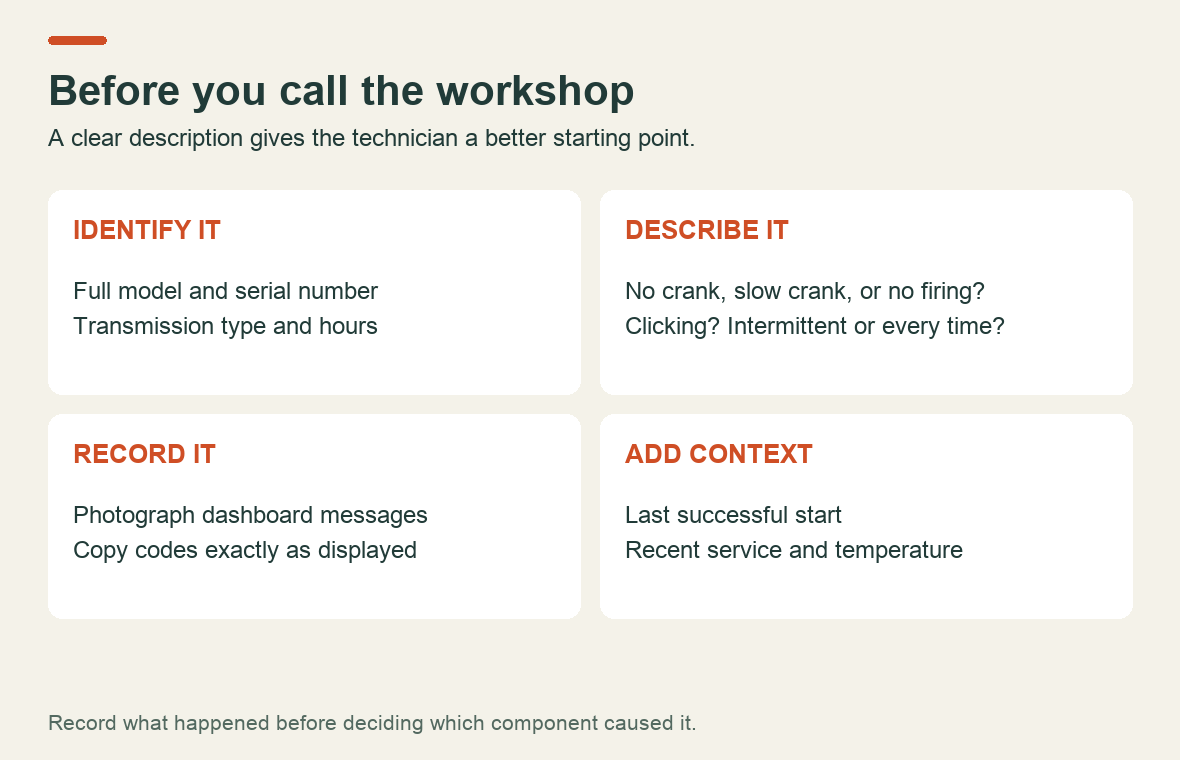
For example, this illustrative report gives a workshop something concrete to investigate:
MX5400, HST. Engine cranks at its usual speed but does not fire. It last ran before the fuel-filter change. Fuel is in the tank. I have recorded the serial number and photographed the dashboard. No parts have been replaced since the symptom appeared.
That is more useful than “I think it needs an injection pump.” Stop attempts if you notice leaking fuel, damaged wiring, smoke from electrical components or unexpected movement. A fault that requires bypassing a safety device to continue is a repair job, not a starting technique.
When the workshop manual becomes useful
The operator’s manual is the first reference for starting controls, preheat and routine checks. Once diagnosis requires wiring, connector identification or component tests, you need the service information for the exact machine.
For MX5400/MX6000 owners, our Workshop Manual 9Y111-21166 listing includes electrical-system, electric-circuit and connector-diagram entries in its published contents. Check model and edition coverage before ordering. Owners of other tractors can start with the Kubota manuals catalog.
Before buying a part, aim to fill in this sentence: “The test that points to this component is…” If the only answer is “it will not start,” you have a symptom worth investigating, but not yet a reason to replace that part.
Recent Post
-
Why a Kubota Manual May N...
16 Sep, 2026
-
Kubota Tractor Won’t Star...
16 Sep, 2026