New Holland DEF Storage: Shelf Life, Freezing and Contamination
New Holland DEF Storage: Shelf Life, Freezing and Contamination
A part-used DEF container comes out of the shed at the start of a busy week. The fluid looks clear, but nobody remembers when it was opened or whether the spout was used for something else. Should it go into the tractor?
Check its date, storage history and handling equipment before filling. For a New Holland machine equipped with SCR, DEF quality is part of looking after the emissions system. This guide is about the fluid you buy and store; warning messages and repair procedures still belong to the instructions for your particular machine.
DEF goes in its own tank
New Holland's MyCNH DEF guidance describes DEF as a mixture of 32.5% urea and 67.5% purified water used by selective catalytic reduction. It is supplied separately from diesel fuel. Do not assume that every New Holland model uses it; identify the machine's emissions system and filler locations in its operator's manual.
Before a new employee or occasional operator refills the tractor, show them the actual fillers. A label saying “tractor fluid” on a portable container is not a useful identification system. Keep the product label, batch details and dedicated filling equipment together.
How long does DEF last in storage?
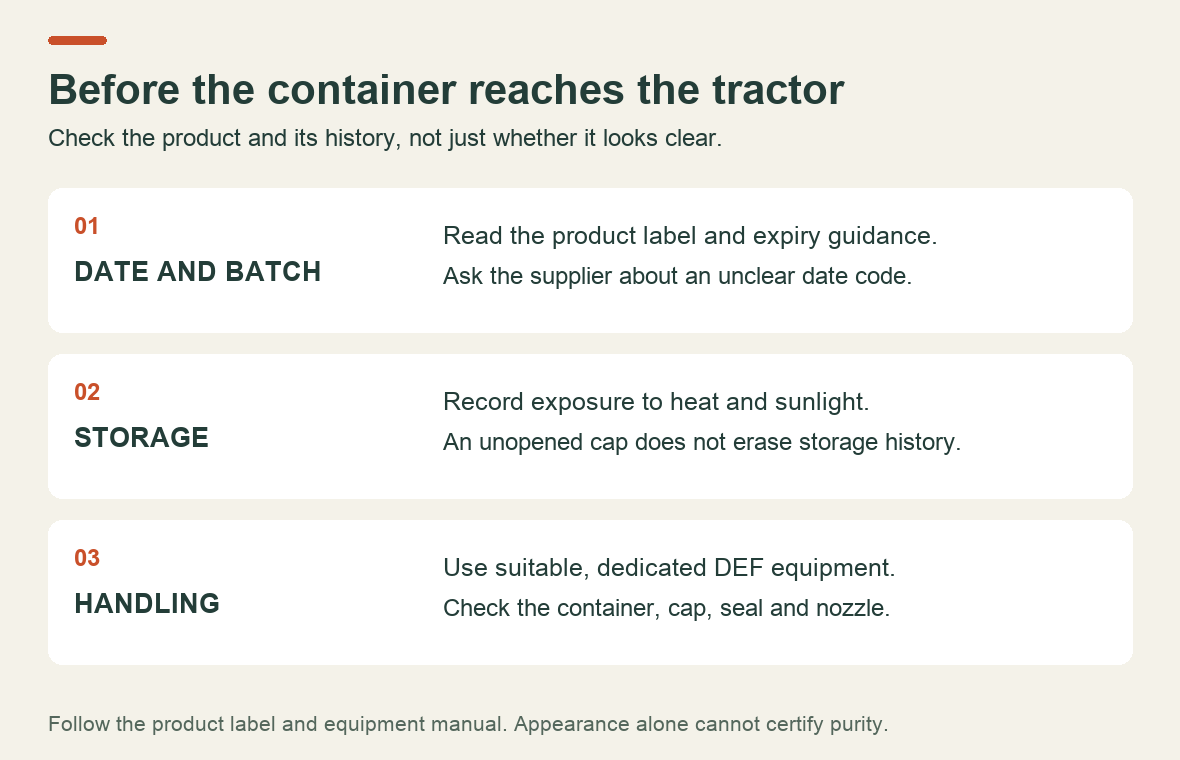
The American Petroleum Institute's consumer guidance says DEF can have a shelf life of at least 12 months, or longer under optimum conditions. That is not a promise for a container left anywhere on the farm. API notes that average temperatures above 86°F / 30°C, or direct sunlight, can speed degradation. Follow the product label's storage and expiry information.
Think of the date and the storage history as two separate checks. A readable date cannot tell you whether a container spent weeks in a hot vehicle. Equally, an old container does not become newer because it has never been opened.
For purchasing, API recommends looking for its DEF Certification Mark and checking products in its licensee directory. Certification helps identify compliant product; clean handling remains your responsibility after purchase.
Does freezing ruin DEF?
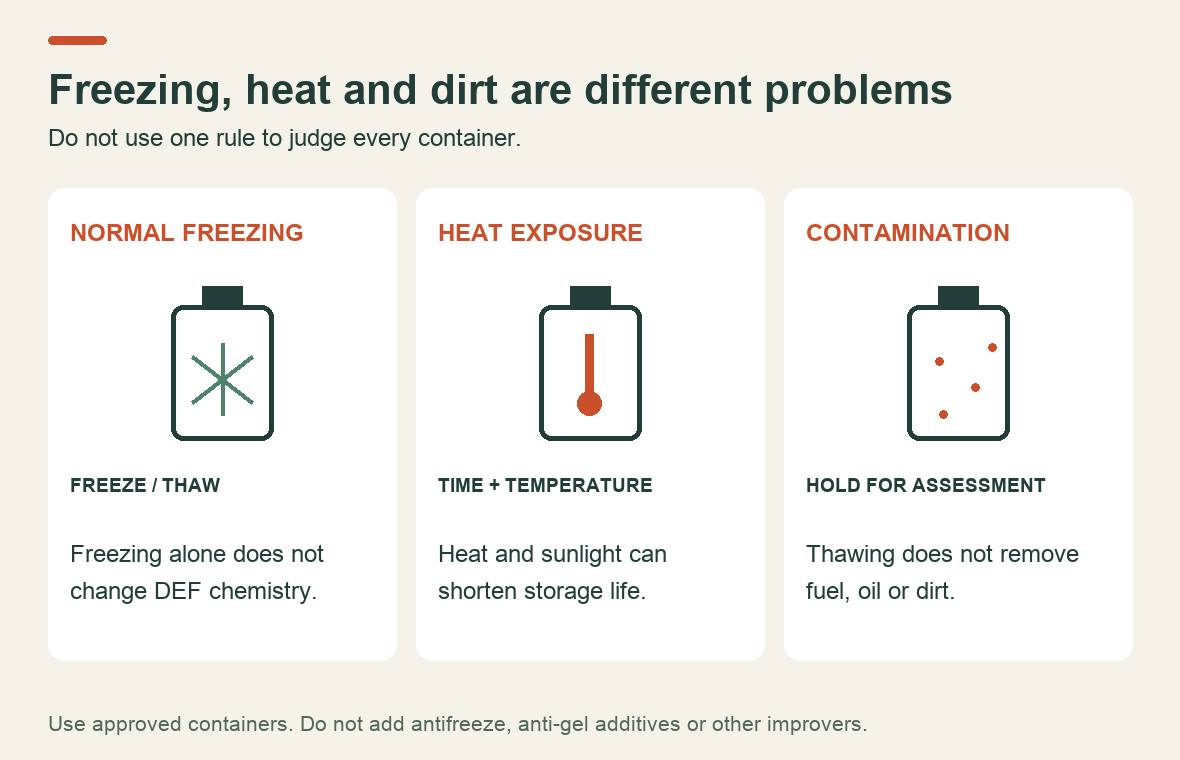
Normal freezing is different from contamination. MyCNH states that freezing and thawing do not change DEF's chemical properties. Its preferred storage range is 12°F / −11°C to 86°F / 30°C. Use approved containers and observe their filling instructions; do not brim a container in anticipation of freezing. See New Holland's storage and handling advice.
Cummins' DEF questions and answers confirms the approximately 12°F freezing point and specifically rejects anti-gelling additives and freezing-point improvers. Do not try to “winterize” DEF with a diesel additive or antifreeze. This is general fluid guidance, not a description of the heating system fitted to every New Holland tractor.
A frozen, correctly stored container and a dirty, damaged container need different decisions. Do not discard sound product solely because it froze. Conversely, thawing does not undo contamination or repair damaged packaging. If you cannot establish what is in the container, keep it out of the tractor and ask the supplier about assessment or disposal.
The funnel matters as much as the container
Cummins' DEF Quality and Maintenance booklet identifies fuel, oil, dust, detergents and other chemicals as contaminants to keep out of DEF equipment. It also notes that some opened containers have paper seals that can deteriorate. Check the cap, seal and dispensing parts rather than concentrating only on the liquid inside.
Use equipment intended for DEF and maintained according to its supplier's instructions. An old diesel funnel is a poor shortcut, even if somebody has wiped it with a rag. Keep nozzles protected from workshop dirt between fills. Cummins also cautions that container materials matter: an empty container is not automatically a suitable DEF container.
Do not treat clear appearance as proof of acceptable purity. A visual check can identify a reason to reject a container; it cannot certify everything that has been mixed into it. If contamination is suspected, separate and label that stock so another person does not use it by mistake.
A small stock record prevents expensive guesses
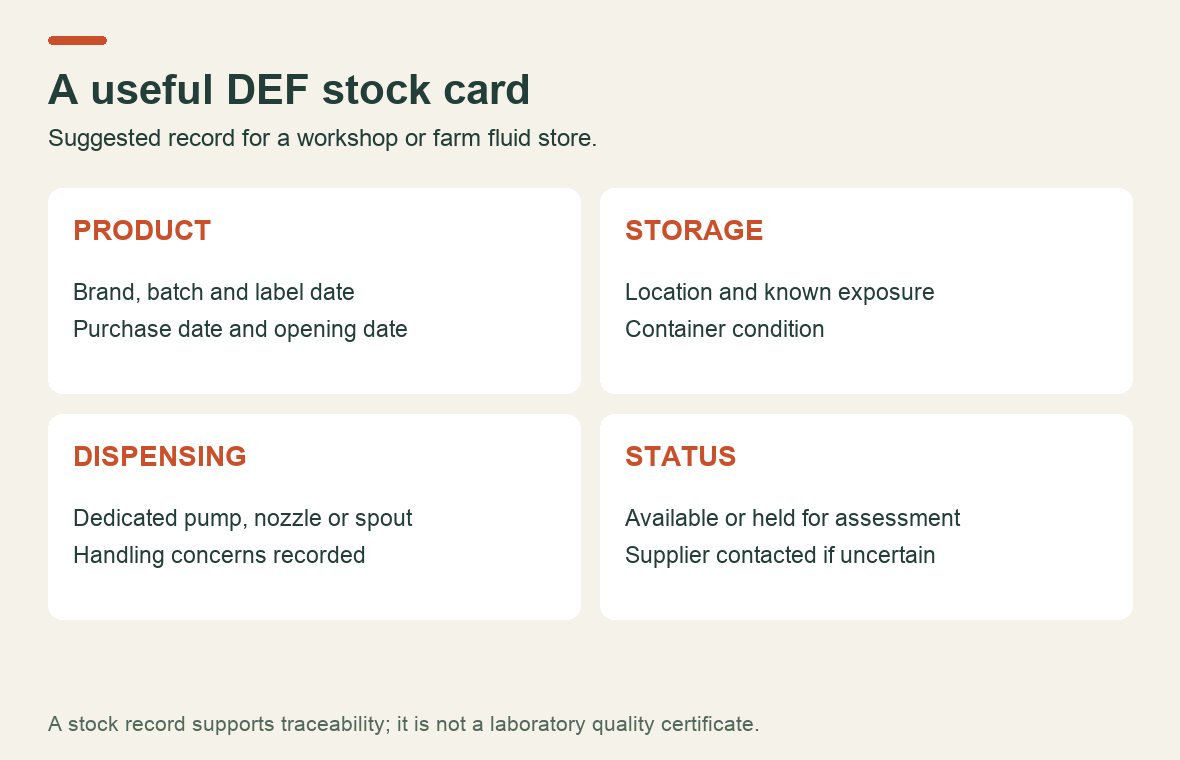
The following is a suggested workshop record, not a manufacturer service form. One row per container or batch is enough.
| Field | Why record it? |
|---|---|
| Brand and batch code | Lets the supplier identify the product |
| Label date and purchase date | Separates expiry information from when you bought it |
| Date opened | Makes the handling history easier to reconstruct |
| Storage location | Helps identify exposure to heat or sunlight |
| Dispensing equipment | Records which nozzle or pump was used |
| Status | Available, held for assessment, or removed from use |
For example, “opened September, stored in shaded fluid cabinet, dedicated spout” gives the next operator something to check. “Probably last year's” does not. Buy quantities that fit your actual use, and review older stock before opening another batch.
What if the tractor already shows a DEF warning?
Record the exact message, any code and when it appeared, including whether it followed a refill. Follow the operator's manual's instructions for that message. A storage article cannot establish the cause from “DEF light on,” and repeatedly adding fluid is not a diagnosis.
For owners investigating a covered T8 machine, Byte Market lists a New Holland T8.320–T8.435 and selected SmartTrax service manual. Its contents include engine and electrical sections. Match the exact model, transmission, serial applicability and emissions version, and confirm coverage of the relevant fault before purchasing. The listing alone does not verify that a particular SCR code is covered.
Keep that diagnostic work separate from the decision about the container in your shed. A known product with a documented history is a much better starting point than an unidentified refill added to an existing fault.
Recent Post
-
Why a Kubota Manual May N...
16 Sep, 2026
-
Kubota Tractor Won’t Star...
16 Sep, 2026
-
Kubota DPF Light Flashing...
18 Sep, 2026
-
Kubota Tractor Overheatin...
21 Sep, 2026
-
Kubota Hydraulic Couplers...
22 Sep, 2026
-

Kubota UDT vs Super UDT2:...
23 Sep, 2026
-

Kubota 3-Point Hitch Won'...
24 Sep, 2026
-
Kubota Excavator Track Te...
25 Sep, 2026
-
New Holland 540 vs 540E P...
28 Sep, 2026
-
Kubota BX Mower Cutting U...
29 Sep, 2026
-
Kubota Excavator Controls...
30 Sep, 2026
-
New Holland DEF Storage:...
01 Oct, 2026