Kubota 4WD Won't Disengage? Start With the Lever and Tires
Kubota 4WD Won't Disengage? Start With the Lever and Tires
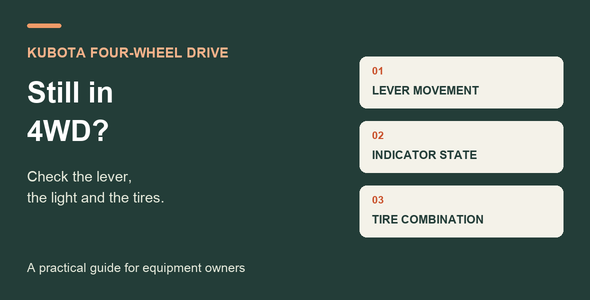
A stiff four-wheel-drive lever after working on firm ground does not automatically mean the front axle is broken. Before forcing it, separate two complaints: a lever that will not move to 2WD and a lever that moves normally while a 4WD indicator stays on.
For the Kubota L3200/L3800 example below, the operator's manual says to stop the tractor, turn the steering wheel and move the lever if front-wheel drive is difficult to disengage. That is a model-specific instruction. Other Kubota tractors use different controls and indicator behaviour, so a universal “just pull harder” or “reverse until it releases” answer is unhelpful.
First establish what is stuck
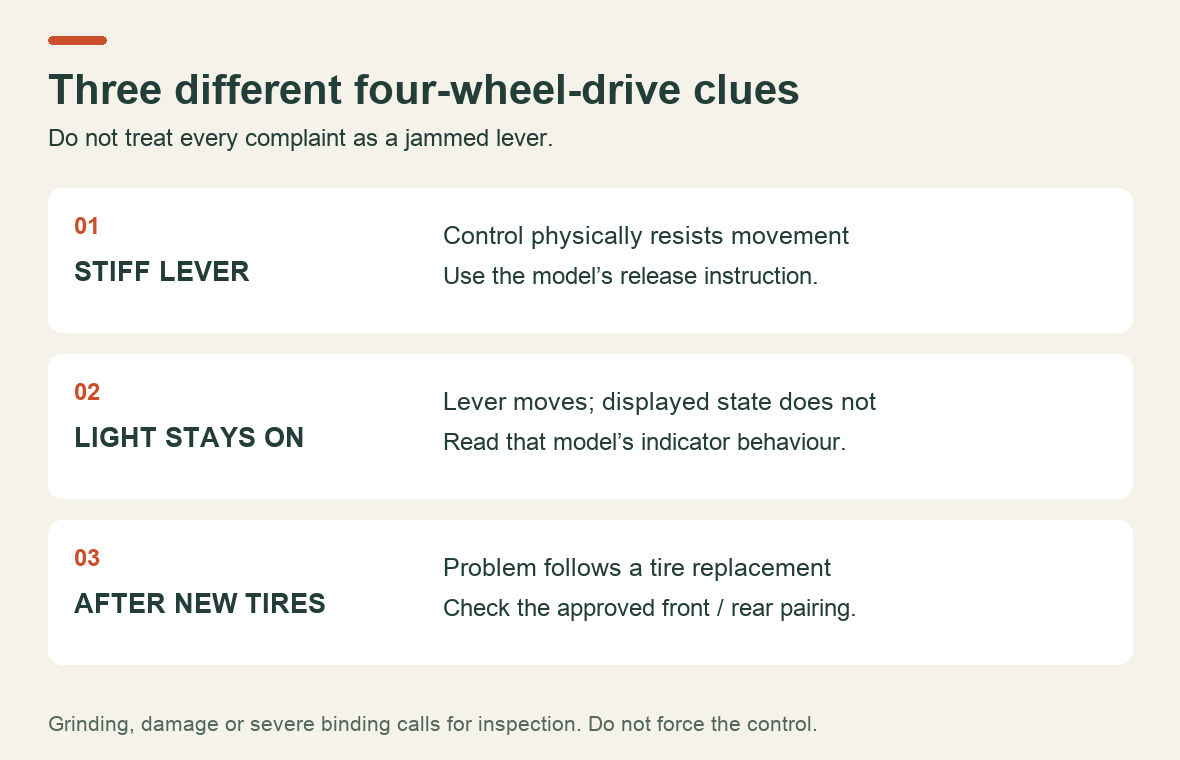
| Observation | What it tells you to check |
|---|---|
| The lever feels unusually hard to move | Follow the model's release procedure; inspect accessible linkage only with the tractor safely stopped |
| The lever moves, but the light stays on | Read the indicator behaviour for that model before concluding the drive remains engaged |
| The issue began after tire replacement | Verify the approved front/rear tire combination and inflation requirements |
| There is grinding, severe binding or damaged linkage | Stop trying to operate it and arrange inspection |
Describe what you observed during normal operation. Do not create a wheel-slip test, lift the tractor to spin wheels, or deliberately turn tightly on pavement to prove whether the front axle is driving.
Why firm ground and tire matching matter
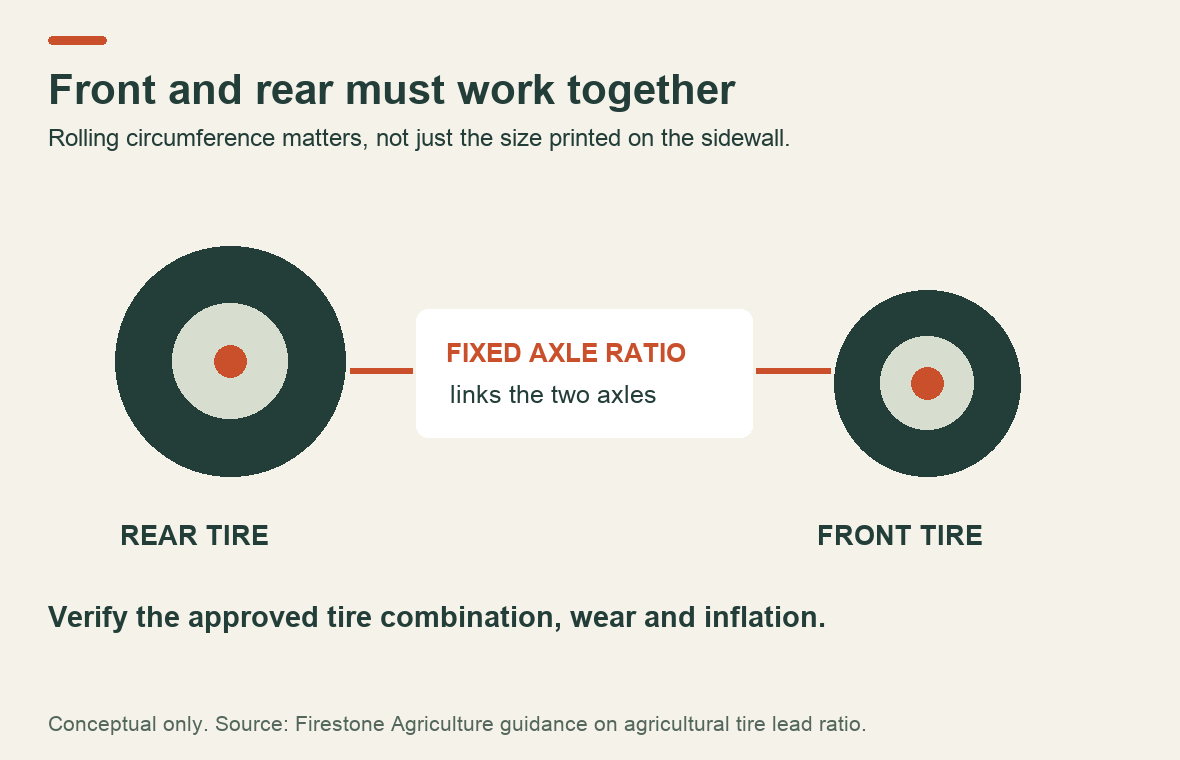
In four-wheel drive, the front and rear axles have to work together. Their mechanical gearing and the tires' rolling circumferences determine how their travel speeds relate. When that relationship is wrong, the driveline has to accommodate the mismatch.
Firestone's technical explanation of agricultural tire lead ratio describes how tire choice, wear and inflation affect this relationship. Two tires with the same nominal size are not automatically equivalent in rolling circumference. Excessive mismatch can increase wear and mechanical stress.
That makes tire history relevant when a complaint appears after a replacement. It does not establish that tires are the cause of every stiff lever. The useful question is whether the fault coincided with a change in the tractor's setup or operating surface.
The L3200/L3800 release instruction
The Kubota L3200/L3800 operator's manual, printed pages 20–21, covers the front-wheel-drive lever. It specifies stopping the tractor and using the clutch pedal for engagement. Where the lever is difficult to move to OFF, it says to stop, turn the steering wheel and move the lever.
The manual also warns that using front-wheel drive on paved roads accelerates tire wear. Its operating cautions include the difference in braking characteristics between two- and four-wheel drive.
Use the instruction with the full operating context for your tractor. If the lever still resists, extra force is not a diagnostic method. A bent lever or damaged linkage creates another repair without resolving the original complaint.
Do not transfer an instruction for a hydraulic or electronically controlled system onto this mechanical lever, or vice versa. The fact that two tractors both say “Kubota” on the hood does not make their shifting procedures interchangeable.
A light that stays on can be a different issue
The Kubota M108S operator's manual, printed page 25, gives a useful contrast. It describes cases where the 4WD indicator does not change immediately with the lever, but changes as the tractor travels. It also describes turning the steering wheel at a standstill to change the indicated state.
This is an example of documented behaviour on that model, not a promise that a persistent light on every Kubota is normal. If your tractor's manual does not describe the behaviour you see, report both the control position and the displayed indication to the workshop.
What to check after new tires were fitted
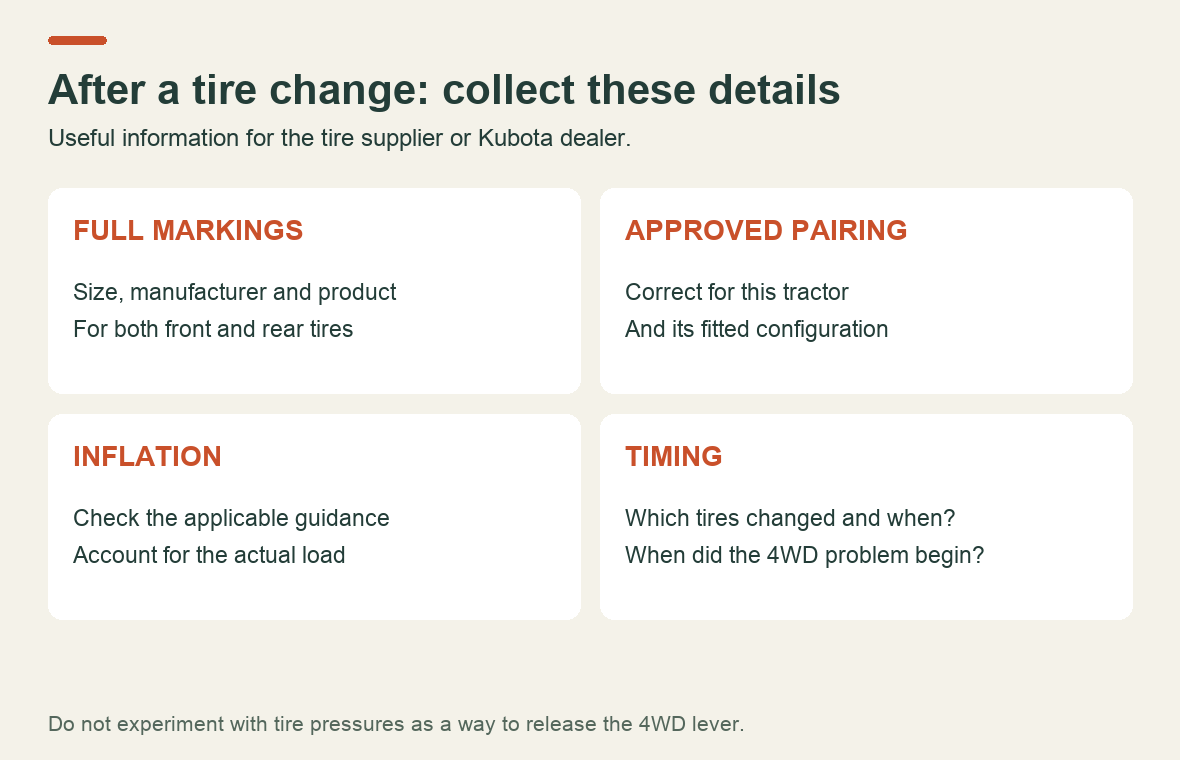
Collect the full size markings, manufacturer and product name from all four tires. Keep the invoice if the issue appeared immediately after replacement. A note saying only “same size as before” leaves out information that may matter.
Ask the tire supplier or Kubota dealer to confirm the approved combination for the tractor and its configuration. Check inflation against the applicable tractor and tire guidance for the load. Do not change pressures experimentally to make the lever easier to move.
For a used tractor, check what is fitted now rather than assuming the previous owner maintained the original combination. A front pair may have been replaced years before the rear pair, or a different tread type may have been installed.
When the problem needs workshop diagnosis
A useful repair request includes the exact model, control type, whether the lever physically moves, what the indicator does, the surface where it happened and recent tire or linkage work. Say whether following the operator's release instruction changed anything.
Stop for unusual noise, visible damage or unpredictable engagement. Do not disconnect linkages, force actuators or bypass electrical controls as an operating workaround.
For an L3200, the workshop manual listed by Byte Market includes transmission, front-axle and steering coverage. Check the listing against your tractor before ordering. The operator's manual gives the release instruction; workshop information becomes useful when the control still does not behave as intended.
Recent Post
-
Why a Kubota Manual May N...
16 Sep, 2026
-

Kubota Tractor Won’t Star...
16 Sep, 2026
-

Kubota DPF Light Flashing...
18 Sep, 2026
-

Kubota Tractor Overheatin...
21 Sep, 2026
-
Kubota Hydraulic Couplers...
22 Sep, 2026
-
Kubota UDT vs Super UDT2:...
23 Sep, 2026
-
Kubota 3-Point Hitch Won'...
24 Sep, 2026
-
Kubota Excavator Track Te...
25 Sep, 2026
-
New Holland 540 vs 540E P...
28 Sep, 2026
-
Kubota BX Mower Cutting U...
29 Sep, 2026
-
Kubota Excavator Controls...
30 Sep, 2026
-

New Holland DEF Storage:...
01 Oct, 2026
-

Kubota Air Filter: When t...
02 Oct, 2026
-
Kubota SVL Standard vs Hi...
06 Oct, 2026
-

New Holland Water in Fuel...
07 Oct, 2026
-
Kubota Loader Float: What...
08 Oct, 2026
-
Kubota HST Tractor Won't...
09 Oct, 2026
-
Kubota 50-Hour Service Ch...
12 Oct, 2026
-
Kubota 4WD Won't Disengag...
13 Oct, 2026