Kubota 3-Point Hitch Won't Lower? Check the Controls Before the Hydraulics
Kubota 3-Point Hitch Won't Lower? Check the Controls Before the Hydraulics
You pull into the shed, move the hitch lever down, and the implement stays in the air. It lifted normally a few minutes ago. Before assuming the hydraulic pump has failed, check whether the hitch has been prevented from lowering by a control setting.
The lowering-speed control is a useful first check on Kubota tractors that have one. It is separate from the lift lever, and some versions include a lock position. Identify it in your operator's manual before moving it: an implement that has been held up may start descending when the setting changes.
Keep clear of the implement while investigating
Park on firm, level ground and secure the tractor as instructed in its manual. Operate the hitch only from the prescribed operating position, with everyone clear of the linkage and implement. Never ask someone to stand on the arms, push the implement down, or reach between it and the tractor while you try the controls.
If it remains raised, keep people out of the space underneath. A hydraulic lock is not a mechanical support for working below a load. Stop the engine and remove the key before hands-on inspection; if the job requires access beneath the implement, arrange the specified support with someone competent to do it. The HSE's machinery maintenance guidance explains why isolation and support of raised equipment matter.
Find the right control, not just the nearest knob
Kubota's B2301/B2601 operator's manual, Hydraulic Unit section shows a lowering-speed knob with fast, slow and lock settings. That gives you a concrete possibility to check when the hitch raises but will not descend. The same manual warns against rapid lowering and specifies at least two seconds for implement descent in that application.
Use the markings and instructions for your own tractor. Do not treat a photograph of another B-series control panel as proof of the knob's location or direction on yours. A mower cutting-height dial, loader control lock and three-point lowering-speed control are different controls, even when several are close to the seat.
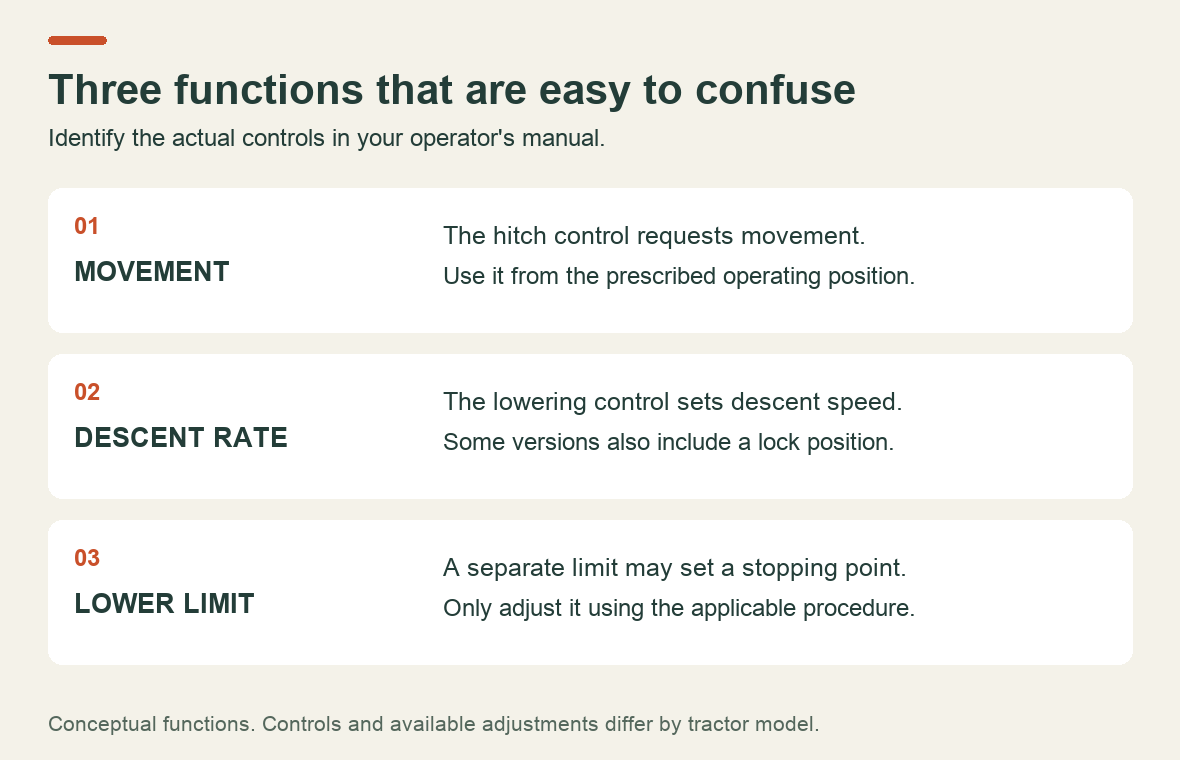
With the area clear, check whether the lowering control was inadvertently set to lock or an unusually slow setting. Follow the manual to restore a suitable descent rate. If it then lowers normally, record the setting and explain the control to anyone else using the tractor. There is no reason to replace a pump to correct a control position.
Does it stop at the same height every time?
A hitch that stops partway down deserves a different description from one that never moves. Some tractors have a separate lower-limit adjustment. The Kubota B3300SU operator's manual describes an implement lowering limit and a lowering-speed control as separate functions. One sets a stopping point; the other controls descent rate.
That example is specific to the B3300SU. It is a reason to look for the corresponding section in your documentation, not an instruction to adjust a rod or stop on an unidentified tractor. If an adjustment is needed, use its actual procedure and keep hands away from moving linkage.
| What the hitch does | First question to resolve |
|---|---|
| Raises normally, then refuses to lower | Is the applicable lowering control locked or restricted? |
| Lowers, but very slowly | What descent-rate setting is selected? |
| Stops repeatedly at the same height | Is a lower limit or implement setup restricting travel? |
| Will neither raise nor lower | Is this a broader hydraulic or control problem? |
| Changed immediately after an implement swap | What changed in the linkage, support or setup? |
The table narrows the investigation. It does not prove that the listed possibility caused the fault.
Inspect the setup before changing adjustments
Think back to the last successful lowering cycle. Was the same implement fitted? Was a quick hitch installed? Did someone change the top link, move a parking stand or alter a transport restraint? These questions can locate a useful change without dismantling anything.
From a safe position, look for visible interference or a restraint left in place. Compare the attachment arrangement with the implement's instructions. The HSE's pre-use machinery checks include secure attachment and the condition of hitching points, pins and clips. Do not pull a pin or release a restraint while it is carrying an unsupported load.
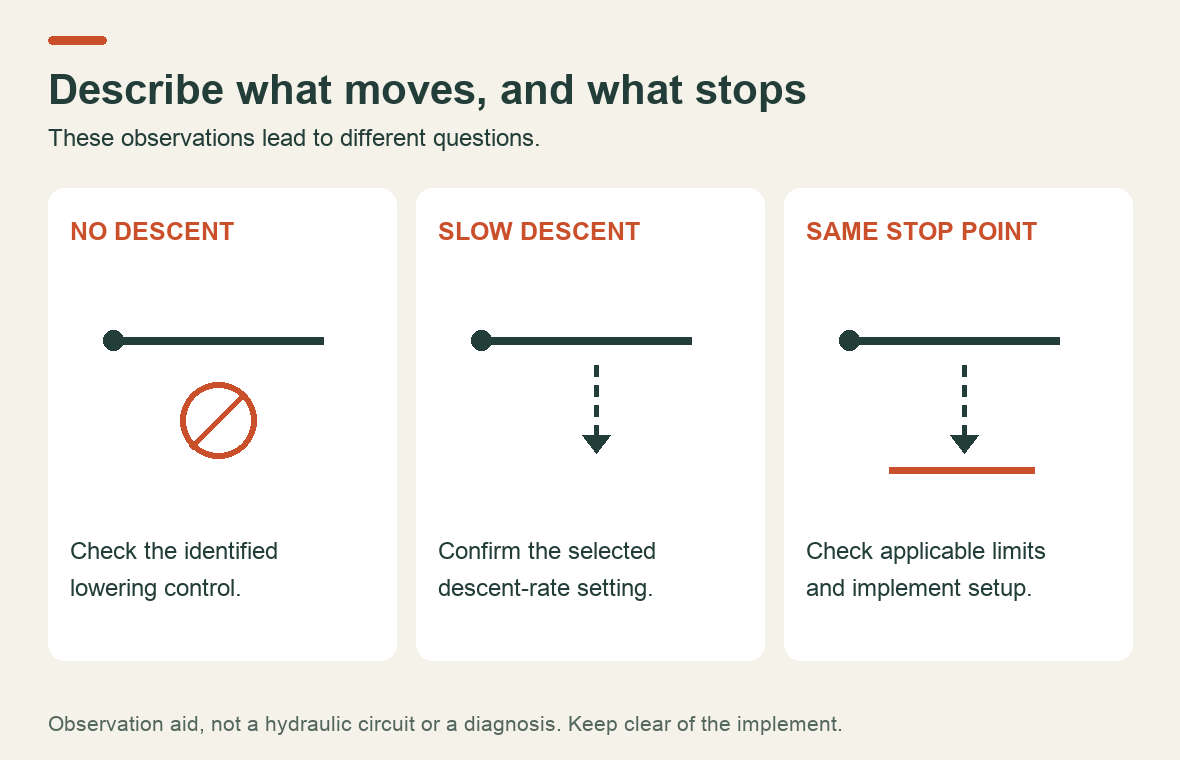
An unloaded pair of hitch arms and a mounted implement are also different test conditions. Write down which you observed. Do not add a person, loose weights or an improvised load to force a response.
When the next step belongs in the workshop manual
If the controls are correctly set and the setup is clear, further work may require checking linkage adjustment or hydraulic components. This is where model-specific service information earns its place. Do not turn an unidentified valve, loosen a hydraulic pipe to make the hitch drop, or increase a relief setting because the implement will not move.
For the B3200, the workshop manual available on Byte Market lists hydraulic pressure-test and valve-adjustment material. Review the contents and confirm applicability before ordering. Those procedures are relevant when an operating-control check has not resolved the issue; the listing itself does not diagnose the tractor.
Owners of another model can use the Kubota manuals catalog, then match the exact machine and required hydraulic section. A similar model number is not enough to borrow a test pressure or adjustment.
What to tell the mechanic
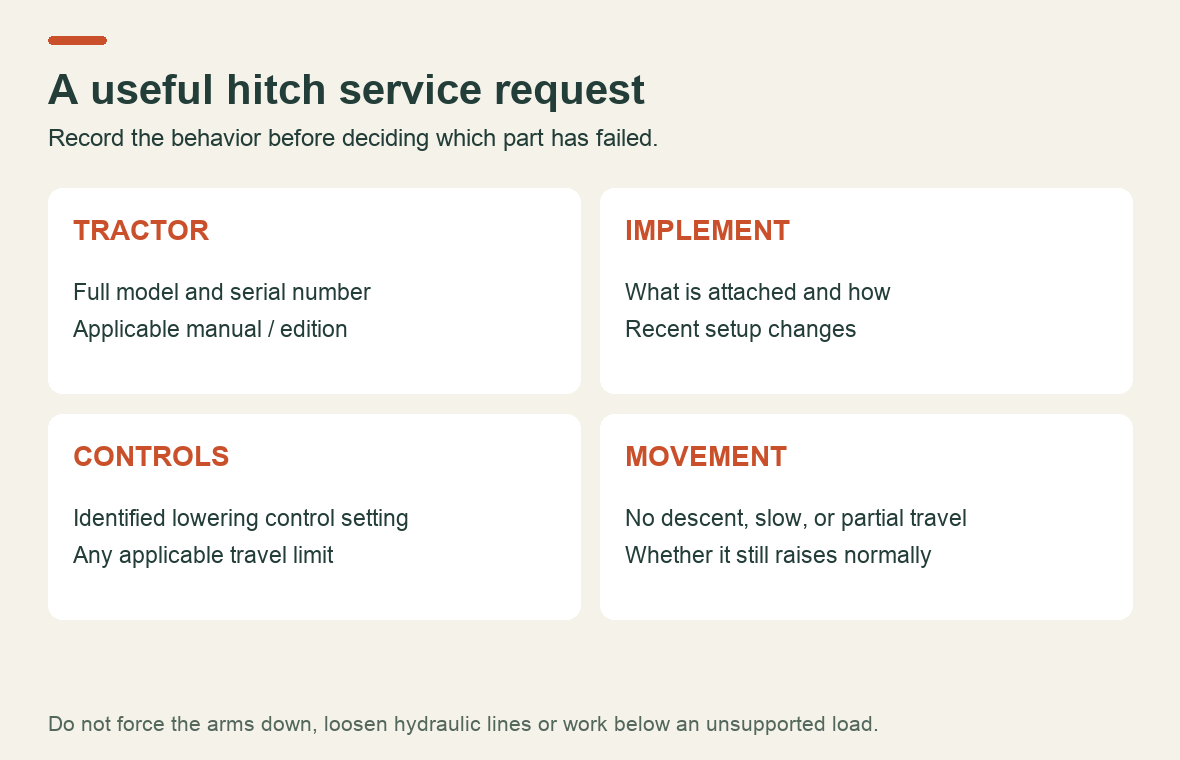
A useful report is short: “The hitch lifts this implement normally but does not descend. I checked the identified lowering-speed control against the operator's manual. The problem began after this change.” Add the model, serial number and photographs taken with the machine safely stopped.
If you are unsure which publication applies, our guide to choosing a Kubota manual explains how to check model, configuration and document coverage before buying.
For the hitch itself, the most useful result of an initial inspection is a precise distinction: a control holding the implement up, a visible setup restriction, or a fault that still needs testing. That distinction gives the repair a sensible starting point.
Recent Post
-
Why a Kubota Manual May N...
16 Sep, 2026
-
Kubota Tractor Won’t Star...
16 Sep, 2026
-
Kubota DPF Light Flashing...
18 Sep, 2026
-

Kubota Tractor Overheatin...
21 Sep, 2026
-
Kubota Hydraulic Couplers...
22 Sep, 2026
-
Kubota UDT vs Super UDT2:...
23 Sep, 2026
-
Kubota 3-Point Hitch Won'...
24 Sep, 2026