Kubota Excavator Controls: ISO vs SAE and What to Check Before Digging
Kubota Excavator Controls: ISO vs SAE and What to Check Before Digging
You get into a different excavator, pull the joystick you normally use for the boom, and the arm moves instead. On a machine with selectable control patterns, that can be a configuration difference. It is also a reason to stop and identify the controls before continuing.
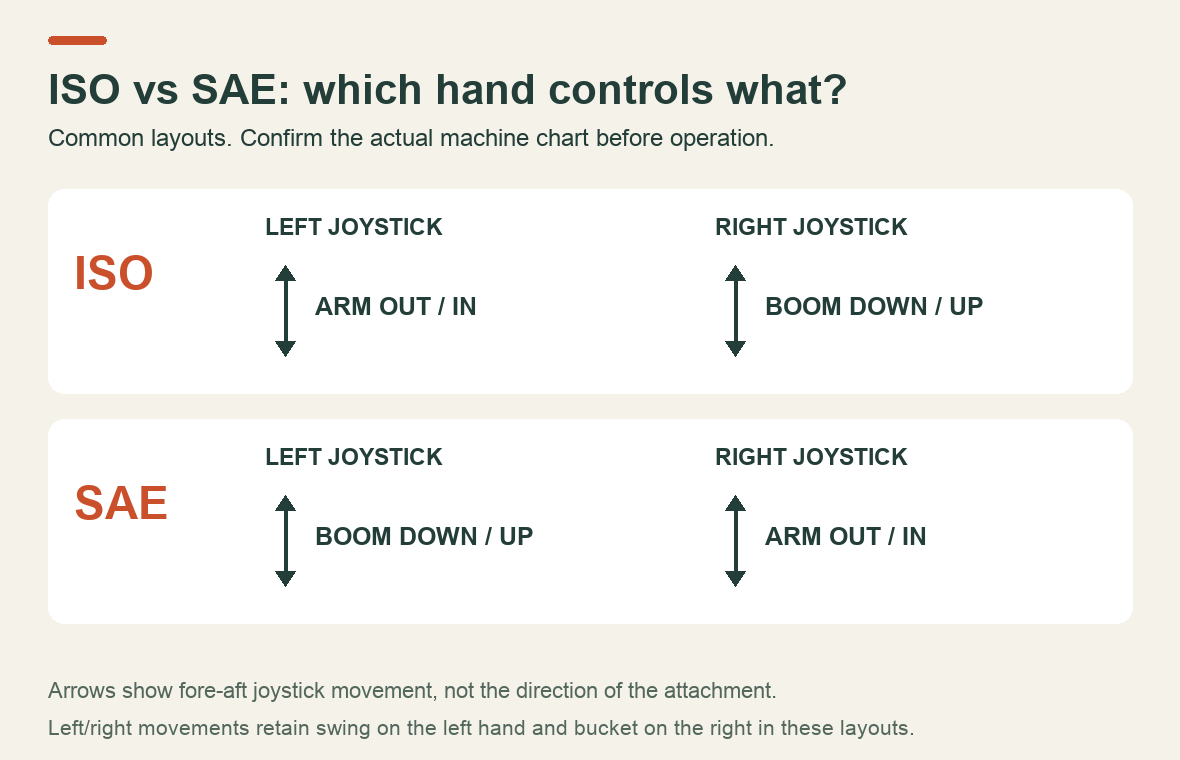
ISO and SAE change which hand controls the boom and arm in the common layouts compared here. The badge on the excavator does not tell you which pattern is currently selected. This explanation helps an already trained operator check a machine; it is not operating training.
What changes between ISO and SAE?
The boom is the main section attached to the machine. The arm, also called the stick or dipper, is the next section toward the bucket. Confusing those names makes a control description surprisingly easy to misread.
| Joystick movement | Common ISO layout | Common SAE layout |
|---|---|---|
| Left joystick, forward/back | Arm out/in | Boom down/up |
| Right joystick, forward/back | Boom down/up | Arm out/in |
| Left joystick, left/right | Upper structure swings left/right | Upper structure swings left/right |
| Right joystick, left/right | Bucket curls/dumps | Bucket curls/dumps |
These paired functions also appear in the TPSS chart in Kubota's U35-4 operator's manual, under its Pattern A and Pattern B labels. The table above translates the functions into the common ISO/SAE comparison; it does not prescribe a selector position.
Kubota's U17-3 brochure describes TPSS, its Two Pattern Selection System, as allowing selection between ISO and SAE. Use the machine's own control chart to confirm the installed arrangement. Do not treat the comparison above as a replacement decal or instructions for an altered machine.
A real manual example: U17-3 Pattern A and Pattern B
The Kubota U17-3 operator's manual, in its TPSS and attachment-control sections on printed pages 31–32, uses Pattern A and Pattern B. In that edition, A assigns boom movement to the left lever and arm movement to the right; B assigns arm movement to the left and boom movement to the right. Swing and bucket functions remain on their respective hands. Those assignments correspond to the common SAE and ISO layouts above.
Kubota tells the operator to study both patterns, select the familiar one and become familiar with it by operating slowly. Follow the full manual and machine markings for the selection procedure. A lever position remembered from another excavator is not enough evidence to change this one.
You can also read the manufacturer-authored U17-3 manual reproduced on Manualzz. Check the edition and machine applicability; a document sharing “U17” in its title is not automatically identical to the one supplied with your excavator.
Pattern selection and hydraulic isolation do different jobs
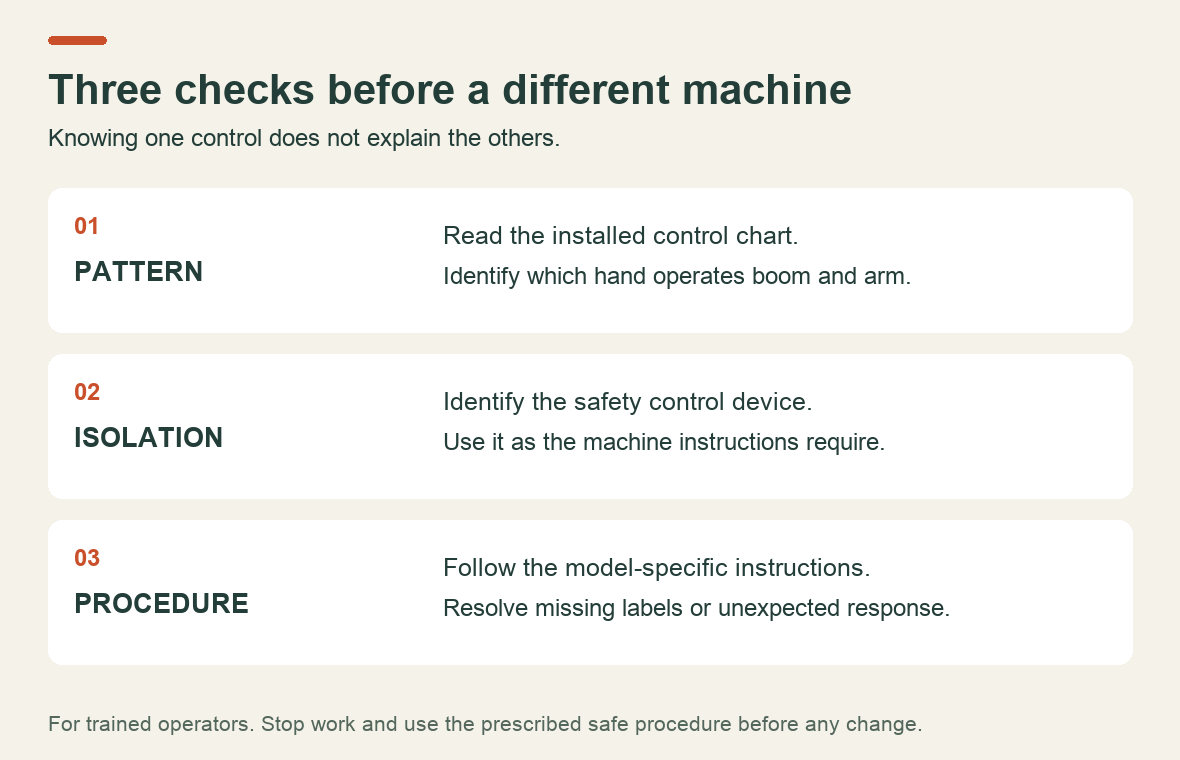
A pattern selector changes which control commands a function. A safety control lever or isolation device is used to prevent unintended operation in the circumstances specified by the manufacturer. Identifying one does not establish how the other works.
The UK's HSE safety bulletin on excavator isolation describes a fatal incident in which an operator inadvertently contacted a joystick while leaning out to communicate. It stresses correct use of isolation devices and communication before people approach. That is relevant even when the operator knows the selected pattern perfectly.
Before any pattern change, stop work and use the machine's prescribed safe parking and shutdown procedure. Do not move a selector while operating. Follow the applicable instructions for attachment position, engine state and any selector locking arrangement. If those instructions or labels are missing, resolve that before using the machine.
Make the operator handover specific
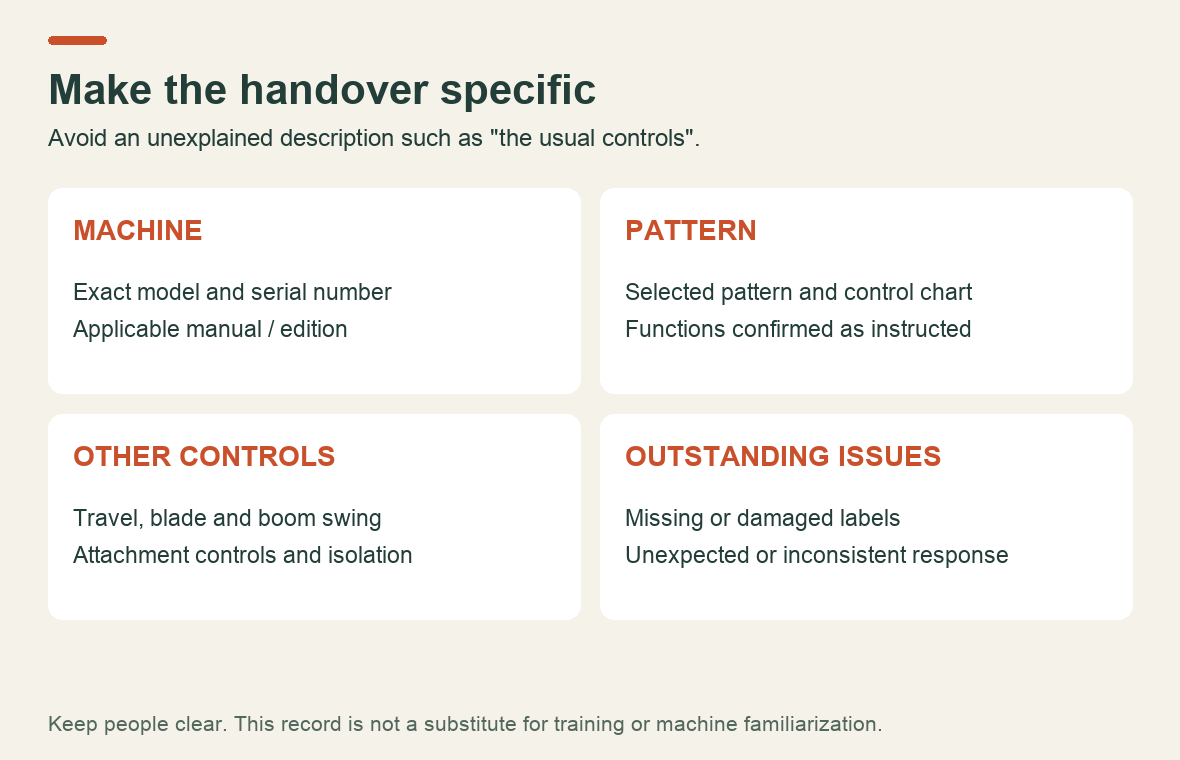
“It has the usual controls” is a poor handover. A better record identifies the machine, selected pattern, supporting manual or decal, and any outstanding concern. For hired equipment, ask for that information before the machine starts work.
HSE's excavator safety overview calls for trained, competent operators and separation of people from excavators. A familiarization check therefore needs an appropriate clear area and the manufacturer's procedure, not a demonstration with somebody standing beside the bucket.
Treat the following as a suggested handover note. It does not replace the required training or site checks.
| Record | A useful question |
|---|---|
| Machine identity | Which exact model and serial number is this? |
| Selected pattern | What does the machine's control chart call it? |
| Confirmation | Has the trained operator checked the functions as instructed? |
| Other controls | Are travel, blade, boom swing and attachment controls understood? |
| Outstanding issue | Is any label missing, or any response inconsistent with the chart? |
Photograph the control chart while the machine is safely shut down if you need to discuss it with a workshop. Include the whole chart and its position, rather than sending a cropped letter A or B with no context.
When the response does not match the chart
Stop using the machine if the controls respond inconsistently or do not match the applicable markings. Do not move hydraulic hoses to imitate a preferred layout, bypass an isolation device, or continue digging to see whether you get used to an unexplained response. Report what command produced what movement, without declaring a failed valve from that observation alone.
Byte Market's Kubota U17 and U17-3 workshop manual, publication 97899-61970 lists a TPSS valve section specifically marked PP-version only. That limitation matters when choosing repair documentation. Confirm the model, version and serial applicability before buying it for a control-system investigation.
Use the operator's manual to establish intended behavior and the applicable workshop documentation for qualified service. At handover, the useful result is simple: the next operator knows what each control will do before the bucket moves.
Recent Post
-
Why a Kubota Manual May N...
16 Sep, 2026
-
Kubota Tractor Won’t Star...
16 Sep, 2026
-
Kubota DPF Light Flashing...
18 Sep, 2026
-
Kubota Tractor Overheatin...
21 Sep, 2026
-
Kubota Hydraulic Couplers...
22 Sep, 2026
-

Kubota UDT vs Super UDT2:...
23 Sep, 2026
-
Kubota 3-Point Hitch Won'...
24 Sep, 2026
-
Kubota Excavator Track Te...
25 Sep, 2026
-
New Holland 540 vs 540E P...
28 Sep, 2026
-
Kubota BX Mower Cutting U...
29 Sep, 2026
-
Kubota Excavator Controls...
30 Sep, 2026