Kubota BX Mower Cutting Unevenly? Check the Deck Before Buying Blades
Kubota BX Mower Cutting Unevenly? Check the Deck Before Buying Blades
One side of the lawn looks shorter after every pass. Or the cut looks fine on the flat but leaves bare patches over a rise. Both get described as an “uneven cut,” yet they are different complaints. Before ordering blades for your Kubota BX, identify the pattern and write down which mower deck is actually fitted.
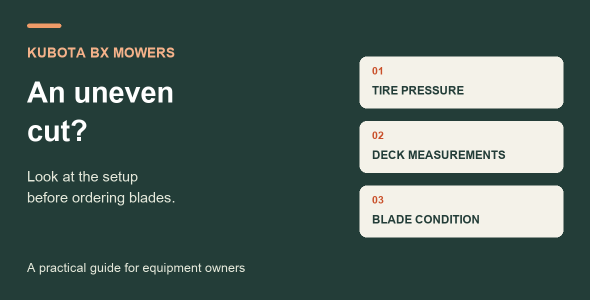
Start with tire pressure, deck setup and the condition of the cut. A tractor model alone is not enough to choose a leveling procedure. The mower has its own model number, adjustment points and instructions.
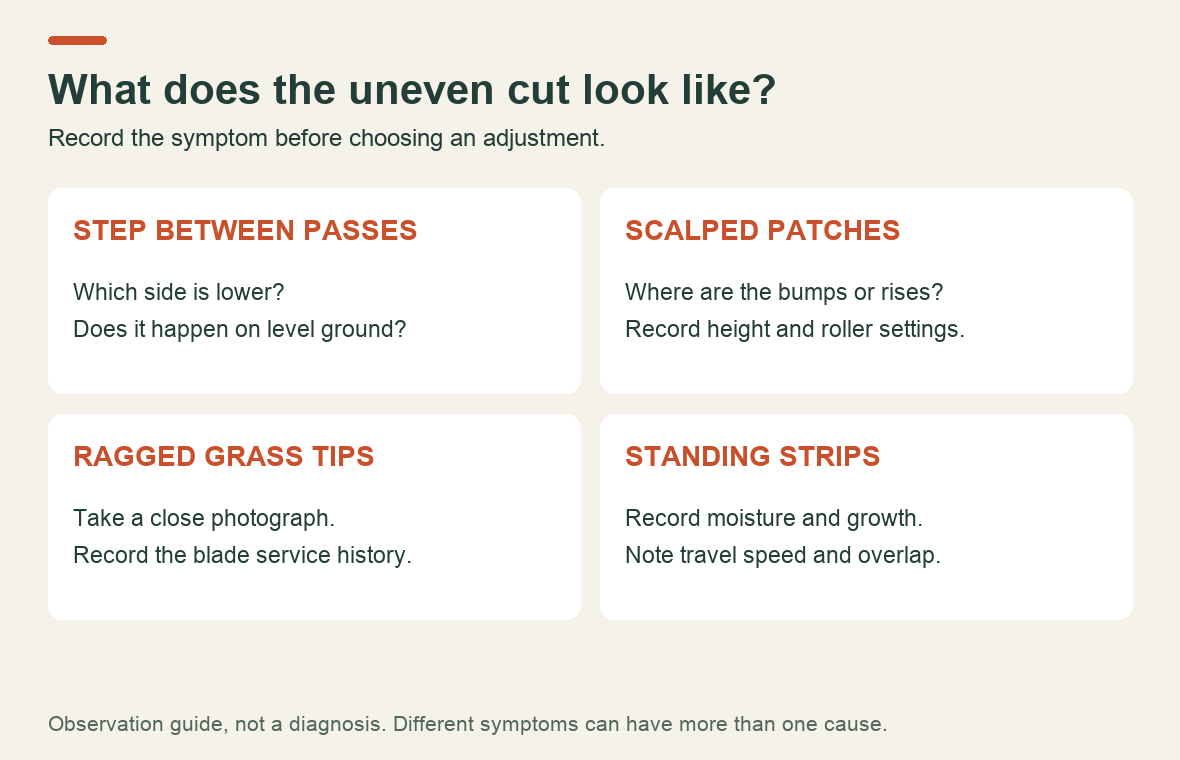
Describe the cut before changing anything
Take a photograph of the result and note whether the problem appeared after deck installation, blade work or a change in mowing conditions. That history gives the next inspection a purpose.
| What you see | What to record first | What the observation does not prove |
|---|---|---|
| A repeatable step between passes | Which side is lower and whether it happens on level ground | That the blades need replacing |
| Short patches over bumps | Terrain, height setting and roller positions | That the whole deck is permanently tilted |
| Ragged grass tips | A close photograph of the grass and the blade service history | That changing the height dial will help |
| Standing strips or clumps | Grass moisture, growth, travel speed and overlap | That one spindle has failed |
This is a recording guide, not a diagnosis from the appearance of the lawn alone. Avoid changing several adjustments together: you lose the comparison that tells you which change helped.
Check the tires before leveling the deck
Kubota's mower preparation and blade maintenance guide identifies incorrect tire inflation as a cause of poor cut quality. Check the pressures against the tractor instructions for the tires fitted. Do not invent one pressure for all four tires.
A useful order is to record the pressures, correct them, then begin the specified deck checks. Otherwise, you may adjust the deck around a tire problem and have to redo the work when the tire is inflated correctly. Write the before-and-after readings on the same sheet as your deck measurements.
Use the mower's measurements, not the edge of its shell
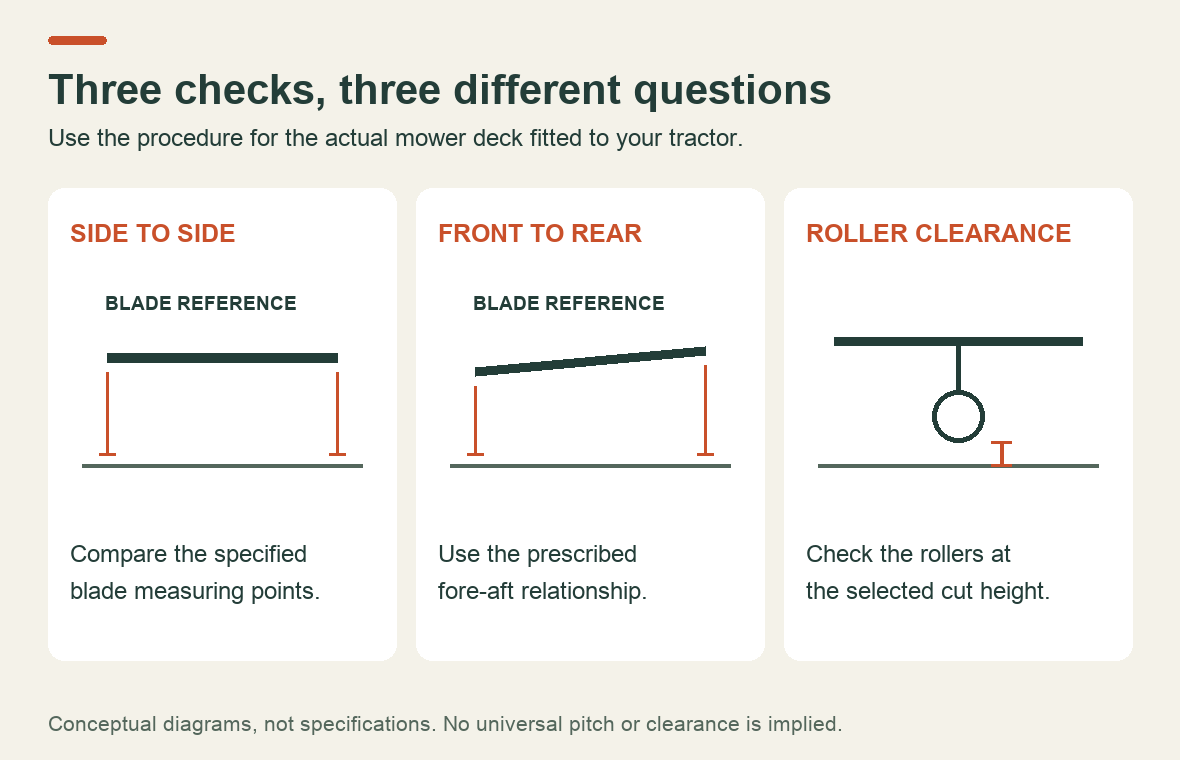
The Kubota RCK60B-23BX and RCK54-23BX operator's manual, reproduced on Manualzz, checks the outside blade tips against a level surface, with the blades oriented across the tractor. Its left-to-right difference is less than 3 mm. That specification belongs to the stated procedure, not every BX deck.
It separately covers front-to-rear adjustment, roller clearance and a self-balance linkage adjustment for the RCK60B-23BX only. Turning the height dial does not perform these checks.
Before adjustment: park on a firm, flat, level surface, set the brake, stop the engine, remove the key and wait for the blades to stop. Follow the complete procedure, blade-handling precautions and support instructions. Never reach under a deck supported only by hydraulics.
When blade condition deserves attention
Look closely at the grass, not just the overall mowing pattern. Kubota's blade maintenance guidance connects shredded or jagged grass tips with blades needing attention. It also calls for checking blade condition and balance, and cleaning grass and mud from the deck before blade work.
If the complaint started immediately after blades were serviced, include that in the inspection. Check the applicable assembly instructions and part identification before another mowing trial. “New” describes when a part was fitted; it does not establish that it is the correct part or that its installation matches the manual.
Stop mowing if there is abnormal vibration or visible damage. Have the blade assembly and related components inspected before continuing. Do not use repeated test cuts to investigate a machine that is visibly damaged.
Make the next comparison useful
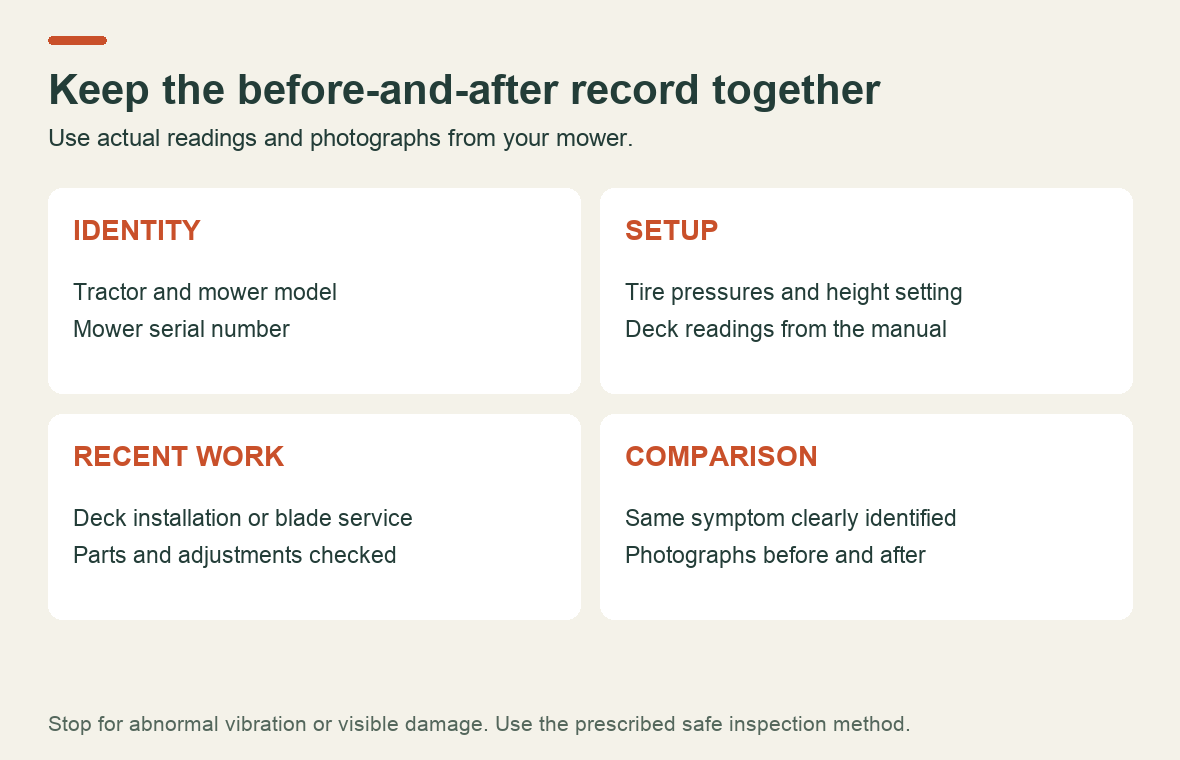
Once inspection and any required service are complete, keep a short comparison record. Use it to avoid a conversation that starts and ends with “it still cuts badly.”
| Record | Example of a useful entry |
|---|---|
| Equipment | Tractor model, mower model and mower serial number |
| Starting complaint | Lower strip on the same side of each pass |
| Conditions | Flat test area; grass dry; height setting recorded |
| Work completed | Pressures checked; deck measurements recorded; blade inspection completed |
| Result | Photograph of the new cut, with the same side identified |
These are example entries, not a claimed repair case. Keep the actual numbers from your machine. If a workshop becomes involved, this record is more useful than a list of parts already replaced.
Which manual helps with a BX mower problem?
Use the operator's manual for routine setup and the workshop manual when inspection leads to component service. Byte Market's BX1860, BX2360 and BX2660 workshop manual, publication 9Y111-01951 also lists the RCK54-23BX and RCK60B-23BX among its covered mower models. Check both your tractor and deck against that listing before buying.
The operator-manual example above is from an edition identifying the BX2350D as its tractor application. Its measurements illustrate why the deck procedure matters; they do not establish compatibility with every tractor in the workshop-manual listing. If the documents or fitted equipment do not agree, resolve that mismatch before adjusting anything.
Recent Post
-
Why a Kubota Manual May N...
16 Sep, 2026
-
Kubota Tractor Won’t Star...
16 Sep, 2026
-
Kubota DPF Light Flashing...
18 Sep, 2026
-

Kubota Tractor Overheatin...
21 Sep, 2026
-
Kubota Hydraulic Couplers...
22 Sep, 2026
-

Kubota UDT vs Super UDT2:...
23 Sep, 2026
-
Kubota 3-Point Hitch Won'...
24 Sep, 2026
-
Kubota Excavator Track Te...
25 Sep, 2026
-

New Holland 540 vs 540E P...
28 Sep, 2026
-
Kubota BX Mower Cutting U...
29 Sep, 2026
-

Kubota Excavator Controls...
30 Sep, 2026