New Holland Water in Fuel Warning: What to Check Before Replacing Parts
New Holland Water in Fuel Warning: What to Check Before Replacing Parts
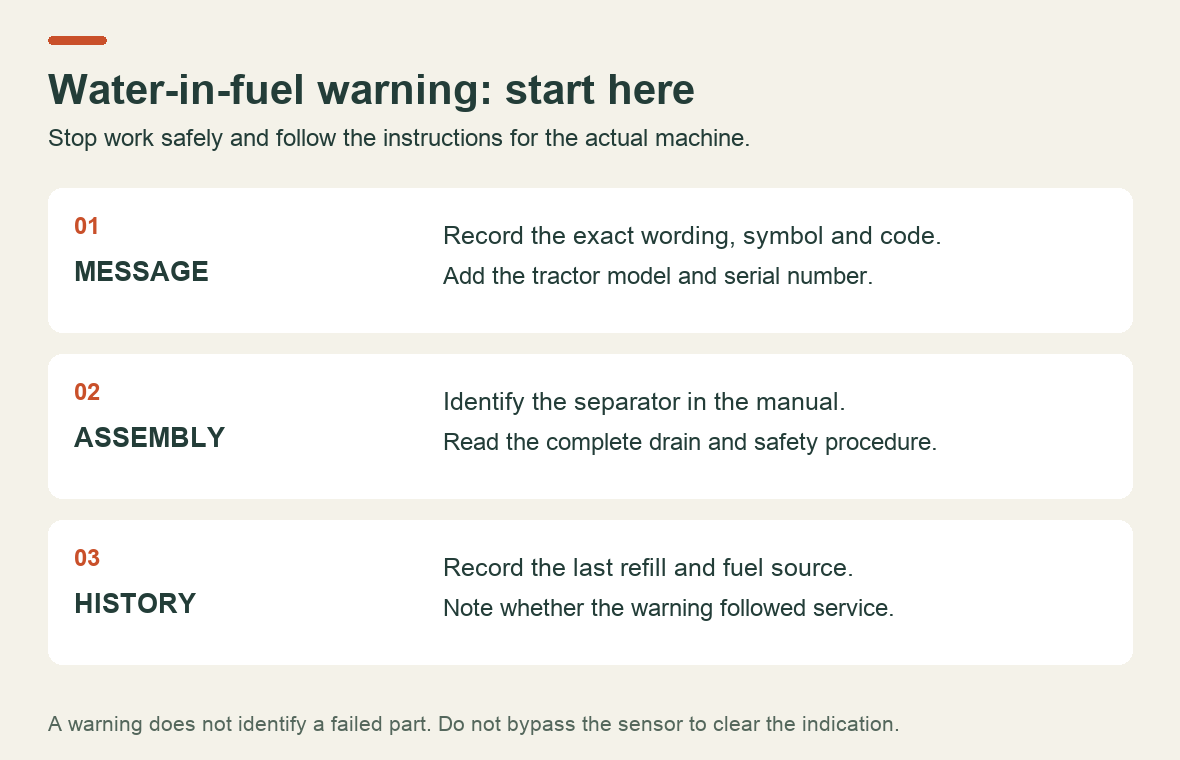
A water-in-fuel warning appears just after a refill. The tractor may still sound normal, which makes it tempting to finish the job and deal with the light later. The useful first question is what the warning instructions require on this model, not which sensor to order.
Take the warning seriously, stop work safely and follow the operator's manual for the fuel-water separator. Do not assume normal engine behavior proves the fuel is acceptable. Equally, a warning by itself does not establish that an injector, pump or sensor has failed.
Identify the message before opening the fuel system
Photograph or write down the exact symbol, wording and any code. Include the model and serial number when looking up its meaning. A remembered description such as “the yellow fuel light” may point to the wrong instruction.
New Holland's T6020 Delta operator's manual, reproduced on Manualzz, gives a concrete example on printed page 4-13. When the indicator signals water in the sedimenter, it calls for the filter-and-sedimenter assembly to be drained immediately. The procedure includes cleaning the work area, handling the sensor connection, collecting the drained liquid and reconnecting the sensor after closing the drain.
That sequence belongs to the illustrated assembly. It is not a universal instruction to turn a particular knob or unplug a wire on every New Holland tractor. Find the matching diagram and read the complete procedure before touching the system. Use the specified shutdown precautions and keep ignition sources away from fuel.
Why draining the bowl does not prove the whole tank is clean
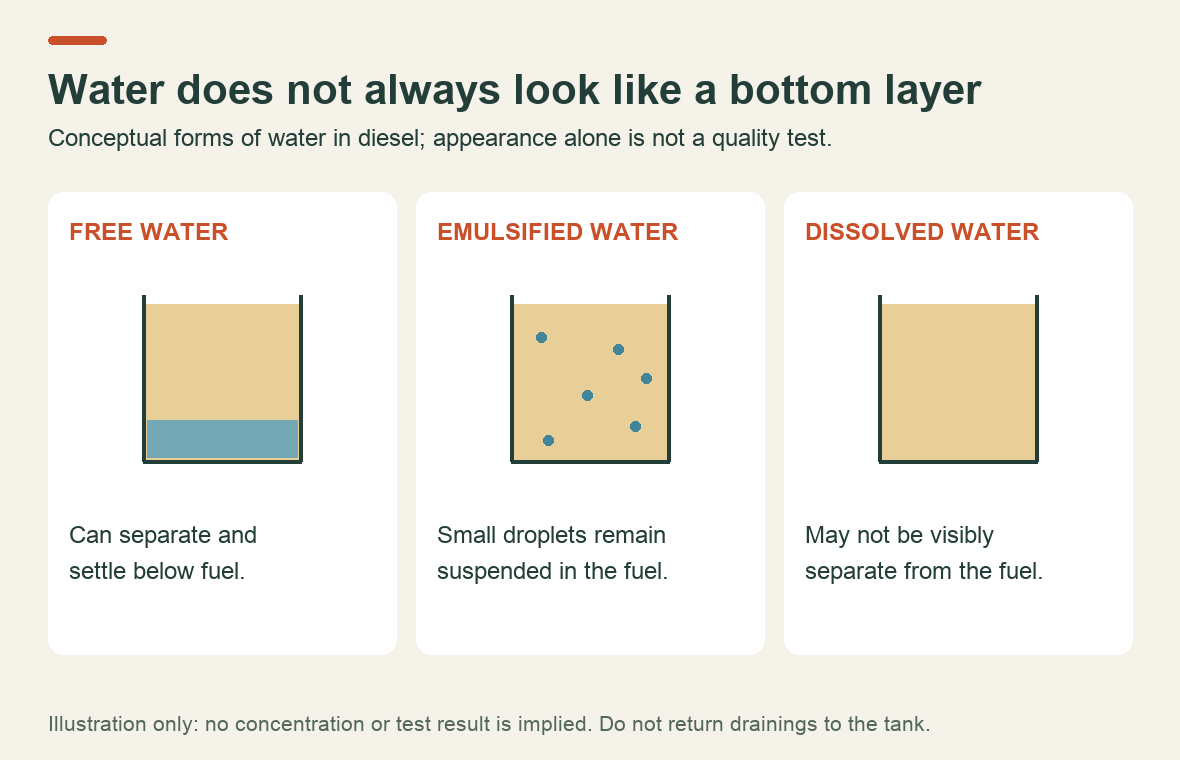
Donaldson's technical explanation of water in diesel distinguishes three forms. Free water separates and settles; emulsified water remains as small suspended droplets; dissolved water is not visible. It also identifies several entry routes, including fuel delivery, condensation and poorly sealed openings.
A drain sample can therefore tell you something about the liquid collected at that point, without certifying all the fuel upstream. If water keeps returning, the next question is where it is coming from. Continuing to drain the separator without investigating the supply can turn the same complaint into a daily routine.
Do not pour drained liquid back into the tank. Collect it as the manual requires and arrange proper disposal. If a workshop or fuel supplier needs a sample, ask for its sampling instructions so the container and collection method do not compromise the result.
Draining, changing a filter and bleeding are different jobs
Draining removes collected liquid from the separator's drain point. Filter replacement renews the specified element. Priming or bleeding deals with air introduced into the fuel supply during applicable service operations. One task does not automatically complete the others.
The T6020 manual treats separator draining separately from filter replacement and fuel-system bleeding. Use the correct procedure for the work actually done. Do not extend its instructions to another injection-system design, and do not loosen high-pressure injection pipes as a casual bleeding method.
There is a similar distinction in New Holland's Performance Tips for TG and TJ Series Tractors, hosted on Manuals+. It discusses water-separator draining alongside, but separately from, engine fuel-filter replacement intervals. A filter that is not yet due for replacement does not cancel the need to respond to a water warning.
Use the timing of the warning to guide the next question
The following observations are useful to pass to a workshop. They suggest questions to investigate, not conclusions about which part has failed.
| What happened | Useful next question |
|---|---|
| Warning began soon after refueling | Which supply, delivery or portable container was used? |
| Warning returns after the prescribed draining procedure | Is contamination returning, and has the warning circuit been checked? |
| Warning appeared immediately after filter service | Was the correct assembly fitted and the prescribed reconnection completed? |
| More than one machine is affected after using the same supply | Should that shared supply be held for assessment before further use? |
If the warning persists, stop guessing and arrange assessment. Do not bypass the sensor to make the indication disappear. A cleared display and an identified, corrected cause are different results.
For recurring contamination, include the storage and dispensing system in the investigation. Record which tank or can supplied the fuel, recent deliveries, and any known cap or seal damage. Have suspect fuel assessed rather than blending it into another machine's tank.
A short record makes workshop help more useful
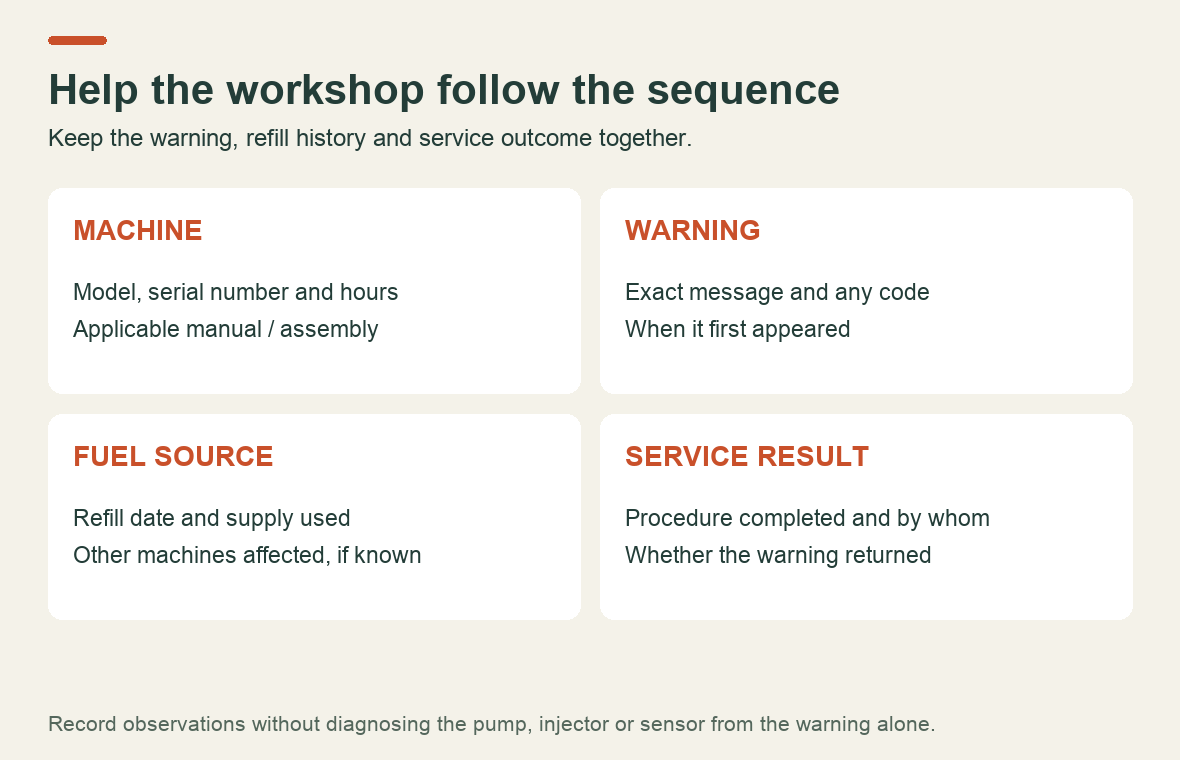
Keep the warning photograph, hour-meter reading, refill date and source together. Add what the operator's manual instructed, what service was completed, and whether the warning returned. Record observations plainly: “separate liquid layer seen in collected sample” is more useful than guessing its composition or the condition of the injection pump.
For TG210, TG230, TG255 and TG285 owners, Byte Market lists the New Holland TG Series Repair Manual, publication 87367126. The listing identifies separate electrical schematics before and from PIN JAW129992. That distinction matters if an investigation reaches wiring checks. Confirm the relevant coverage and serial applicability before buying; the T6020 draining example above is not a TG procedure.
Use the operator's manual for the immediate maintenance response and the matching repair information when further testing is needed. The aim is to establish why the warning appeared and whether the fuel supply is fit for use, rather than replacing a part merely because it is attached to the separator.
Recent Post
-
Why a Kubota Manual May N...
16 Sep, 2026
-
Kubota Tractor Won’t Star...
16 Sep, 2026
-
Kubota DPF Light Flashing...
18 Sep, 2026
-

Kubota Tractor Overheatin...
21 Sep, 2026
-
Kubota Hydraulic Couplers...
22 Sep, 2026
-
Kubota UDT vs Super UDT2:...
23 Sep, 2026
-
Kubota 3-Point Hitch Won'...
24 Sep, 2026
-
Kubota Excavator Track Te...
25 Sep, 2026
-
New Holland 540 vs 540E P...
28 Sep, 2026
-
Kubota BX Mower Cutting U...
29 Sep, 2026
-

Kubota Excavator Controls...
30 Sep, 2026
-
New Holland DEF Storage:...
01 Oct, 2026
-
Kubota Air Filter: When t...
02 Oct, 2026
-
Kubota SVL Standard vs Hi...
06 Oct, 2026
-
New Holland Water in Fuel...
07 Oct, 2026