Kubota Tractor Overheating? What to Check Before Replacing the Thermostat
Kubota Tractor Overheating? What to Check Before Replacing the Thermostat
The temperature climbs halfway through mowing. You stop, look through the grille and see nothing obviously wrong. A thermostat is an easy part to suspect, but the symptom does not yet tell you which part has failed.
Begin with the machine's overheating instructions, then inspect airflow, coolant and the fan drive once it is safe. Kubota's M8540/M9540 operator's manual lists overload, low coolant, fan-belt problems, obstructed radiator or grille screens and a corroded coolant path among possible causes. The thermostat should not be the only item on your list. See the engine troubleshooting table in the Kubota manual.
If it is overheating now
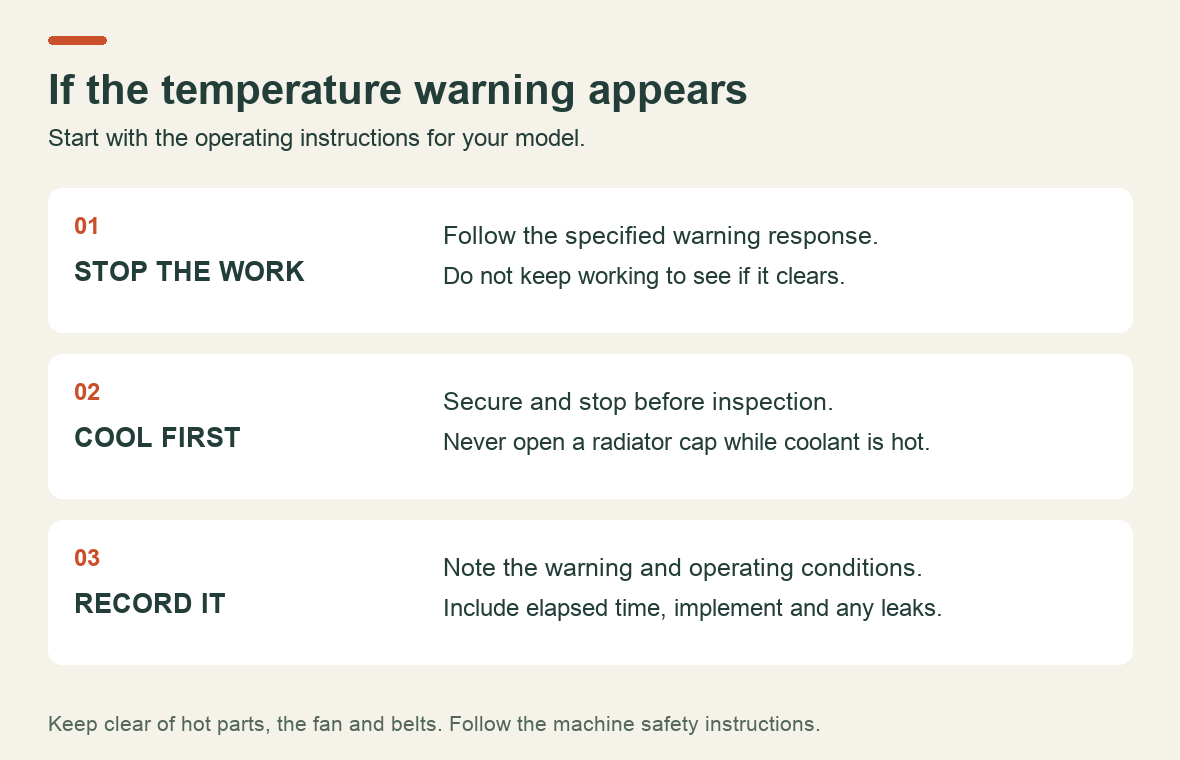
Stop the work and follow the response specified for the warning on your model. Do not continue mowing to see whether the temperature will eventually settle. Steam or an obvious coolant leak is a reason to stop operating and arrange inspection, not to attempt another loaded run.
Before hands-on inspection, park safely, stop the engine, remove the key and allow hot components to cool. Keep clear of the fan and belts. Never remove a radiator cap while the coolant is hot. Kubota includes this warning in its coolant-checking instructions in the manual linked above.
Record the warning before you forget it: gauge position, lamp or message, operating time, implement and whether coolant escaped. “Hot after twenty minutes of mowing” gives a technician a better starting point than “needs a thermostat.”
A clean grille does not finish the airflow check
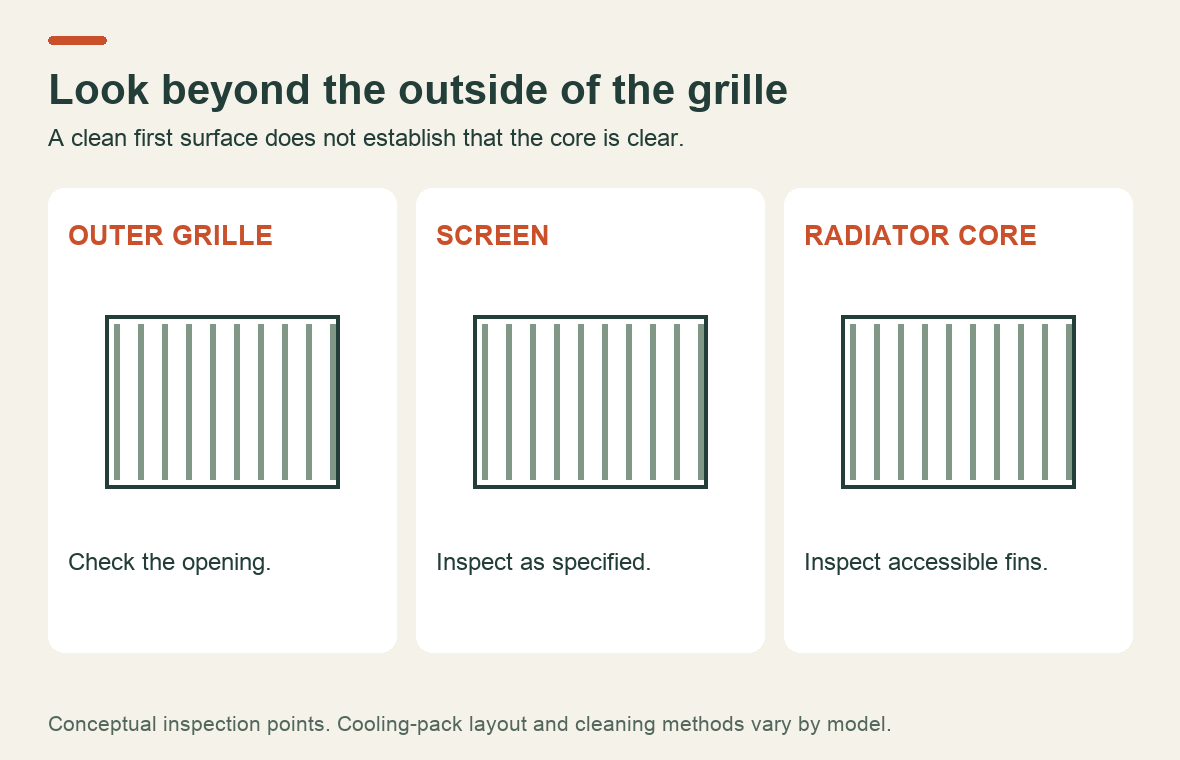
Look at the areas your manual identifies for cleaning, rather than judging the entire cooling system from the outside of the hood. Kubota's maintenance check points include radiator screen and core cleaning, as well as panel and hood screens. These are separate inspection points.
For a tractor used around dry grass, take a light and inspect the accessible screen and core with the engine stopped. On machines with several heat exchangers, check the accessible spaces the manual directs you to inspect. Do not assume the radiator is clear because the first surface looks clean.
Use the model's cleaning method and access instructions. Do not guess a compressed-air pressure, force a nozzle against delicate fins or dismantle a cooler assembly just to reach debris. If safe access is unclear, that is the point to get the procedure.
Check coolant and the fan drive when cold
Check the prescribed coolant-level points, then inspect for visible leaks and damaged hoses. Do not choose coolant by color alone or guess the mixing ratio from another machine. Use the specification and filling procedure for your tractor. The goal is to establish the condition of the system, not merely to make a low mark disappear.
A level that drops again needs investigation. The Gates cooling-system diagnostic guide treats leaks, trapped air, caps, circulation and other components as separate diagnostic possibilities. It is a general automotive guide; it supports the diagnostic approach, not Kubota-specific settings or repair instructions.
For a belt-driven fan, inspect the stopped belt using the machine's maintenance instructions. Use the specified tension-check method if adjustment is required. “It feels tight enough” is not a measurement, and tightening a belt without the specification is not a useful substitute for one.
Use the pattern to choose the next check
The following observations help organize a service visit. They do not identify a failed component by themselves.
| Observed pattern | Information worth collecting |
|---|---|
| Temperature rises during mowing | Grass and dust conditions, accessible screen condition, implement and operating load |
| Problem began after coolant service | Product used, filling procedure, amount added and any follow-up level check |
| Coolant repeatedly falls below the specified level | Cold readings taken consistently, visible leak locations and photographs |
| Gauge rises unusually soon after a cold start | Exact time, starting conditions and any accompanying warning |
| Temperature rises under heavy work but was previously normal | What changed in the task, setup, maintenance or ambient conditions |
In its M8540/M9540 troubleshooting example, Kubota includes reducing overload among the responses. That does not make a hot gauge normal under hard work. If the warning returns, the observation belongs in the diagnosis rather than becoming an instruction to keep working at a different speed.
When should the thermostat be tested?
When the initial checks have not explained the problem, move to the tests in the applicable workshop manual. A thermostat fault is one possibility; so are problems elsewhere in the cooling system or in temperature indication.
Kubota's Super Mini Series engine manual, troubleshooting section explicitly distinguishes thermostat trouble from gauge or sensor trouble and other overheating causes. This is an engine-family example, not a statement that every tractor uses that engine or shares its settings.
A technician can verify temperature indication and use the correct component tests before ordering parts. Thermostat opening temperature, cap test pressure and belt tension must come from the relevant documentation. Do not replace those values with a generic internet number, and do not remove the thermostat as an experiment in normal operation.
What to have ready for the workshop
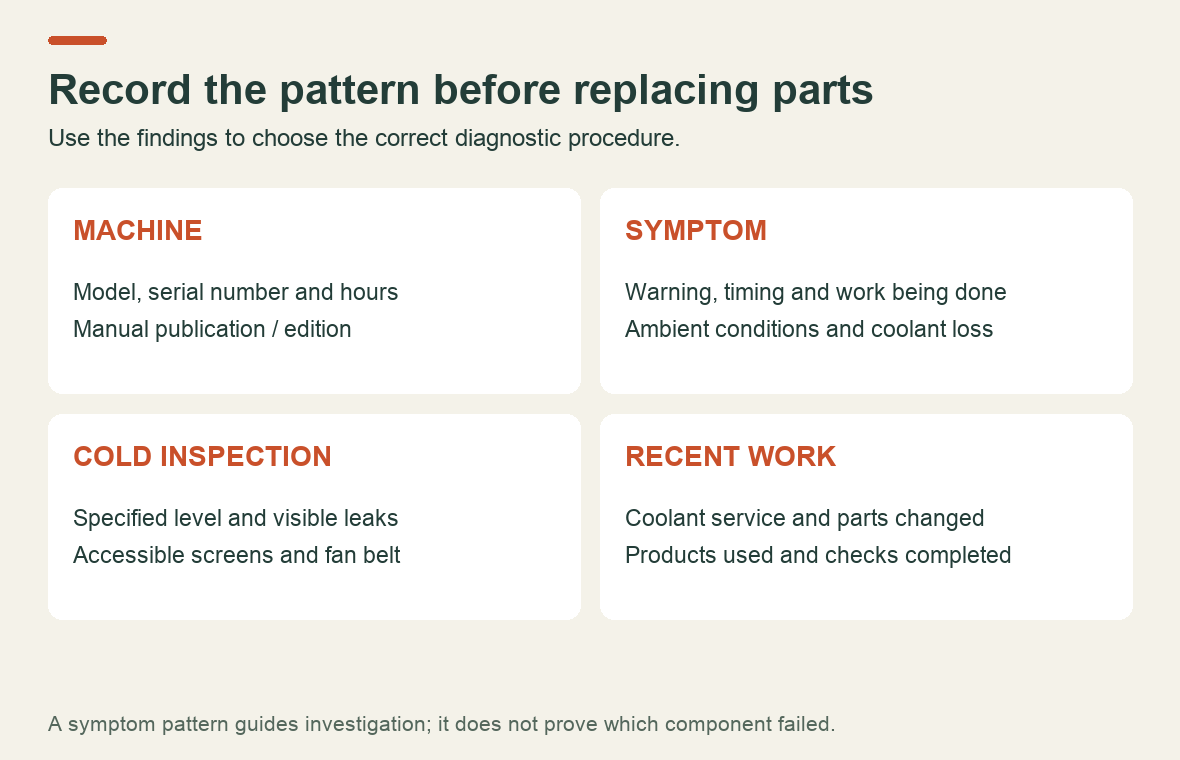
Bring the tractor model, serial number and hours; photographs of the warning and any leaks; the conditions when it happened; and the checks already completed. Include recent cooling-system work, even if it seemed unrelated at the time.
If you maintain an MX5400 or MX6000, the Byte Market workshop manual listing lets you review maintenance, engine and electrical coverage before buying. Match the publication to your machine and check that it contains the procedure you need. The reason to get the manual is to replace guesses with the correct checks and specifications.
After a repair, follow the prescribed verification procedure and record the result. A new thermostat in the housing is evidence that a part was changed; normal operation under the appropriate checks is the evidence that the overheating problem has been resolved.
Recent Post
-
Why a Kubota Manual May N...
16 Sep, 2026
-
Kubota Tractor Won’t Star...
16 Sep, 2026
-
Kubota DPF Light Flashing...
18 Sep, 2026
-
Kubota Tractor Overheatin...
21 Sep, 2026