Kubota HST Tractor Won't Move? What to Check When the Engine Runs
Kubota HST Tractor Won't Move? What to Check When the Engine Runs
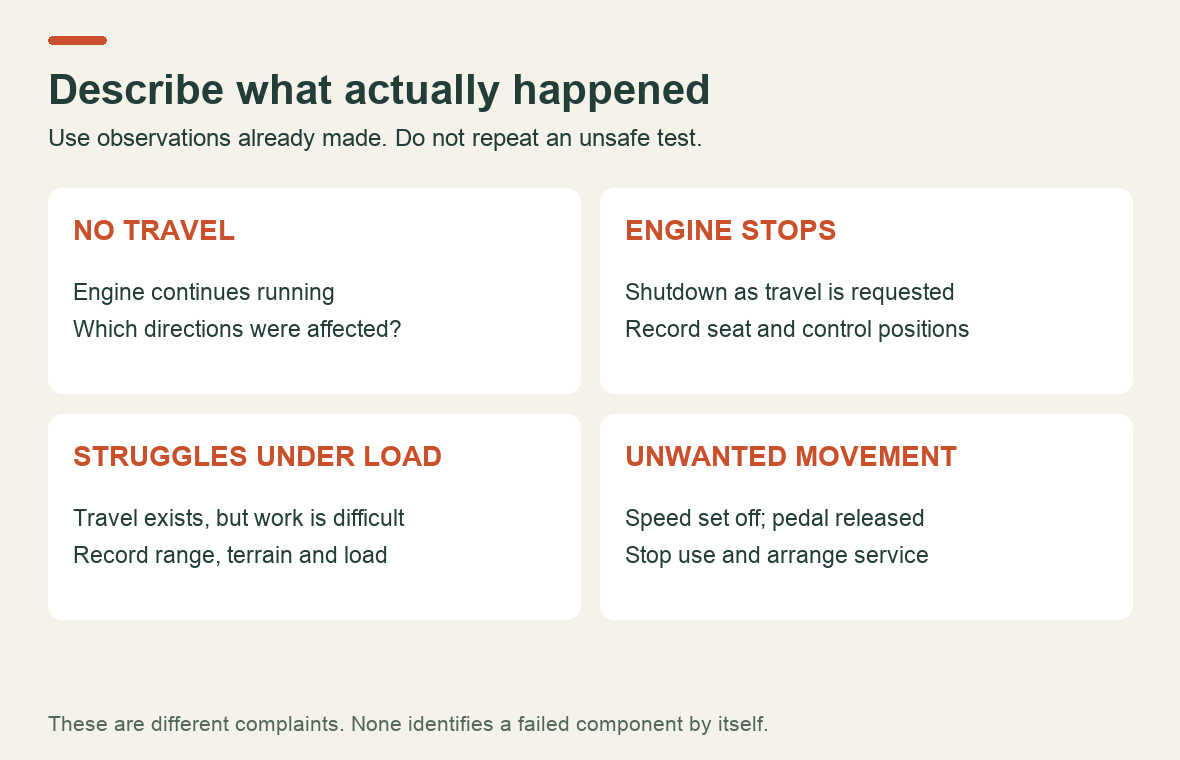
The engine starts normally. You press the travel pedal, but the tractor stays where it is. Before ordering a hydraulic pump, describe exactly what happened: no movement in either direction, movement in only one direction, or an engine that stops when you ask the tractor to move. Those are different complaints.
Start with the selected range, parking brake and travel controls. If those are correctly set and the tractor still will not move, stop repeated attempts and collect the information a workshop needs. This guide covers initial owner checks on hydrostatic tractors, with BX1880/BX2380/BX2680 and B2301/B2601 examples. It does not cover shuttle transmissions or compact track loaders.
First, separate a travel problem from an engine shutdown
Write down what you already observed; do not keep reproducing a fault to fill in every box below. Work on firm, level ground with a clear area. If the tractor has stopped on a slope or in traffic, secure the situation and arrange assistance before troubleshooting.
| What happened | What to record | What it does not establish |
|---|---|---|
| Engine keeps running; no travel | Whether both directions were affected and which range was selected | A failed HST pump |
| Engine stops as the travel pedal is pressed | Seat position, PTO setting and any warning | That the transmission seized |
| Tractor moves but struggles during work | Load, terrain, selected range and whether the problem changes when warm | That it has the same fault as a tractor with no travel |
| Tractor moves with the pedal released and speed set disengaged | The circumstances, without repeating the test | That it is safe to keep using it |
Kubota's B2301/B2601 operator's manual, printed page 24 explains that operator-presence control can stop the engine if the operator leaves the seat with travel commanded. It also describes the speed-set device, which deliberately holds a forward travel setting: distinguish that from uncommanded movement. The page warns against operation with unintended travel on level ground and against adjusting the HST pedal stopper bolts. Do not bypass a seat switch or improvise a pedal adjustment.
Check the range selection before blaming the hydraulics
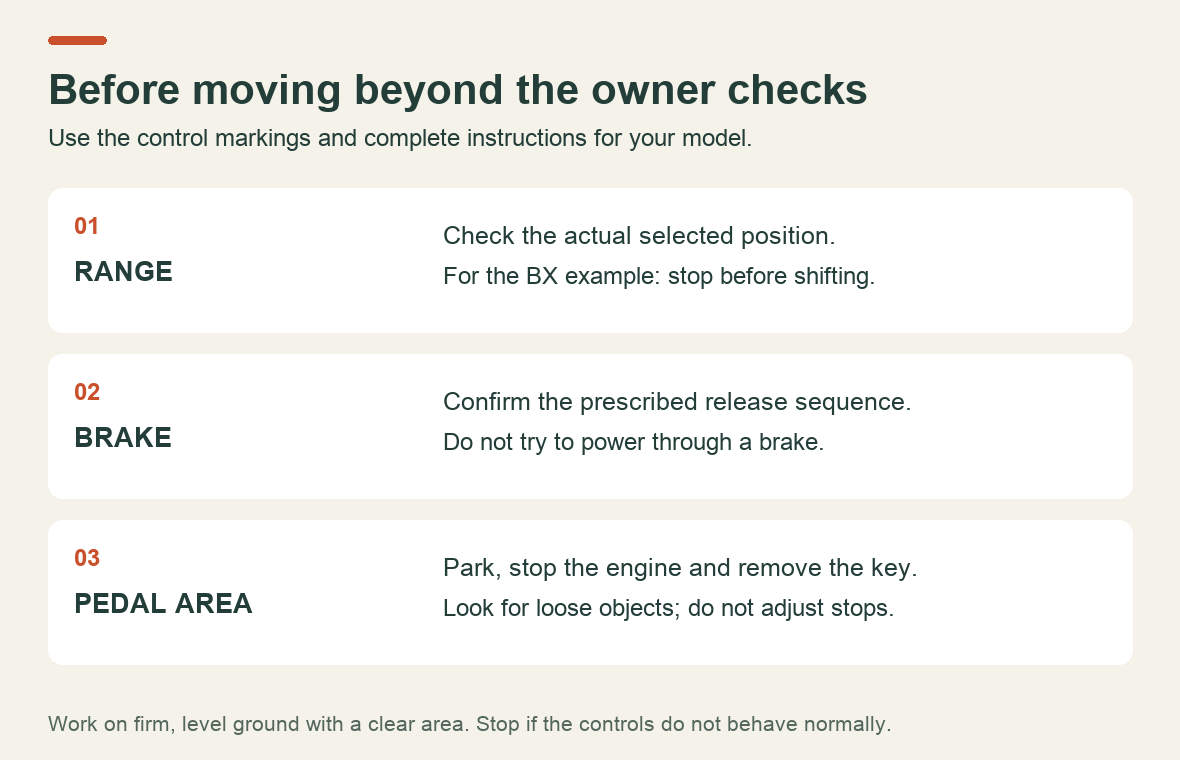
An HST pedal and a range lever do different jobs. Kubota's BX-series brochure specifies a high/low HST transmission for the listed BX models. By comparison, the B01-series information identifies three ranges on the B2301 and B2601. A control layout from another series is a poor troubleshooting shortcut.
For the BX1880/BX2380/BX2680, the operator's manual, printed page 32 shows low, neutral and high positions. It requires the tractor to be completely stopped before changing ranges and says not to force the lever. It also explains the parking-brake release on that page.
Look at the actual markings. Was the lever left in neutral after parking? Is the parking brake still applied? Follow the starting and travel sequence for your model from the operator's seat. If a lever will not engage normally, use the manual's procedure or ask for service; forcing it adds another problem to investigate.
With the machine safely parked, engine off and key removed, look for loose objects around the pedal. Keep hands out of linkages and do not crawl underneath to watch them while someone operates the controls.
Read the oil level correctly, and keep the service history
Kubota includes transmission-oil level, leakage, control operation and abnormal noise in its daily maintenance checks. Use the model's specified parking position and checking method. A dipstick reading taken under the wrong conditions is not a sound reason to add more fluid.
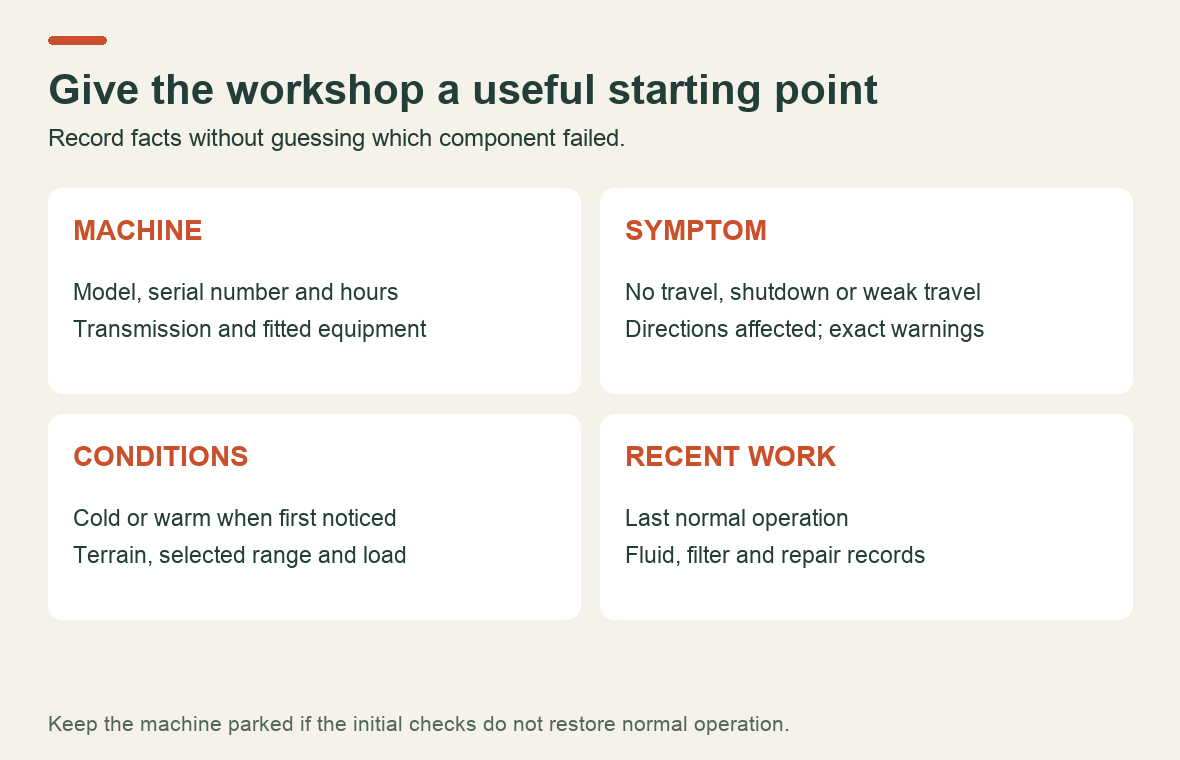
If the fault began after maintenance, put the invoice beside your notes. Record which filter was changed, its part number, the fluid used and the amount added. Tell the workshop whether the tractor travelled normally before the work. A close sequence is worth investigating, but it does not prove the new filter caused the fault.
Do not use an oil change as a diagnostic experiment. Likewise, a loader that still lifts does not give you enough evidence to declare the entire transmission healthy. Record that observation if it is already known; let the service procedure determine which circuit needs testing.
Know when the owner checks are finished
If correct control settings do not restore normal operation, leave the tractor parked for diagnosis. Stop sooner for unexpected movement, a significant leak, a warning requiring shutdown or a new abnormal noise. Do not keep increasing throttle against a tractor that will not travel, open pressurized lines or adjust relief valves to see what happens.
Your next useful step is a short, factual report. “It will not move” leaves a technician with many questions. “BX2380, 420 hours, engine keeps running, no forward or reverse, first noticed after parking overnight” is a much better starting point. That is an example of a report format, not a diagnosis or a real repair case.
Find the service information for the tractor you have
The operator's manual supplies control instructions and routine checks. Further diagnosis may require the transmission and electrical sections of a workshop manual, along with the specified equipment and a competent technician.
Byte Market lists the BX1880/BX2380/BX2680 Workshop Manual, 9Y111-16342 and the B2301/B2601 Workshop Manual, 9Y111-11560. Check the listed models and contents before buying. Bring your symptom record to the relevant procedure; the phrase “won't move” alone cannot identify the part to replace.
Recent Post
-

Why a Kubota Manual May N...
16 Sep, 2026
-

Kubota Tractor Won’t Star...
16 Sep, 2026
-

Kubota DPF Light Flashing...
18 Sep, 2026
-

Kubota Tractor Overheatin...
21 Sep, 2026
-
Kubota Hydraulic Couplers...
22 Sep, 2026
-

Kubota UDT vs Super UDT2:...
23 Sep, 2026
-

Kubota 3-Point Hitch Won'...
24 Sep, 2026
-
Kubota Excavator Track Te...
25 Sep, 2026
-
New Holland 540 vs 540E P...
28 Sep, 2026
-

Kubota BX Mower Cutting U...
29 Sep, 2026
-

Kubota Excavator Controls...
30 Sep, 2026
-

New Holland DEF Storage:...
01 Oct, 2026
-

Kubota Air Filter: When t...
02 Oct, 2026
-

Kubota SVL Standard vs Hi...
06 Oct, 2026
-

New Holland Water in Fuel...
07 Oct, 2026
-

Kubota Loader Float: What...
08 Oct, 2026
-
Kubota HST Tractor Won't...
09 Oct, 2026