Kubota PTO Won't Engage? Check the Selector, Interlocks and Implement
Kubota PTO Won't Engage? Check the Selector, Interlocks and Implement
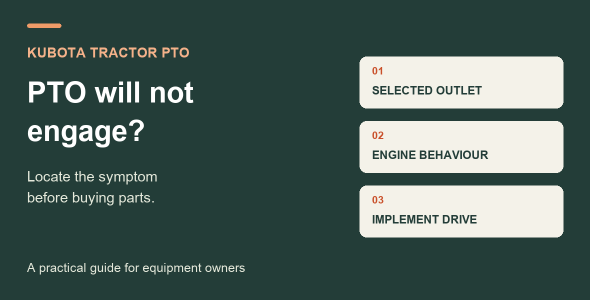
The mower has stopped, but the tractor still runs. Before ordering a PTO switch or clutch, establish what actually stopped: the tractor's power take-off, the implement's driveline, or the engine when you tried to engage it. Those are different starting points.
On a compact Kubota tractor, first check the selected PTO outlet and the engagement control against the operator's manual. If the engine shuts down, check the prescribed operating conditions. If the tractor appears to engage normally but the implement does no work, its driveline protection may need inspection. None of these observations alone proves that a component has failed.
This guide concerns tractor PTOs, with a B2301/B2601 example. A Kubota lawn tractor or zero-turn mower can use different controls and should not inherit the same diagnosis.
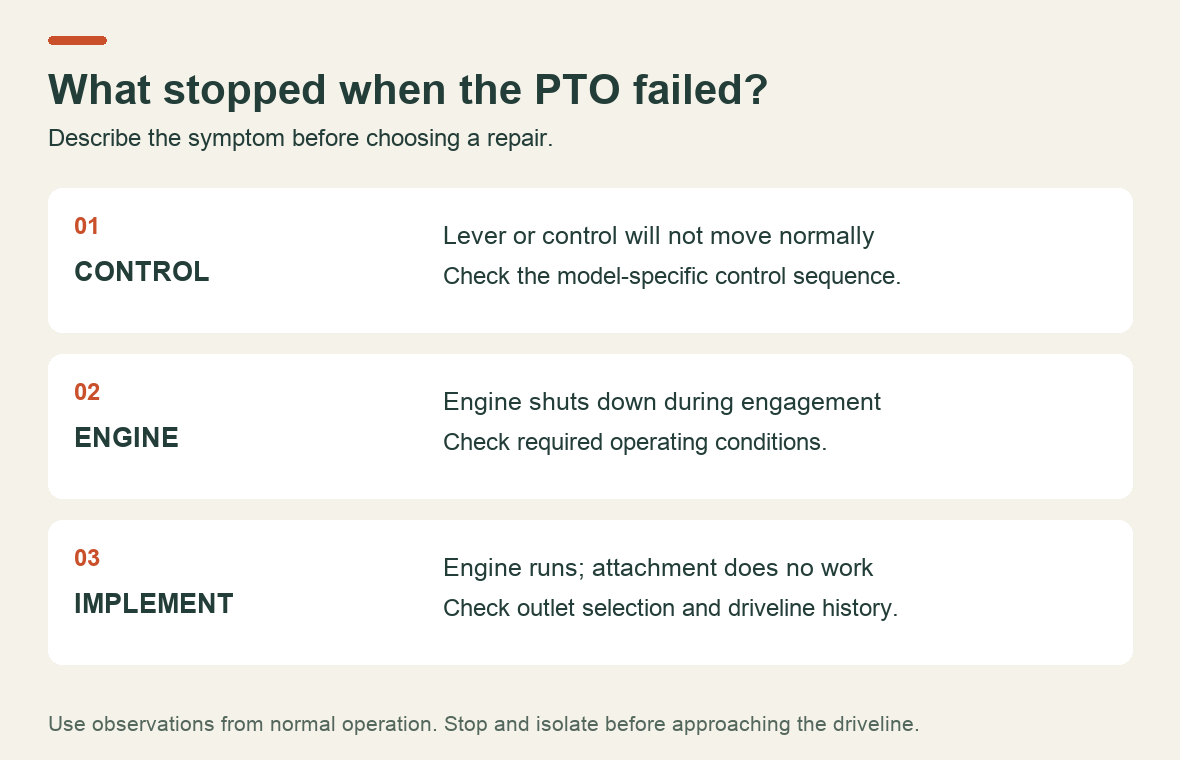
Start with the symptom you can describe
| What happened during normal operation? | Useful next question |
|---|---|
| The engagement control will not move normally | Is the control sequence correct, and is there visible damage or obstruction? |
| The engine stops when PTO is engaged | Were the operator presence and other required operating conditions satisfied? |
| The engine stays running but the attachment does not work | Is the correct outlet selected, and is the implement driveline intact? |
| The implement stopped after striking something | Does it have a shear bolt or slip clutch that needs inspection? |
These are observations to report, not instructions to stand beside a running shaft. Before approaching the driveline, follow the shutdown instructions, remove the key and wait for all movement to stop. The HSE machinery safe-use guidance sets out the Safe Stop approach: parking brake, controls safe, engine stopped and key removed.
A PTO selector is not the same as a PTO clutch control
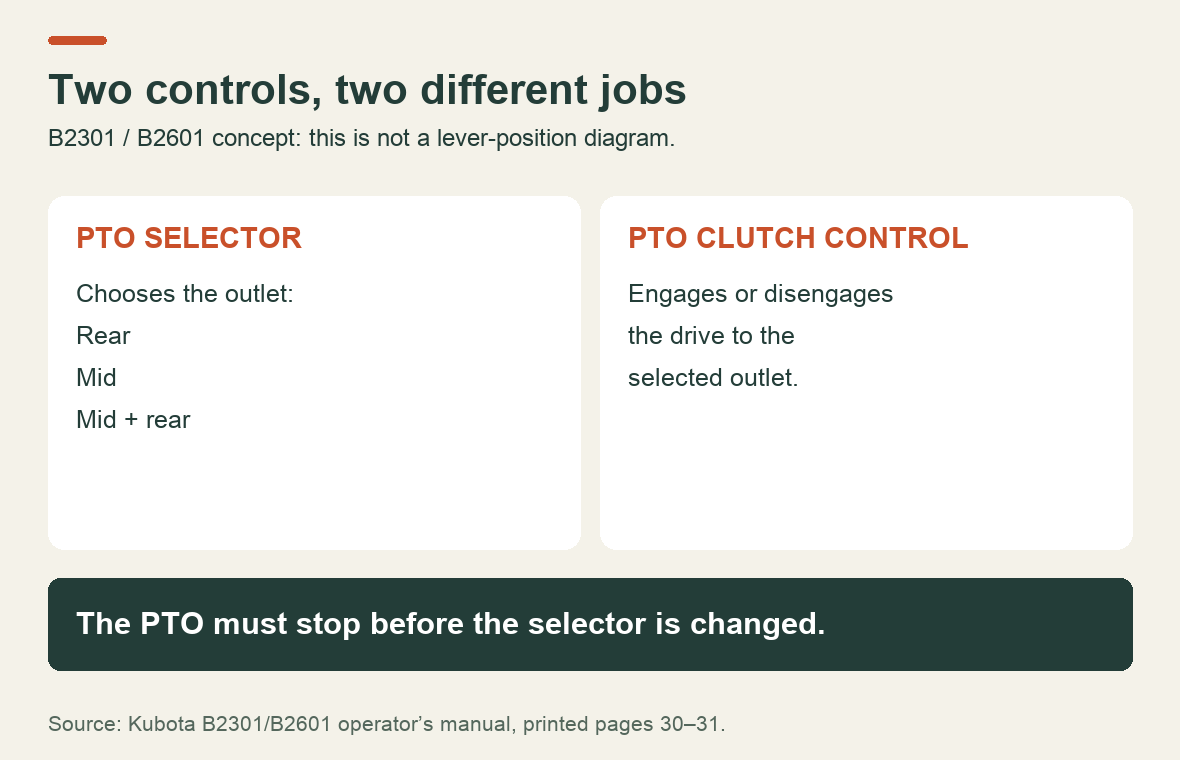
On the B2301 and B2601, the selector chooses rear, mid, or combined mid-and-rear PTO. A separate clutch lever engages or disengages the drive. A selector in the wrong position can therefore send you looking for a fault in the wrong place.
The Kubota B2301/B2601 operator's manual, printed pages 30–31, requires the PTO to stop before changing the selector. For engagement, it calls for low engine speed, followed by the required operating speed; the clutch lever should not be held halfway. Use the actual control markings and procedure on your tractor.
The same manual describes an operator presence shutdown when the operator leaves the seat with PTO engaged, and a separate procedure for permitted stationary PTO work. That exception is another reason a generic “seat switch trick” is poor advice. Do not bypass the switch or improvise the stationary procedure.
If the engine dies, do not begin by replacing the PTO clutch
Write down when the shutdown occurs: immediately as the control moves, when you change position in the seat, or after the implement begins loading the engine. Include any warning displayed. A repeatable shutdown linked to an operating condition is a different complaint from a shaft that never receives drive.
Check the operator's instructions before testing again. If the tractor still shuts down under the required conditions, a technician has a defined symptom to investigate. Replacing a switch on suspicion can leave a wiring, adjustment or unrelated engine problem untouched.
There is no useful universal answer to “where is the Kubota PTO safety switch?” across all models. Record the exact model and use its control layout and electrical information. Do not unplug switches to see which one makes the engine run.
If the implement stopped, inspect its side of the connection
A rotary cutter can stop cutting without the tractor's PTO clutch being the failed part. Some implement drivelines use a shear bolt; others use a slip clutch. Identify which arrangement your attachment actually has before ordering tractor parts.
The Land Pride RCR12 Series operator's manual, under “Driveline Protection” on printed page 34, explains both arrangements. A shear bolt sacrifices itself under overload. Replacing it with a stronger bolt can defeat that protection. The manual also specifies slip-clutch servicing, including run-in after extended storage. Follow the implement's own instructions rather than tightening the clutch until it stops slipping.
With the machine safely stopped, look for an obviously broken protective bolt, a disconnected coupling or damage. If access requires removing a guard, keep the tractor isolated and restore the guard before operation.
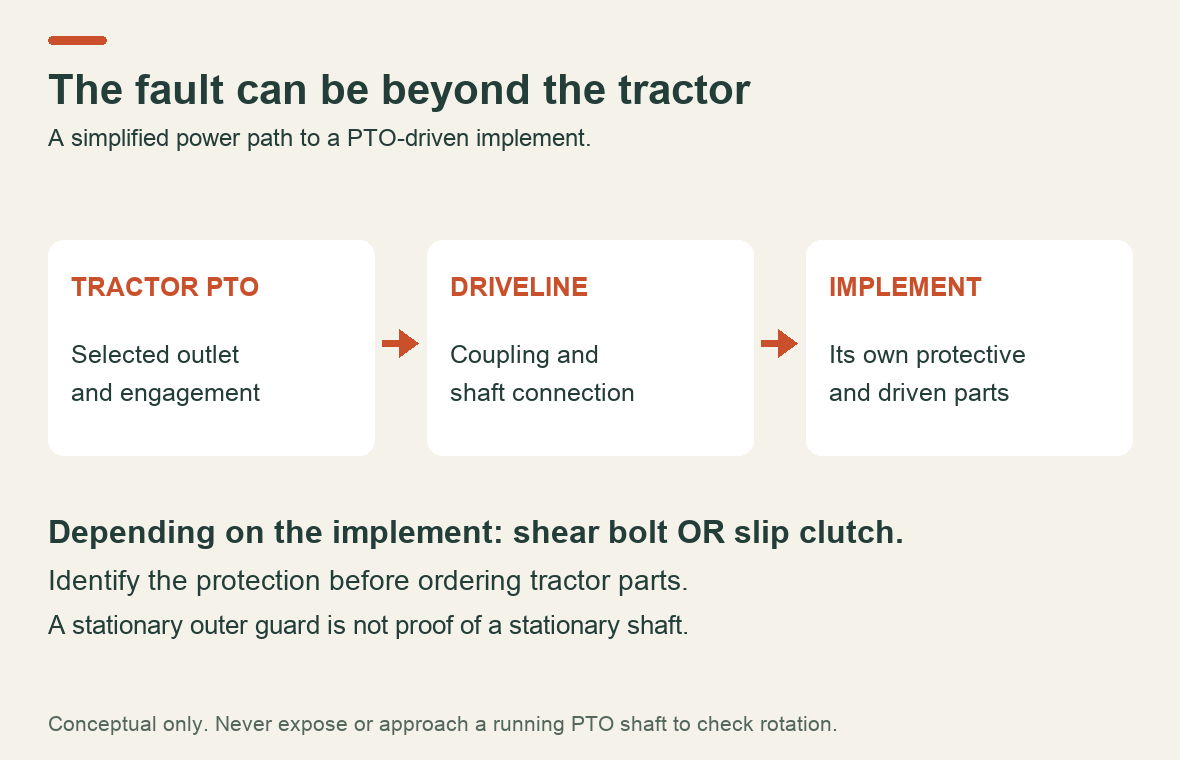
A stationary plastic shaft guard does not mean that the shaft inside it is stationary. The HSE PTO-shaft guidance explains guarding and restraint. Never remove a guard or reach toward a running driveline to confirm rotation.
What to record before arranging a repair
Give the workshop the tractor model, implement model, selected PTO outlet and a plain description of the failure. Add whether the problem began after an impact, attachment change, service or storage. Distinguish “the engine stops” from “the mower blades stop”; that single detail can change the diagnostic starting point.
Do not keep repeating engagement attempts if there is grinding, smoke, damage or unexpected movement. Pressure tests and internal clutch work require the appropriate procedure and equipment.
For the models used here, Byte Market's B2301/B2601 workshop manual listing lets you check the available transmission, hydraulic and electrical coverage before buying. Pair the tractor documentation with the implement manual: the fault can be on either side of the coupling.
Recent Post
-
Why a Kubota Manual May N...
16 Sep, 2026
-
Kubota Tractor Won’t Star...
16 Sep, 2026
-
Kubota DPF Light Flashing...
18 Sep, 2026
-
Kubota Tractor Overheatin...
21 Sep, 2026
-
Kubota Hydraulic Couplers...
22 Sep, 2026
-
Kubota UDT vs Super UDT2:...
23 Sep, 2026
-
Kubota 3-Point Hitch Won'...
24 Sep, 2026
-
Kubota Excavator Track Te...
25 Sep, 2026
-
New Holland 540 vs 540E P...
28 Sep, 2026
-
Kubota BX Mower Cutting U...
29 Sep, 2026
-
Kubota Excavator Controls...
30 Sep, 2026
-
New Holland DEF Storage:...
01 Oct, 2026
-
Kubota Air Filter: When t...
02 Oct, 2026
-
Kubota SVL Standard vs Hi...
06 Oct, 2026
-
New Holland Water in Fuel...
07 Oct, 2026
-
Kubota Loader Float: What...
08 Oct, 2026
-
Kubota HST Tractor Won't...
09 Oct, 2026
-
Kubota 50-Hour Service Ch...
12 Oct, 2026
-
Kubota 4WD Won't Disengag...
13 Oct, 2026
-
Kubota KX040-4 Final Driv...
14 Oct, 2026
-
Kubota PTO Won't Engage?...
15 Oct, 2026