How to Check Hydraulic Oil on a Kubota SVL75-3
How to Check Hydraulic Oil on a Kubota SVL75-3
The hydraulic sight gauge is not a “fill to the top” indicator. On the SVL75-3, both the machine's position and the oil temperature are part of the level check. Reading it straight after hard work, then adding oil until the glass looks full, can produce the wrong result.
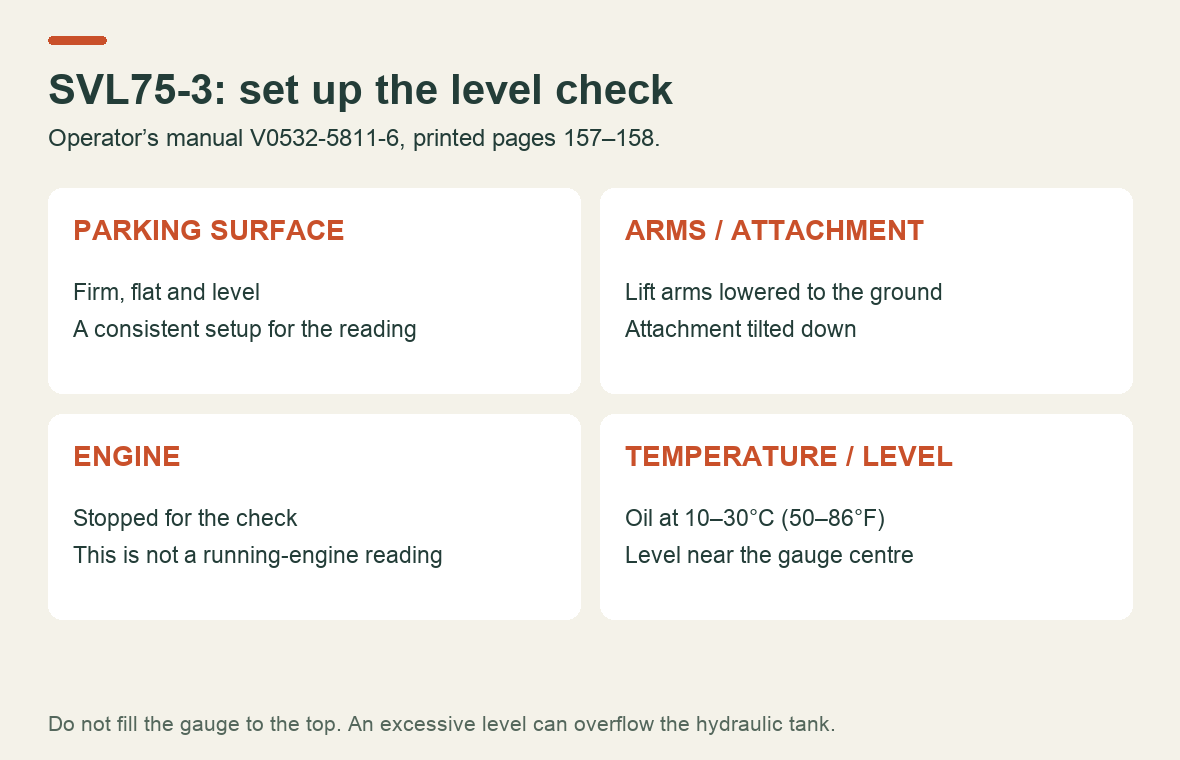
The cited Kubota SVL75-3 manual calls for firm, level ground, lift arms lowered, attachment tilted down and the engine stopped. At 10–30°C (50–86°F), the oil should be near the centre of the gauge. Check under those conditions before deciding that oil needs to be added.
The level-check conditions
The reference is the SVL75-3 operator's manual, code V0532-5811-6, printed pages 157–158. The temperature conversion to Fahrenheit below is calculated from the Celsius values in that edition.
| Check | Required condition |
|---|---|
| Parking surface | Firm, flat and level |
| Lift arms | Lowered to the ground |
| Attachment | Tilted down |
| Engine | Stopped |
| Oil temperature for the reading | 10–30°C / 50–86°F |
| Reference level | Near the centre of the gauge |
This is a daily level check, not the oil-change procedure. The manual warns that an excessive level can overflow the tank. Do not treat additional oil as a precaution when the reading is already correct.
Which gauge and fill point should you use?
Printed page 158 identifies the hydraulic level gauge and the hydraulic tank cap/oil-filling port in the same drawing. Use those labels to distinguish them from the engine-oil dipstick and other service points. The guide applies to the SVL75-3; do not identify a cap on another loader from a similar-looking photograph.
If you want a visual walkthrough on the actual model, CRYSTAL Tractor & Equipment's SVL75-3 hydraulic-fluid video is a useful companion to the manual drawing. The manufacturer's procedure remains the reference for the required conditions.
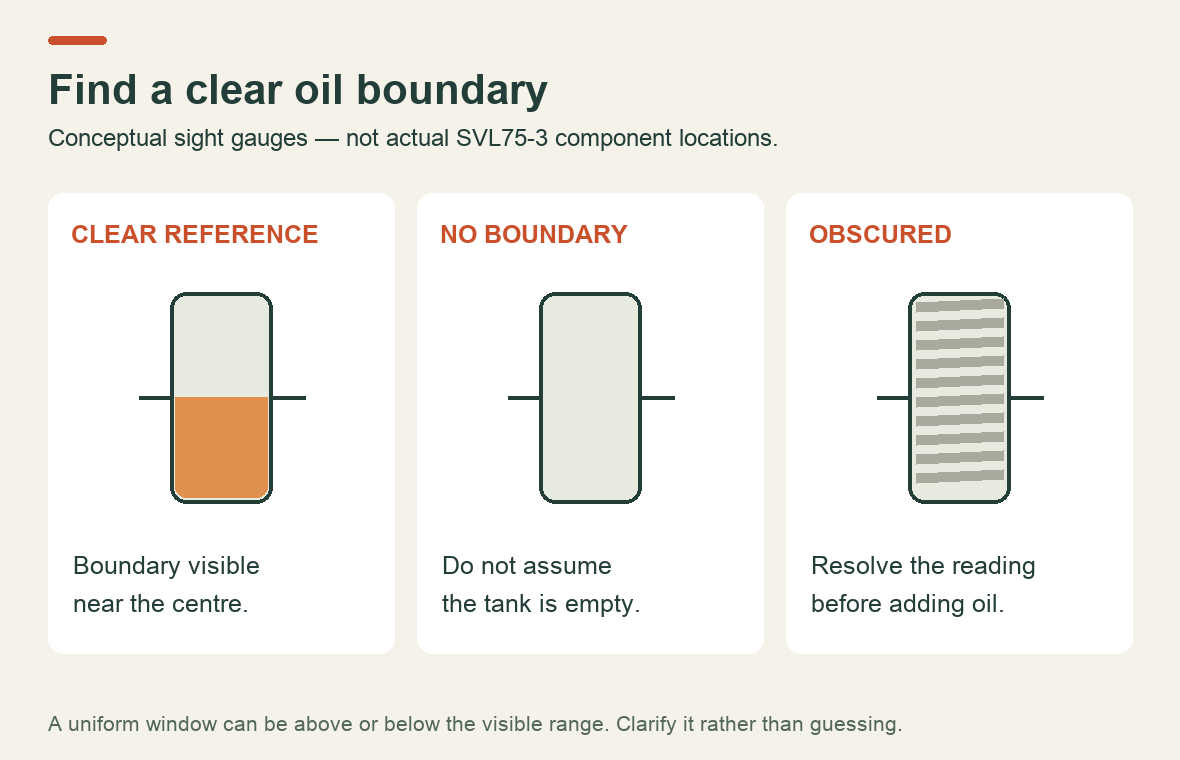
The diagram below explains the level reading. It is an original schematic, not a location drawing or a replacement for the gauge fitted to the loader.
What if you cannot see an oil line?
First make the outside of the gauge readable and confirm the machine is set up for the check. Look for a distinct boundary rather than assuming a uniformly coloured window is empty. A window with no visible boundary does not, by itself, tell you whether the level lies above it, below it or is simply obscured.
Do not add several litres as an experiment to see whether a line appears. If the gauge remains unreadable, establish the actual level using the applicable service information or have it checked. A dirty, damaged or ambiguous gauge is a reason to resolve the measurement, not a reason to guess the quantity.
Record whether the observation was “below the reference,” “above the reference” or “no clear reading.” Those descriptions mean different things when someone else reviews the machine.
Which oil belongs in the hydraulic tank?
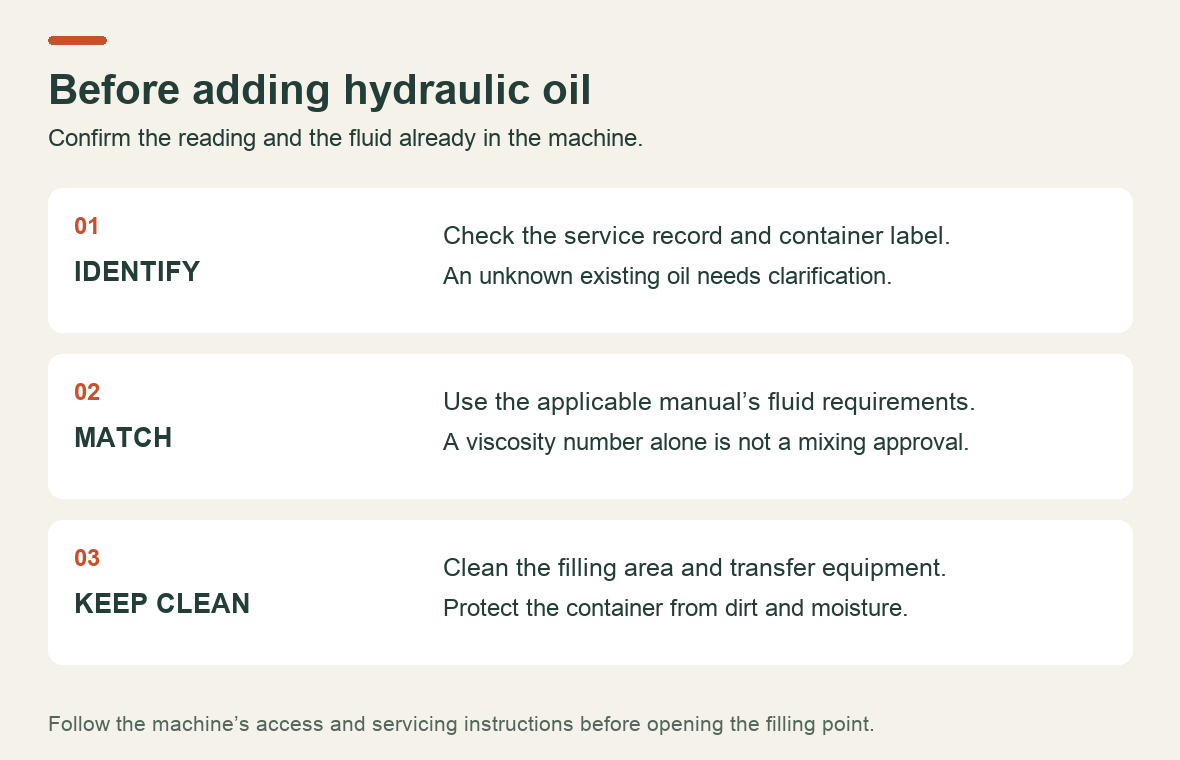
Printed page 208 of the cited manual lists ISO 46 hydraulic oil and Mobil DTE 10 Excel 46, and identifies Idemitsu Daphne Super Hydro 46ST as the shipping fill. The daily-check section instructs owners to use the same fluid type and not mix different oils.
A viscosity number alone is not permission to mix an unknown oil with whatever is already in the tank. For a used machine, check service records or ask the servicing dealer what was installed. Photograph the container label if you have it; “hydraulic oil from the workshop” is not enough information to confirm compatibility.
Before opening the filling point, follow the machine's instructions for safe access and servicing. Clean the surrounding area and use clean, dedicated transfer equipment. Keep the container closed when it is not being used.
New oil still needs clean handling
Donaldson's guidance on hydraulic contamination explains that fresh fluid can already contain contamination and can pick up more during transfer. An open container, dirty funnel or poorly stored hose can turn a small top-up into a source of debris.
Use the cleanliness and fluid-handling requirements appropriate to the machine. There is no benefit in carefully selecting the right product and then pouring it through equipment used for dirty waste oil.
If the level keeps falling
A recurring need to add oil deserves investigation. Keep the readings comparable: the same parking conditions, attachment position and temperature range. Record dates, hours and quantities added, plus recent attachment or hose work. That helps separate a changed check condition from a continuing loss that needs attention.
Do not use a correct tank reading as proof that the entire hydraulic system is healthy. A warning, unusual noise or a performance problem is a separate symptom. Likewise, do not keep adding oil when the reading is uncertain.
Byte Market's SVL75-3 workshop manual listing includes maintenance and hydraulic diagnostic coverage. It is the relevant next reference when the daily check identifies a problem requiring inspection, rather than simply a confirmed low level.
Recent Post
-

Why a Kubota Manual May N...
16 Sep, 2026
-

Kubota Tractor Won’t Star...
16 Sep, 2026
-

Kubota DPF Light Flashing...
18 Sep, 2026
-

Kubota Tractor Overheatin...
21 Sep, 2026
-

Kubota Hydraulic Couplers...
22 Sep, 2026
-

Kubota UDT vs Super UDT2:...
23 Sep, 2026
-

Kubota 3-Point Hitch Won'...
24 Sep, 2026
-

Kubota Excavator Track Te...
25 Sep, 2026
-

New Holland 540 vs 540E P...
28 Sep, 2026
-

Kubota BX Mower Cutting U...
29 Sep, 2026
-

Kubota Excavator Controls...
30 Sep, 2026
-

New Holland DEF Storage:...
01 Oct, 2026
-

Kubota Air Filter: When t...
02 Oct, 2026
-

Kubota SVL Standard vs Hi...
06 Oct, 2026
-

New Holland Water in Fuel...
07 Oct, 2026
-

Kubota Loader Float: What...
08 Oct, 2026
-

Kubota HST Tractor Won't...
09 Oct, 2026
-

Kubota 50-Hour Service Ch...
12 Oct, 2026
-

Kubota 4WD Won't Disengag...
13 Oct, 2026
-
Kubota KX040-4 Final Driv...
14 Oct, 2026
-

Kubota PTO Won't Engage?...
15 Oct, 2026
-
How to Check Hydraulic Oi...
16 Oct, 2026