Kubota SVL75-3 Lift Capacity: Why 2,490 lb Is Not the Whole Answer
Kubota SVL75-3 Lift Capacity: Why 2,490 lb Is Not the Whole Answer
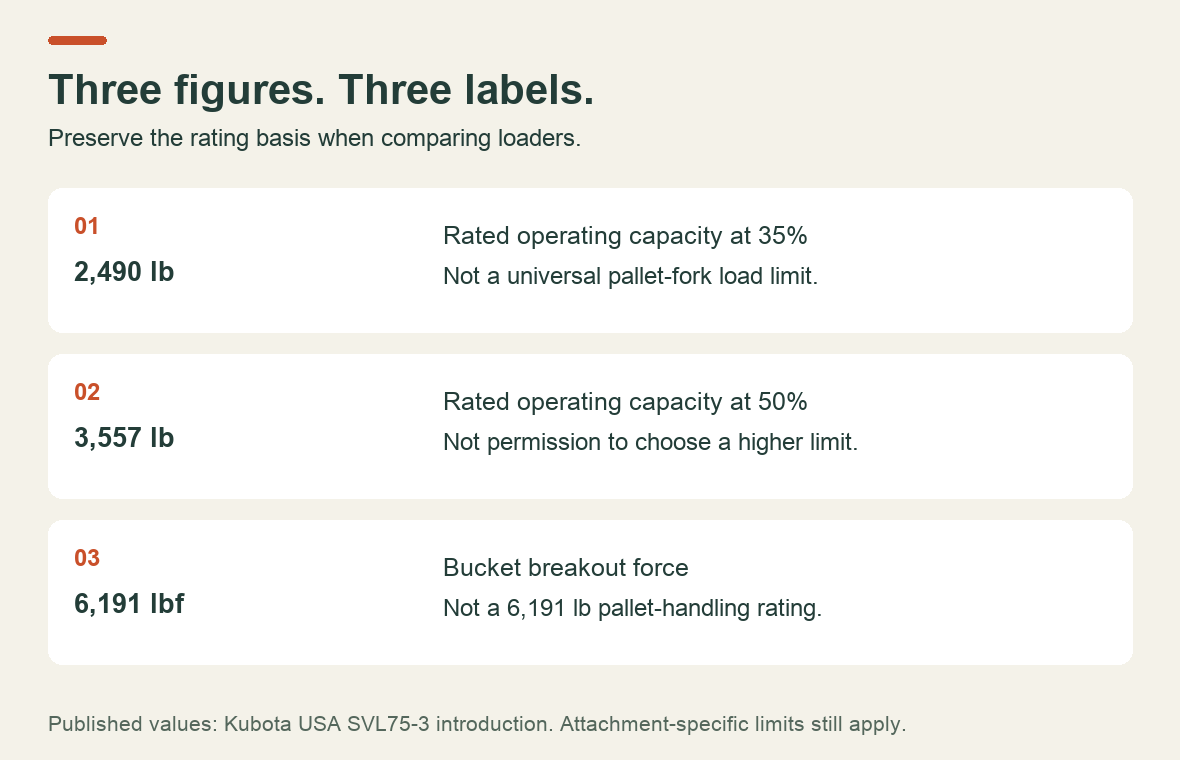
Kubota publishes a rated operating capacity of 2,490 lb at 35% of tipping load and 3,557 lb at 50% for the SVL75-3. Both numbers appear in Kubota USA’s SVL75-3 announcement. Neither number, by itself, tells you what a particular machine can carry on pallet forks.
That matters when the job is a pallet of blocks or a bulk bag. A search for “SVL75-3 lifting capacity” returns several impressive figures, but they describe different things. Before comparing any of them with the weight of a load, identify the rating, attachment and machine configuration.
What do the different capacity figures mean?
| Published figure | What it describes | What it does not establish |
|---|---|---|
| 2,490 lb at 35% | Rated operating capacity on the stated 35% basis | The capacity of every fork or attachment combination |
| 3,557 lb at 50% | Rated operating capacity on the stated 50% basis | Permission to choose a higher limit for a difficult lift |
| 6,191 lbf bucket breakout force | Force available in the specified bucket test | A 6,191 lb pallet-handling rating |
Kubota’s announcement gives all three figures. Preserve their labels when comparing machines: a 35% rating from one brochure and a 50% rating from another are not equivalent comparison points.
Tipping load is also a different figure from rated operating capacity. It describes the tipping threshold under the specified test conditions, not a load to attempt in ordinary work. Breakout force concerns the bucket’s ability to exert force; it does not replace a stability-based operating limit.
Why does the operator’s manual have a separate pallet-fork rating?
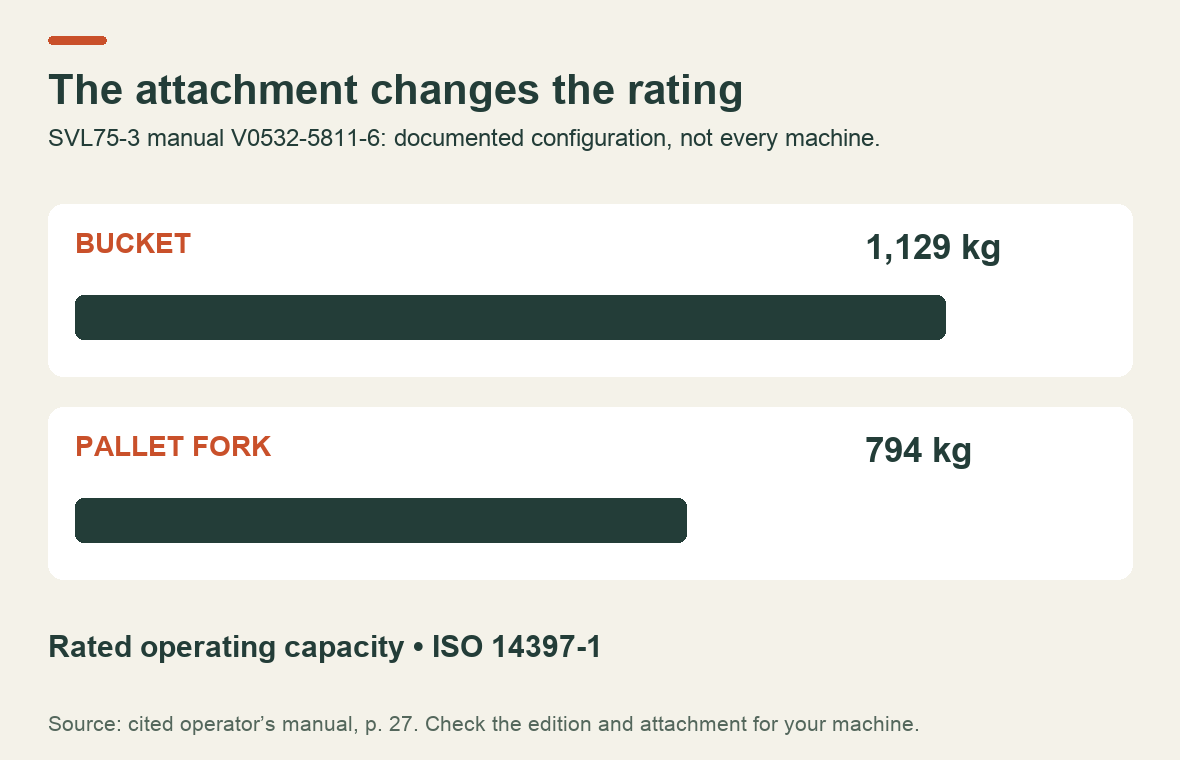
Here is a concrete example. The Kubota-hosted SVL75-3 operator’s manual V0532-5811-6, printed page 27, lists these figures for the configuration documented in that edition:
| Attachment | Rated operating capacity, ISO 14397-1 | Tipping load, ISO 14397-1 |
|---|---|---|
| Bucket | 1,129 kg | 3,226 kg |
| Pallet fork | 794 kg | 2,268 kg |
The fork rating is lower than the bucket rating in the same table. This is why copying the prominent bucket number into a pallet-handling calculation can give the wrong answer.
This edition describes a closed-cab machine and states its configuration and test assumptions below the table. Treat it as a documented example, not a replacement rating for every SVL75-3 in every market. Use the operator’s manual and attachment information applicable to the actual machine.
For scale, 794 kg is approximately 1,750 lb. An illustrative 2,000 lb pallet is approximately 907 kg: below the advertised 2,490 lb figure, yet above this manual’s 794 kg fork rating. That arithmetic is enough to reject the shortcut “the pallet weighs less than the headline capacity, so it must be fine.” It is not a lifting approval.
Do 4,000 lb pallet forks let the loader carry 4,000 lb?
No. The attachment’s structural rating and the loader’s permitted load with that attachment answer different questions. Both restrictions matter. A stronger fork frame does not increase the loader’s stability or create a new machine rating.
Read the fork identification plate and instructions, including any specified load center. Establish where the load’s center of gravity sits, rather than looking only at fork length. A compact pallet held close to the carriage and a long object projecting forward can put the same weight at different distances from the machine.
The mechanical reason is straightforward: turning effect depends on both force and distance. Moving the same load farther forward increases its overturning effect. Do not use that principle to invent a revised allowable load; the machine and attachment documentation must supply the permitted arrangement.
What should you check before collecting a pallet?
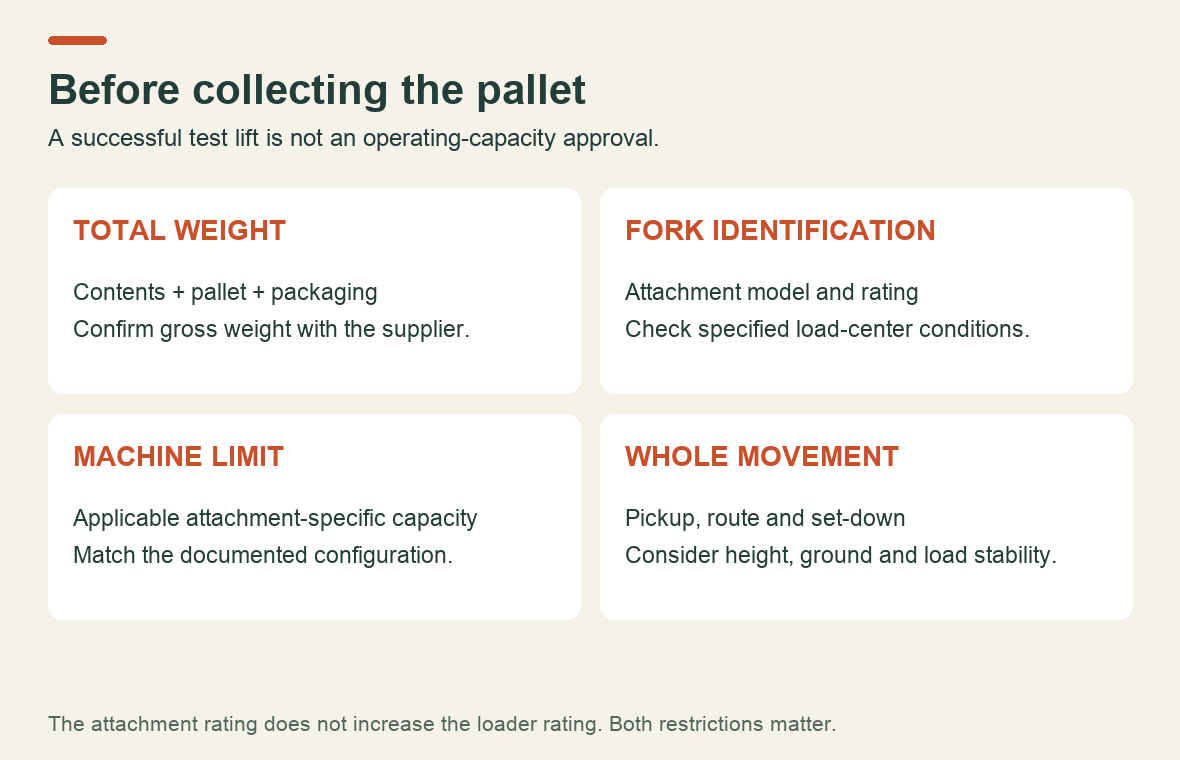
Get the total weight. Include the pallet, packaging and contents. A supplier’s bag weight may describe the material alone. Ask for a confirmed gross weight if the shipment is close to a limit.
Identify the attachment. Record its model, rating and load-center information. Check the applicable machine rating for that attachment and any specified counterweight arrangement. Added weights are not a basis for making your own capacity increase.
Plan the whole movement. Picking an object off level ground is only the start. Consider its stability, the travel route, the required height and the receiving surface. Do not use a test lift or a video of another loader as proof that your arrangement is within its rating.
Does a load lifting off the ground prove it is safe?
No. Hydraulic movement is not a substitute for an operating-capacity check. The SVL75-3 operator’s manual, printed page 125, explicitly prohibits exceeding rated operating capacity. It also describes unwanted lift-arm lowering that can occur with certain combined control inputs when overloaded. A machine that initially raises the load has not demonstrated that the entire handling operation is acceptable.
If a loader behaves abnormally with a load confirmed to be within its applicable rating, that becomes a service question. Byte Market’s SVL75-3 workshop manual RY911-31065 provides a route to model-specific service documentation. Use the operator’s manual and attachment instructions to establish the load limit first; use workshop information to investigate faults, not to justify exceeding that limit.
Recent Post
-
Why a Kubota Manual May N...
16 Sep, 2026
-
Kubota Tractor Won’t Star...
16 Sep, 2026
-

Kubota DPF Light Flashing...
18 Sep, 2026
-
Kubota Tractor Overheatin...
21 Sep, 2026
-
Kubota Hydraulic Couplers...
22 Sep, 2026
-
Kubota UDT vs Super UDT2:...
23 Sep, 2026
-
Kubota 3-Point Hitch Won'...
24 Sep, 2026
-
Kubota Excavator Track Te...
25 Sep, 2026
-
New Holland 540 vs 540E P...
28 Sep, 2026
-
Kubota BX Mower Cutting U...
29 Sep, 2026
-
Kubota Excavator Controls...
30 Sep, 2026
-

New Holland DEF Storage:...
01 Oct, 2026
-
Kubota Air Filter: When t...
02 Oct, 2026
-
Kubota SVL Standard vs Hi...
06 Oct, 2026
-
New Holland Water in Fuel...
07 Oct, 2026
-
Kubota Loader Float: What...
08 Oct, 2026
-
Kubota HST Tractor Won't...
09 Oct, 2026
-
Kubota 50-Hour Service Ch...
12 Oct, 2026
-
Kubota 4WD Won't Disengag...
13 Oct, 2026
-
Kubota KX040-4 Final Driv...
14 Oct, 2026
-
Kubota PTO Won't Engage?...
15 Oct, 2026
-
How to Check Hydraulic Oi...
16 Oct, 2026
-
Kubota Battery Light Stay...
19 Oct, 2026
-
Kubota Ran Out of Diesel?...
20 Oct, 2026
-
Kubota SVL75-3 Lift Capac...
21 Oct, 2026