Kubota Battery Light Stays On? Check the Charging System First
Kubota Battery Light Stays On? Check the Charging System First
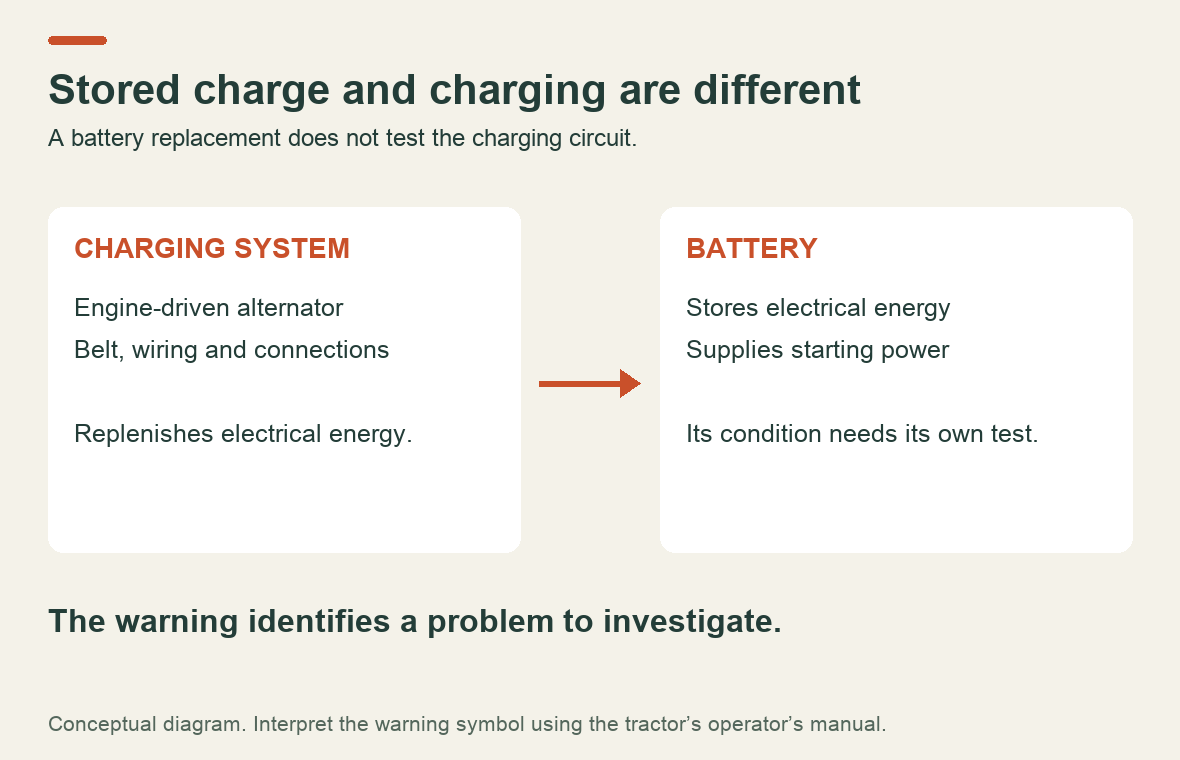
A new battery starts the tractor easily, yet the battery-shaped warning stays on. That is possible because battery condition and charging-system operation are different questions. Replacing the battery does not establish whether it is being recharged while the engine runs.
On the BX1880, BX2380 and BX2680 in the manual cited here, the electrical-charge indicator warns that the alternator is not charging the battery. It is a reason to check the charging system, not an automatic instruction to replace the battery or alternator. Identify the symbol in your model's manual before applying that meaning to another Kubota.
When does the light appear?
Record the difference between the display before starting and the display with the engine running. The BX1880/BX2380/BX2680 AU operator's manual describes the starting checks on printed page 39 and the charge indicator on page 48. After starting, its warning lamps should be off.
| What you notice | Why the distinction matters |
|---|---|
| A lamp appears only before the engine starts | Compare it with that model's normal starting/check sequence |
| The charge lamp remains on while running | Investigate the charging system; a fresh battery does not settle the question |
| The lamp changes with engine speed or electrical load | Record the speed and accessories in use for the test |
| The battery loses charge while parked | Report the parked discharge separately; do not assume the same cause |
If the charge warning appears during work, stop safely and establish the cause. Do not plan the rest of the day around how long a newly charged battery might keep the tractor running.
Check accessible connections and the belt with the engine stopped
Remove the key before approaching belts or wiring. Look for loose battery terminals, corrosion, damaged cables and an obviously damaged or displaced drive belt. Note anything changed during recent battery or alternator work. Do not pull on wires or bridge terminals to see whether the warning changes.
There is a concrete belt reference for the BX models above: printed pages 86–87 specify 7–9 mm of deflection at the middle of the span under moderate thumb pressure. Use the specified span and full procedure; that number is not a universal Kubota belt setting. Tightening a belt as much as possible is not a repair standard.
DENSO's alternator troubleshooting guidance explains why these checks matter: belt slip, poor connections and resistance in the charging circuit can interfere with charging. It also calls for battery assessment before deeper diagnosis. A battery may need charging or testing while a separate charging fault is investigated.
A voltage check gives you evidence
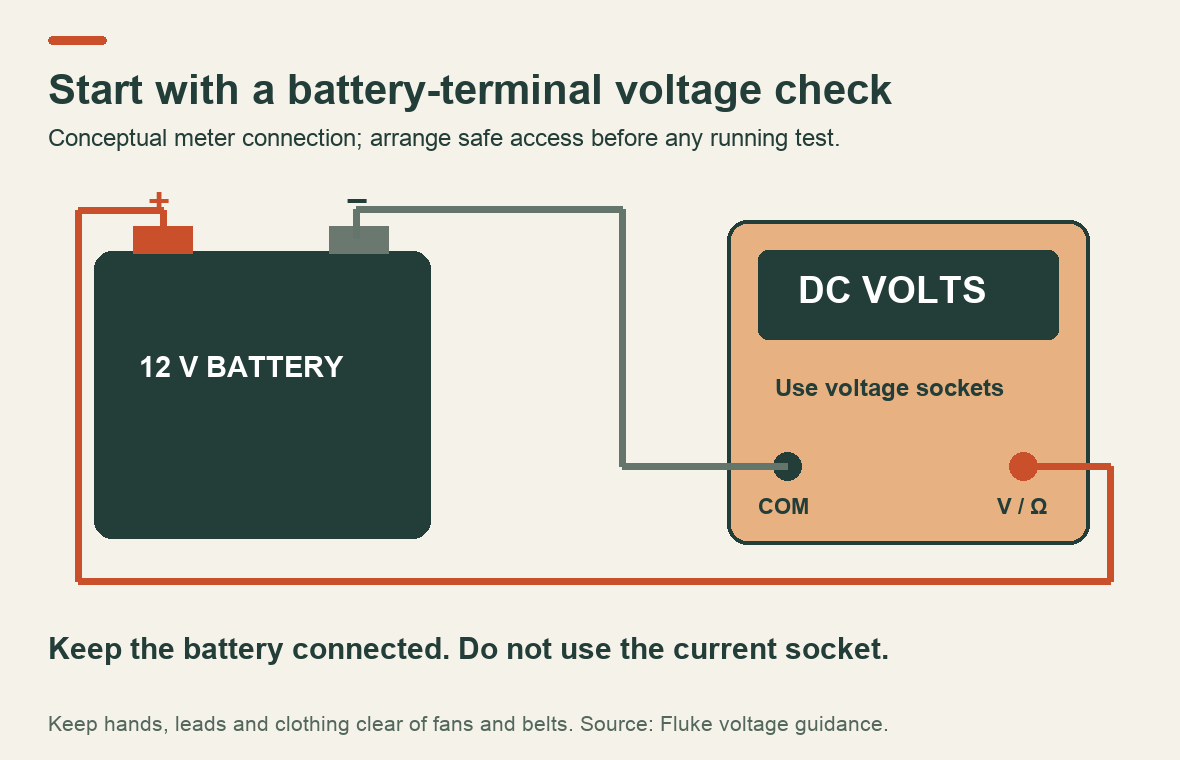
For someone familiar with a multimeter, battery-terminal voltage is a useful starting measurement. Set the meter to DC volts, use its voltage and COM sockets, and connect red to positive and black to negative. Never put a meter set for current directly across the battery.
Use safely accessible terminals and insulated leads. Keep leads, clothing and hands clear of fans and belts. If safe access is not available with the engine running, have the workshop perform the running test.
Fluke's battery-voltage guide describes the measurement method. About 12.6 V is a common fully charged resting reference for a conventional 12 V lead-acid battery. It does not prove the battery can deliver starting current, and a reading immediately after charging needs care in interpretation.
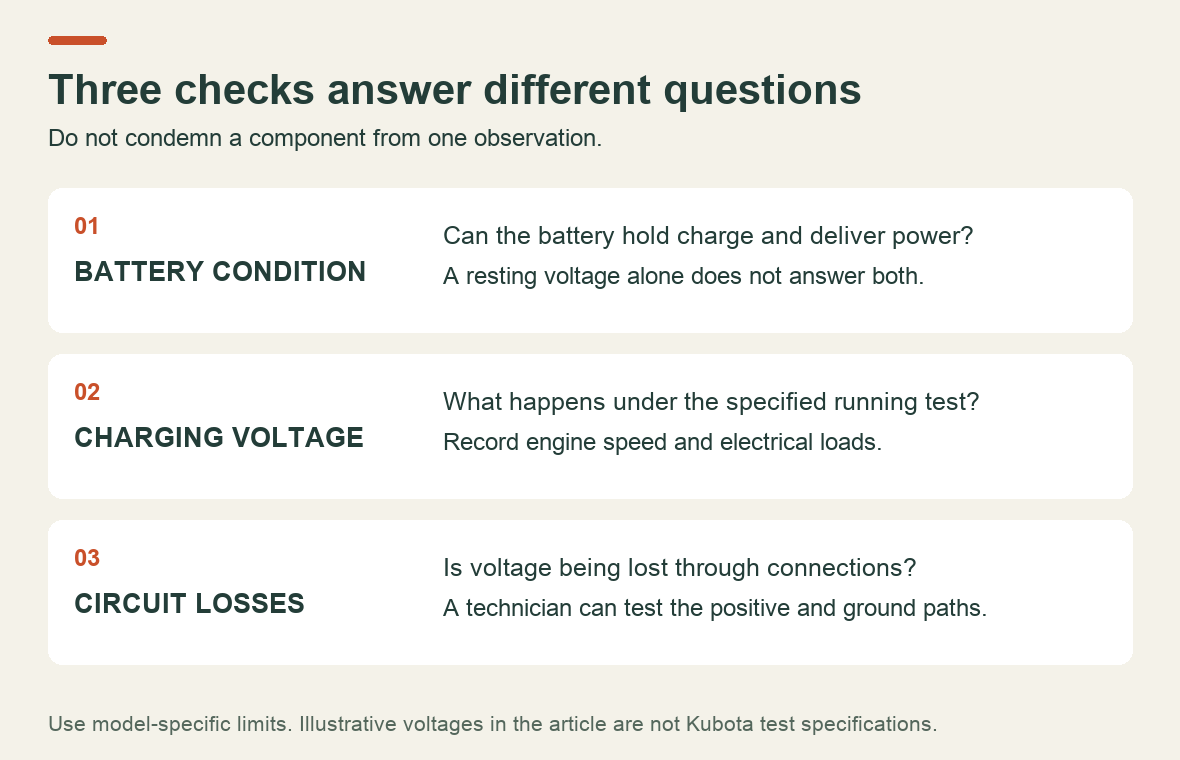
Record voltage with the engine off, then under the running conditions specified for the tractor's charging test. Note engine speed and electrical loads. Compare the result with the workshop specification rather than using one internet voltage threshold for every Kubota.
How to read the result without buying the wrong part
These are illustrative readings, not measurements from a repaired tractor or Kubota acceptance limits.
| Example observation | What it supports |
|---|---|
| 12.6 V stopped, 14.2 V running | Voltage has risen into a charging range; this alone does not establish full output or battery health |
| 12.6 V stopped, 12.2 V running | Charging is not maintaining battery voltage under those conditions; investigate the circuit, belt and charging unit |
| Warning remains on despite a plausible running voltage | The warning circuit and the charging test both need attention |
Do not disconnect a battery cable with the engine running as an alternator test. DENSO warns that this can damage alternator diodes. A voltage-drop test can help a technician find resistance in the positive or ground path; probing the alternator output terminal is further diagnostic work, not a shortcut required for the basic check above.
Before ordering an alternator
Give the supplier the tractor model, charging-unit identification and the test results. Include whether the lamp behaviour changed after a repair. A replacement that looks similar is not enough evidence of the correct fit or electrical specification.
For the BX example, Byte Market's BX1880/BX2380/BX2680 workshop manual listing includes the electrical-system material to check before buying. The useful outcome is a tested explanation for the warning, with the faulty connection or component identified.
Recent Post
-

Why a Kubota Manual May N...
16 Sep, 2026
-
Kubota Tractor Won’t Star...
16 Sep, 2026
-
Kubota DPF Light Flashing...
18 Sep, 2026
-
Kubota Tractor Overheatin...
21 Sep, 2026
-
Kubota Hydraulic Couplers...
22 Sep, 2026
-
Kubota UDT vs Super UDT2:...
23 Sep, 2026
-
Kubota 3-Point Hitch Won'...
24 Sep, 2026
-
Kubota Excavator Track Te...
25 Sep, 2026
-
New Holland 540 vs 540E P...
28 Sep, 2026
-
Kubota BX Mower Cutting U...
29 Sep, 2026
-
Kubota Excavator Controls...
30 Sep, 2026
-
New Holland DEF Storage:...
01 Oct, 2026
-
Kubota Air Filter: When t...
02 Oct, 2026
-
Kubota SVL Standard vs Hi...
06 Oct, 2026
-

New Holland Water in Fuel...
07 Oct, 2026
-
Kubota Loader Float: What...
08 Oct, 2026
-
Kubota HST Tractor Won't...
09 Oct, 2026
-
Kubota 50-Hour Service Ch...
12 Oct, 2026
-
Kubota 4WD Won't Disengag...
13 Oct, 2026
-
Kubota KX040-4 Final Driv...
14 Oct, 2026
-
Kubota PTO Won't Engage?...
15 Oct, 2026
-
How to Check Hydraulic Oi...
16 Oct, 2026
-
Kubota Battery Light Stay...
19 Oct, 2026