Kubota Ran Out of Diesel? How to Bleed the Fuel System
Kubota Ran Out of Diesel? How to Bleed the Fuel System
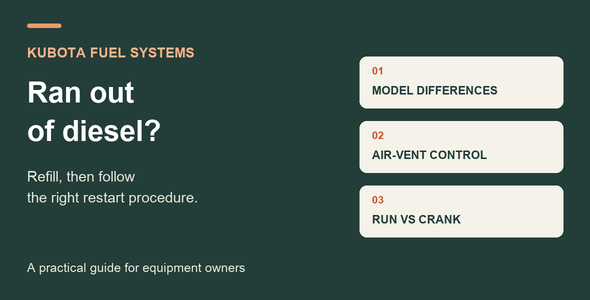
You have put diesel back in the tank, but the tractor still will not start. An empty tank can let air into the fuel system, so refuelling may be only the first part of the restart. The next step depends on the tractor: some Kubota instructions simply call for refilling and running the engine, while others include an air-vent valve.
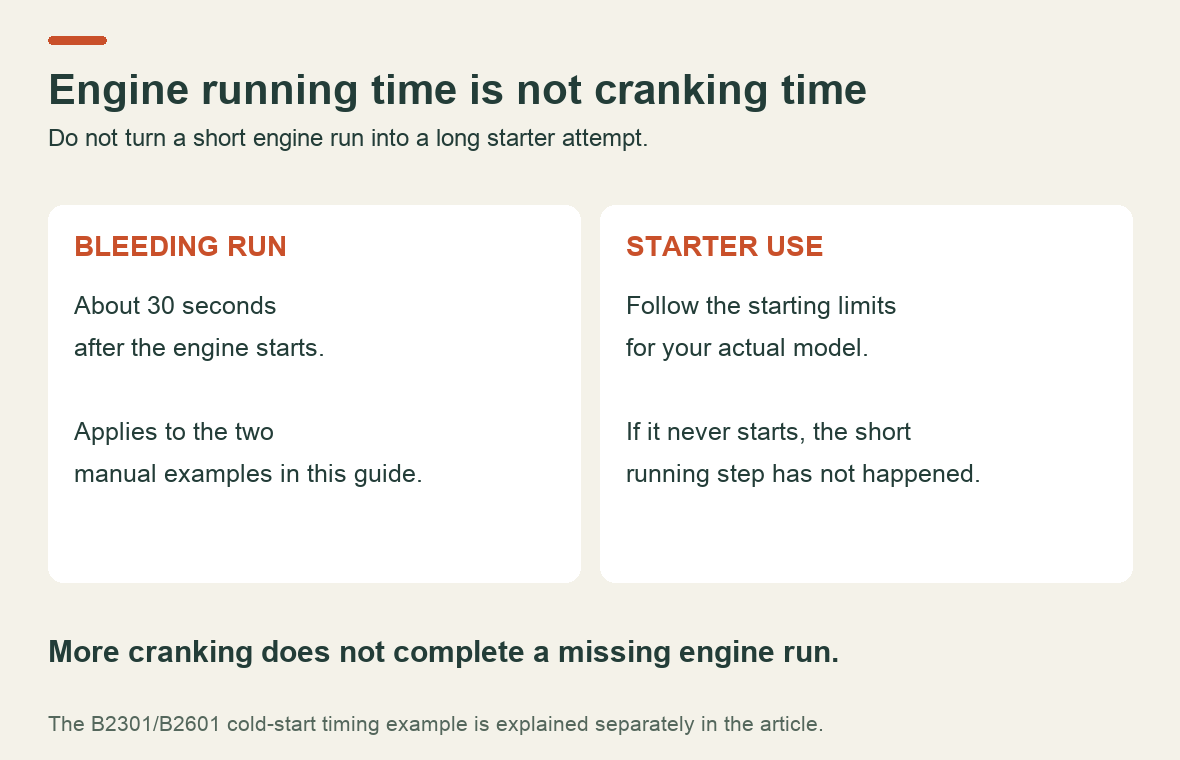
Do not apply one bleeding procedure to every Kubota. The B2301/B2601 and L3200/L3800 examples below show the difference. In both, the stated 30 seconds means time with the engine running after it starts. It does not mean holding the starter on for 30 seconds.
Why this happens after an empty tank or a filter change
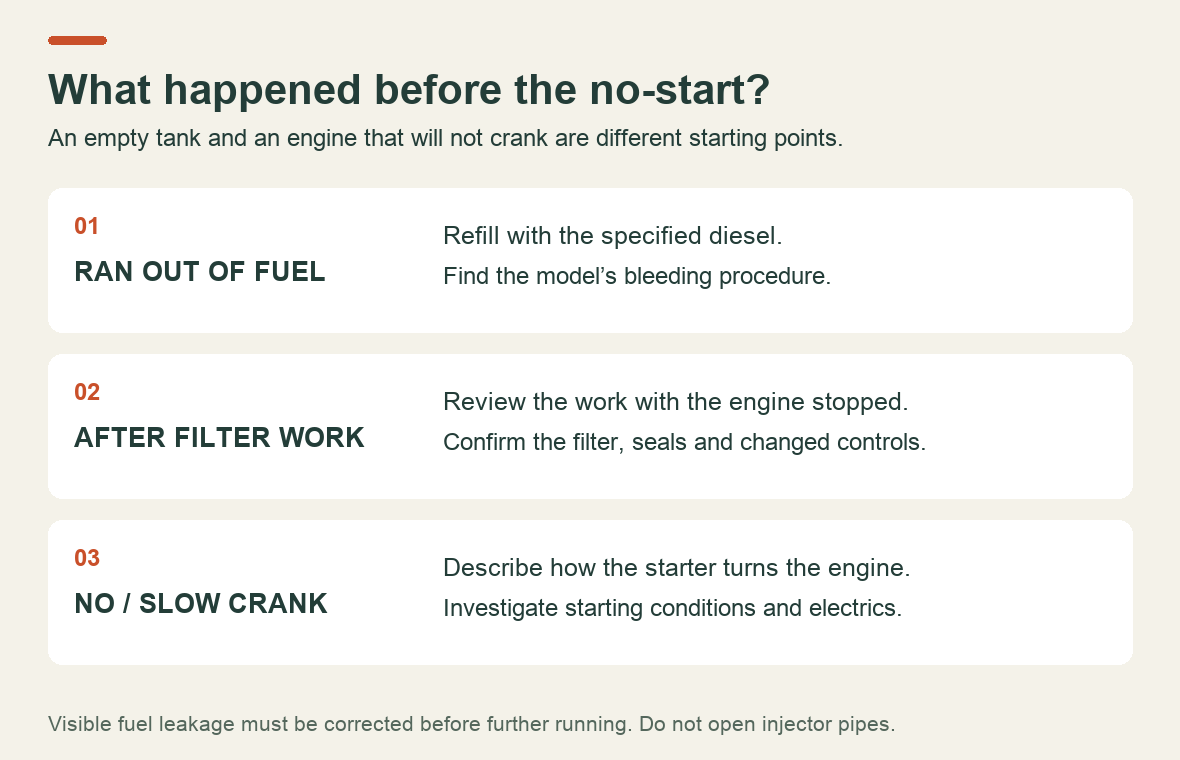
Kubota's B2301/B2601 operator's manual, printed page 68, calls for bleeding after removal of the fuel filter or lines, an empty tank, or a long period out of use. Those events give you a useful starting point when the engine ran normally before the work.
They do not prove that every subsequent no-start is an air problem. If the starter barely turns the engine, or the engine does not crank at all, repeatedly opening the fuel system will not answer that complaint. Establish what the engine actually does before changing more parts.
Two Kubota examples: similar tractors, different instructions
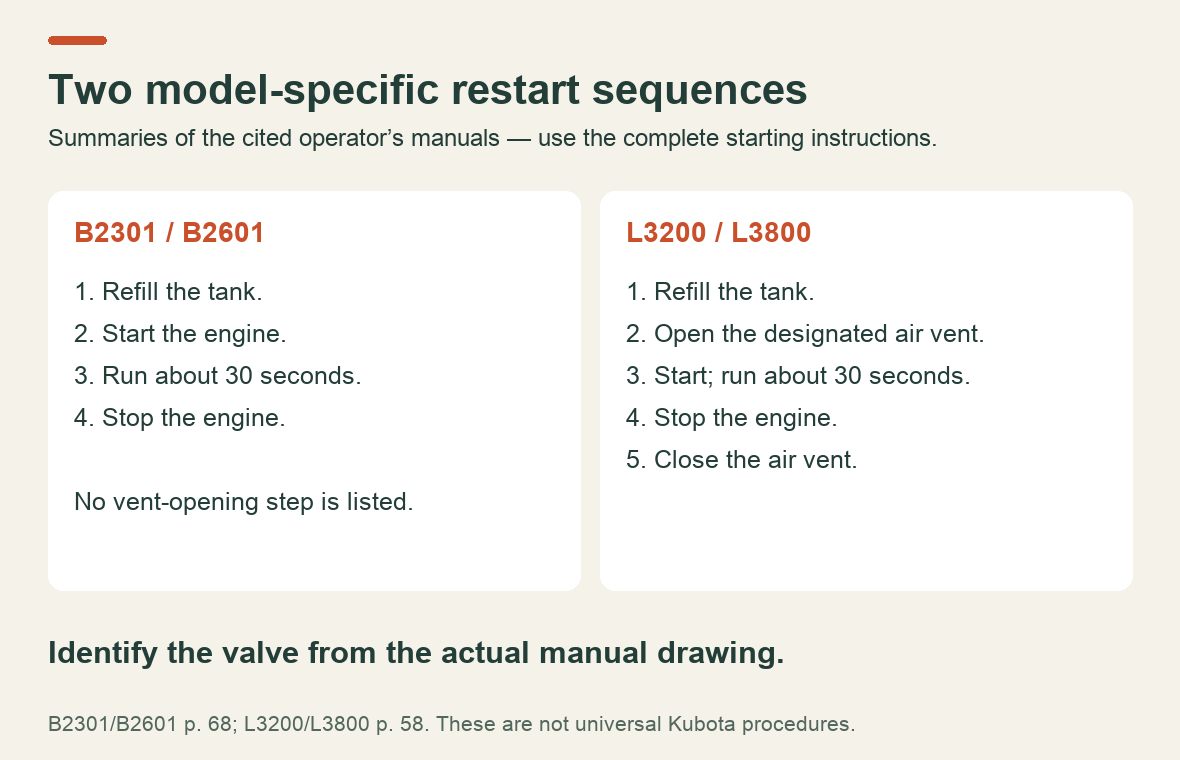
Use these as model-specific summaries alongside the controls and starting instructions in the linked manuals. They are not permission to identify a valve by resemblance alone.
| Model and source | Bleeding sequence in that manual |
|---|---|
| B2301/B2601, printed page 68 | Refill the tank. Start the engine, let it run for about 30 seconds, then stop it. This procedure does not specify opening a bleed valve. |
| L3200/L3800, printed page 58 | Refill. Open the designated air-vent cock on the injection pump. Start and run for about 30 seconds. Stop the engine, then close the cock. |
The second sequence is in the Kubota L3200/L3800 operator's manual. It also warns that leaving the vent cock open outside the bleeding procedure can cause irregular running or repeated stalling. That final closure is worth checking if the engine restarts but will not run properly afterward.
Before starting either procedure, secure the tractor and follow its normal starting conditions, including the required transmission and PTO positions. Keep implements lowered, people clear and the work area ventilated. Stop and remove the key before inspecting or correcting a fuel leak.
Where is the Kubota fuel bleed valve?
There is no useful single location for every model. On the L3200/L3800 example, page 58 labels the air-vent cock on the injection pump and shows its open and closed directions. Use that drawing to identify the control. The B2301/B2601 procedure above does not ask you to find an equivalent valve.
An air vent, a fuel shutoff and an injector-line connection have different jobs. Do not loosen a fitting because an online photograph shows something vaguely similar. Neither of the two cited procedures tells the owner to crack open injector pipes. Keep those connections closed when following this guide, especially if you are unsure which fuel-system design the machine has.
The engine still will not start. What now?
First separate “the procedure could not be completed” from “the procedure was completed but the fault remains.” If the engine never started, it never received the specified short run. More time on the starter is not the same operation.
For example, the B2301/B2601 manual's cold-start section on printed page 13 limits continuous starter use to 10 seconds and specifies a 30-second pause before retrying. Follow the starting limits for your actual tractor rather than treating the bleeding run time as a cranking allowance.
If the problem followed a filter change, review that work with the engine stopped. Confirm the correct filter, the intended seal arrangement and any shutoff position changed during the job. Look for visible leakage or a hose disturbed during access. Do not keep dismantling unrelated components to “let more air out.”
| What you observe | What to establish next |
|---|---|
| No cranking, or very slow cranking | Starting conditions and the battery/starting system |
| Normal cranking after running dry | The applicable fuel-bleeding procedure and whether fuel supply has been restored |
| Starts, then repeatedly stops | Whether the procedure was completed, including vent closure where specified |
| Visible fuel leakage | The leak must be corrected before further running |
What information helps a workshop?
Tell the technician whether the tank ran dry or the symptom began after service. Give the model, filter part number if it was changed, and the exact manual procedure attempted. “It started for five seconds and stopped” is more useful than “I bled it several times.”
Keep the diagnosis focused on the event that preceded the problem. A filter change followed immediately by a no-start deserves a review of that job before an injection pump is condemned.
Byte Market lists the B2301/B2601 workshop manual and the L3200 workshop manual. Check model coverage and contents if you need diagnostic information beyond the operator's restart procedure. The L3200 listing should not be assumed to cover the L3800 simply because the operator's manual above includes both.
Recent Post
-

Why a Kubota Manual May N...
16 Sep, 2026
-
Kubota Tractor Won’t Star...
16 Sep, 2026
-
Kubota DPF Light Flashing...
18 Sep, 2026
-
Kubota Tractor Overheatin...
21 Sep, 2026
-
Kubota Hydraulic Couplers...
22 Sep, 2026
-
Kubota UDT vs Super UDT2:...
23 Sep, 2026
-
Kubota 3-Point Hitch Won'...
24 Sep, 2026
-
Kubota Excavator Track Te...
25 Sep, 2026
-
New Holland 540 vs 540E P...
28 Sep, 2026
-
Kubota BX Mower Cutting U...
29 Sep, 2026
-
Kubota Excavator Controls...
30 Sep, 2026
-
New Holland DEF Storage:...
01 Oct, 2026
-
Kubota Air Filter: When t...
02 Oct, 2026
-
Kubota SVL Standard vs Hi...
06 Oct, 2026
-
New Holland Water in Fuel...
07 Oct, 2026
-
Kubota Loader Float: What...
08 Oct, 2026
-
Kubota HST Tractor Won't...
09 Oct, 2026
-
Kubota 50-Hour Service Ch...
12 Oct, 2026
-
Kubota 4WD Won't Disengag...
13 Oct, 2026
-
Kubota KX040-4 Final Driv...
14 Oct, 2026
-
Kubota PTO Won't Engage?...
15 Oct, 2026
-
How to Check Hydraulic Oi...
16 Oct, 2026
-
Kubota Battery Light Stay...
19 Oct, 2026
-
Kubota Ran Out of Diesel?...
20 Oct, 2026