What Coolant Does a Kubota Need? Type, Mix and BX Capacities
What Coolant Does a Kubota Need? Type, Mix and BX Capacities
Kubota’s general coolant recommendation is a 50/50 mixture of antifreeze and clean water. The product still needs to match the engine and the coolant already in it. For example, the B2301/B2601 operator’s manual specifies ethylene-glycol long-life coolant mixed with clean soft water. Buying a bottle because it is green does not answer those questions. See Kubota’s lubricant and coolant recommendations and the B2301/B2601 operator’s manual, printed pages 65–66.
The useful distinction at the parts counter is between choosing coolant for a complete change and finding something suitable for a top-up. With a used tractor, the second can be harder: the model is known, but the liquid in the radiator may not be.
Does Kubota need a special type of antifreeze?
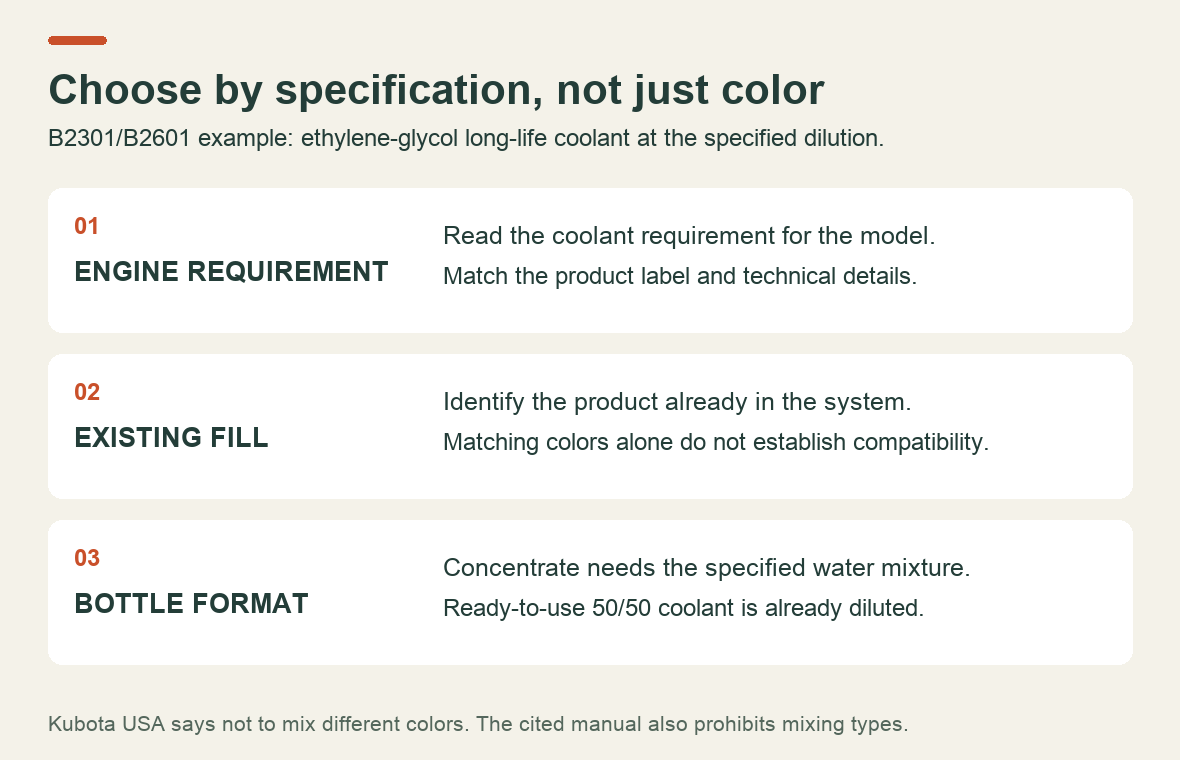
Start with the engine’s coolant requirement, then check the container’s specification and mixing instructions. The words “antifreeze,” “long life” and “universal” on the front are not enough to establish that a product meets the requirements for your machine.
For the B2301/B2601 example, the requirement is ethylene-glycol-type long-life coolant. That identifies the base fluid, but it is not permission to combine every ethylene-glycol product. The same manual prohibits mixing different antifreeze types and says replacement coolant after a mixture leak should match the existing manufacturer, type and concentration.
A practical purchase record is a photograph of the container’s front and back, the product name and the date it went into the tractor. Keep that with the service record. It makes the next top-up a product match instead of a guess.
Can you mix green and orange coolant?
Do not mix different colors of antifreeze: that is Kubota USA’s published instruction. But the reverse is not a compatibility test. Two green liquids have not been shown to be the same product simply because their colors match. Check the label and service history rather than treating dye as a specification.
If you have just bought the tractor and cannot identify its coolant, do not create a new mixture from whatever is on the shelf. Establish a suitable replacement product and follow the model’s drain-and-flush procedure. Record what you used. If coolant keeps disappearing, deal with the loss as a fault rather than repeatedly hiding it with top-ups.
Should you add water to 50/50 premixed coolant?
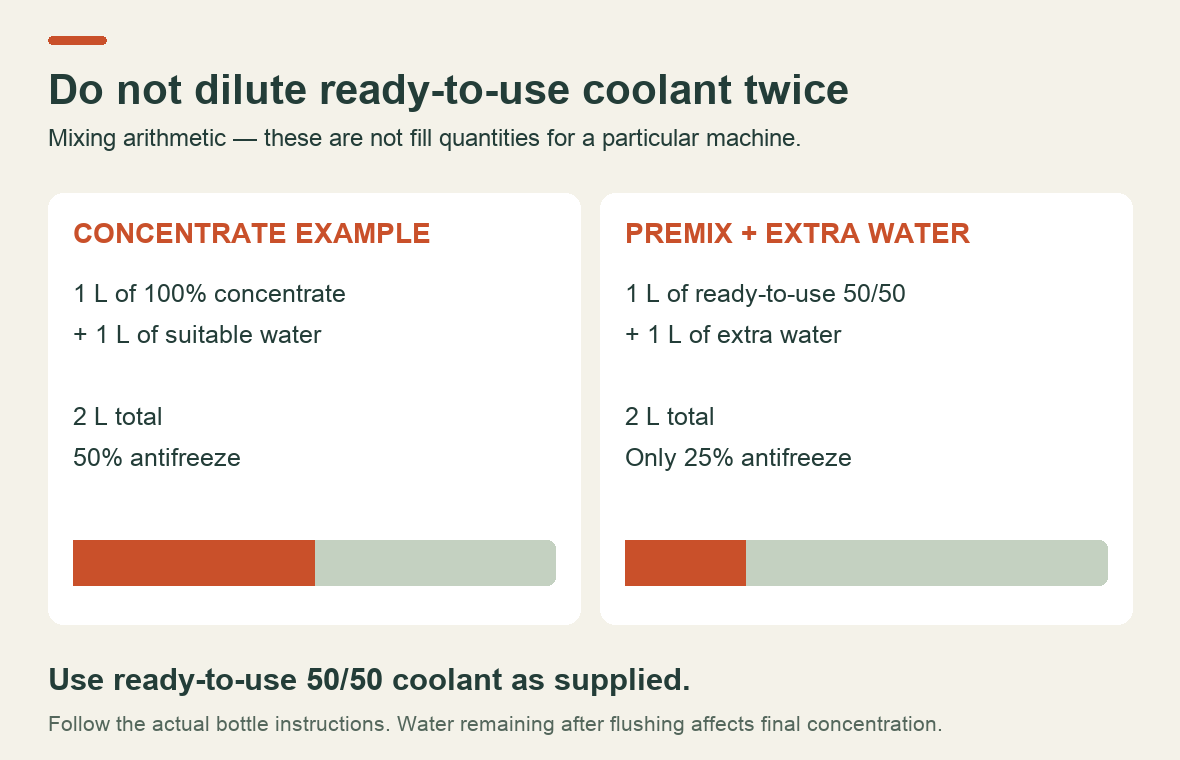
A ready-to-use 50/50 product is already diluted. Adding an equal amount of water does not make a better 50/50 mixture; it cuts the antifreeze concentration in half.
| What goes into the container | Final volume | Antifreeze concentration |
|---|---|---|
| 1 liter of concentrate plus 1 liter of water | 2 liters | 50%, for a product supplied as 100% concentrate |
| 1 liter of ready-to-use 50/50 coolant, used as supplied | 1 liter | 50% |
| 1 liter of ready-to-use 50/50 coolant plus 1 liter of water | 2 liters | 25% |
These are mixing examples, not instructions to add two liters to a particular radiator. Read the actual product label: “concentrate” and “ready to use” require different handling. Use water meeting the coolant and machine instructions; the B2301/B2601 manual calls for clean soft water.
Water left behind after flushing also counts toward the final mixture. A partially drained cooling system is not an empty measuring jug. Check the final concentration with a tester suitable for the coolant, following its instructions, rather than assuming the bottle concentration is necessarily the concentration now in the tractor.
How much coolant does a Kubota BX take?
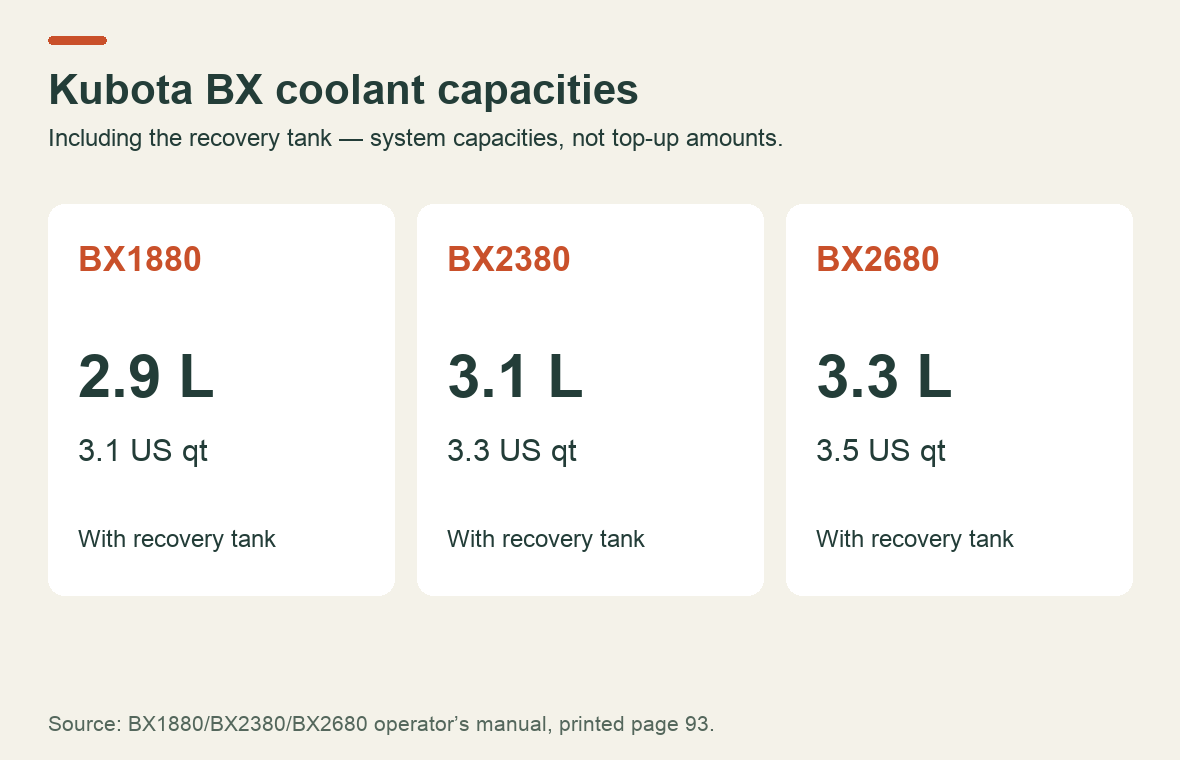
The BX1880/BX2380/BX2680 operator’s manual, printed page 93 gives these capacities including the recovery tank:
| Model | Coolant capacity |
|---|---|
| BX1880 | 2.9 liters / 3.1 US quarts |
| BX2380 | 3.1 liters / 3.3 US quarts |
| BX2680 | 3.3 liters / 3.5 US quarts |
Those are system capacities, not top-up quantities. A BX2380 with a slightly low recovery tank does not need another 3.1 liters. Equally, a coolant change may not accept the full listed volume if liquid remains inside. Follow the filling procedure and level marks rather than forcing a calculated quantity into the system.
When should the coolant be changed?
The cited B2301/B2601 manual sets coolant replacement at 2,000 hours or two years, whichever comes first. Its “long-life” description does not mean the coolant stays in the engine indefinitely. Do not replace the machine’s interval with a longer interval printed on an unrelated coolant bottle.
Let the engine and coolant cool before opening the system. Collect drained coolant and use an appropriate disposal route. The BX procedure also includes running the engine after filling, then stopping it, letting it cool and checking the recovery-tank level again. Do not skip that last check because the first fill looked correct.
Which manual helps with the job?
The operator’s manual supplies the routine coolant requirement, level check and replacement procedure. For deeper work on the cooling system, Byte Market lists the B2301/B2601 workshop manual and the BX1880/BX2380/BX2680 workshop manual. Check the listed models and document details before choosing one. The coolant decision itself should already be clear: correct product, compatible existing fill and the right final concentration.
Recent Post
-
Why a Kubota Manual May N...
16 Sep, 2026
-
Kubota Tractor Won’t Star...
16 Sep, 2026
-

Kubota DPF Light Flashing...
18 Sep, 2026
-
Kubota Tractor Overheatin...
21 Sep, 2026
-
Kubota Hydraulic Couplers...
22 Sep, 2026
-
Kubota UDT vs Super UDT2:...
23 Sep, 2026
-
Kubota 3-Point Hitch Won'...
24 Sep, 2026
-
Kubota Excavator Track Te...
25 Sep, 2026
-
New Holland 540 vs 540E P...
28 Sep, 2026
-
Kubota BX Mower Cutting U...
29 Sep, 2026
-
Kubota Excavator Controls...
30 Sep, 2026
-
New Holland DEF Storage:...
01 Oct, 2026
-
Kubota Air Filter: When t...
02 Oct, 2026
-
Kubota SVL Standard vs Hi...
06 Oct, 2026
-
New Holland Water in Fuel...
07 Oct, 2026
-
Kubota Loader Float: What...
08 Oct, 2026
-
Kubota HST Tractor Won't...
09 Oct, 2026
-
Kubota 50-Hour Service Ch...
12 Oct, 2026
-
Kubota 4WD Won't Disengag...
13 Oct, 2026
-
Kubota KX040-4 Final Driv...
14 Oct, 2026
-
Kubota PTO Won't Engage?...
15 Oct, 2026
-
How to Check Hydraulic Oi...
16 Oct, 2026
-
Kubota Battery Light Stay...
19 Oct, 2026
-
Kubota Ran Out of Diesel?...
20 Oct, 2026
-
Kubota SVL75-3 Lift Capac...
21 Oct, 2026
-
What Coolant Does a Kubot...
22 Oct, 2026