Kubota Engine Oil Level Rising? Check for Overfill and Fuel Dilution
Kubota Engine Oil Level Rising? Check for Overfill and Fuel Dilution
An engine cannot make fresh lubricating oil. If your Kubota’s dipstick level keeps rising without oil being added, first confirm the reading, then investigate what is entering the sump. Fuel dilution is one possibility; an overfill at the last service is another explanation for a high reading, but not for a continuing rise.
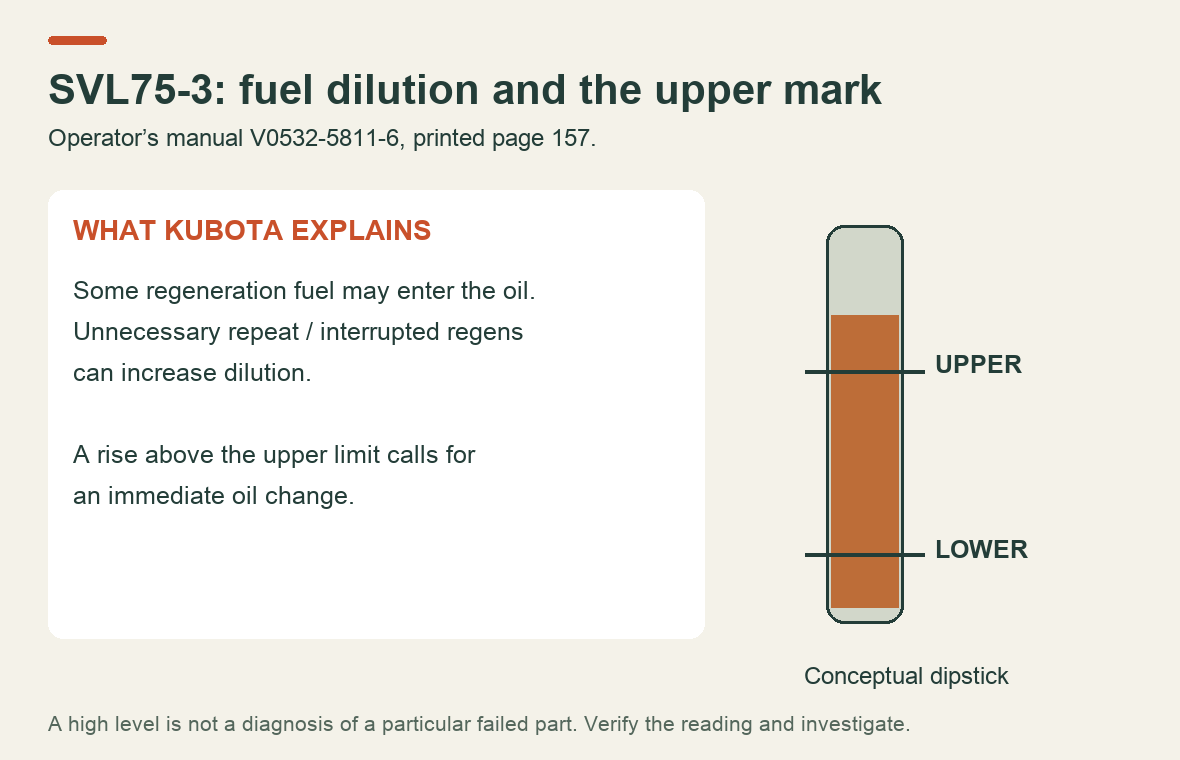
Do not keep working with a confirmed level above the upper mark while hoping it will settle. On the SVL75-3, Kubota specifically warns that a level rising above that mark can indicate excessive fuel dilution and calls for an immediate oil change. The example below comes from the SVL75-3 operator’s manual V0532-5811-6, printed page 157.
Was it overfilled, or is the level actually increasing?
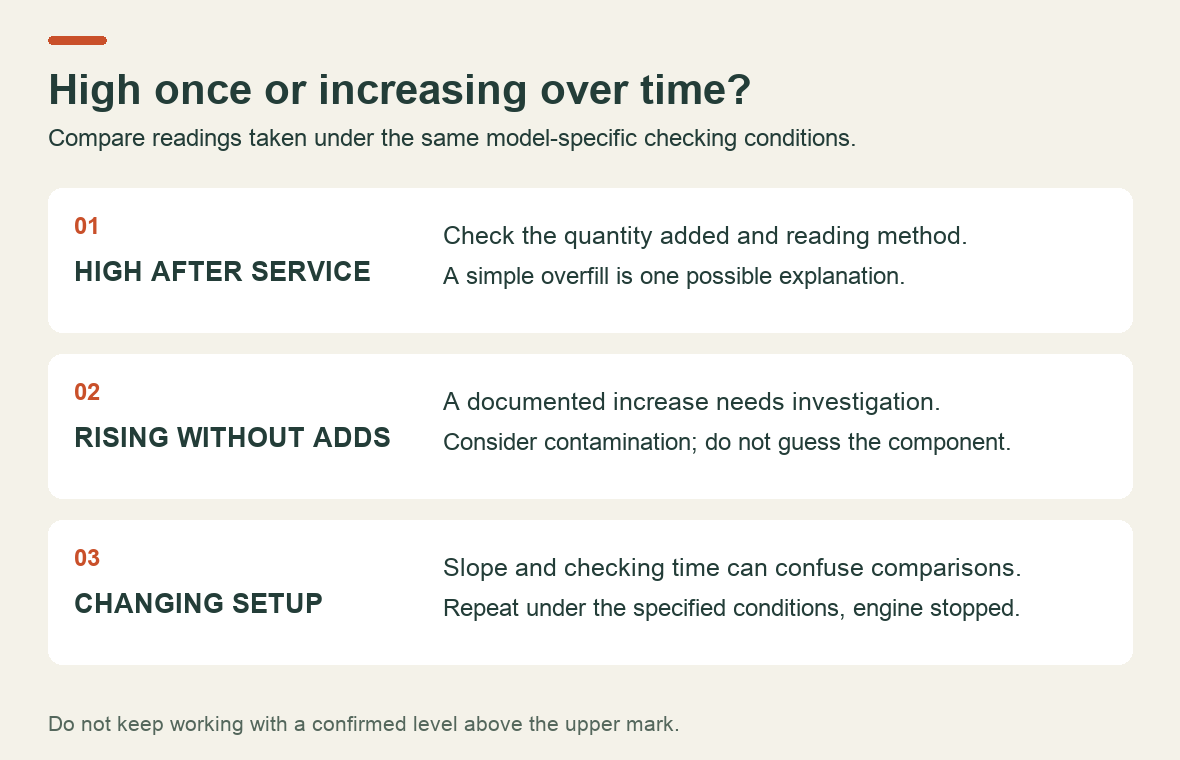
Those are different starting points. A dipstick that reads high immediately after a service may reflect the fill quantity or the checking conditions. A level that was correct after the service and rises over subsequent hours points to a developing problem.
| What you observed | What to establish next |
|---|---|
| High at the first check after an oil change | Quantity added, correct dipstick reading and whether the filter was changed |
| Higher than an earlier, comparable reading | Hours elapsed, any oil additions and evidence of contamination |
| Different readings on a slope or just after shutdown | Repeat the check under the model’s specified conditions |
| High oil level together with coolant loss | Report both symptoms; investigate possible coolant contamination as well as fuel |
Do not infer a failed injector from a single high reading. Equally, do not dismiss a documented upward trend because the engine still starts and sounds normal.
How do you confirm the dipstick reading?
For the SVL75-3 example, park on level ground, stop the engine and wait five minutes. Remove the dipstick, wipe it, reinsert it and read it again. The oil should be between its two notches. Use the checking procedure for your own model; the five-minute instruction here is not a universal specification for every Kubota engine.
If the first reading is already high, there is no reason to run the engine simply to create another test condition. Correct the checking setup with the engine stopped. Record the result and take a clear photograph of the wiped-and-reinserted dipstick reading if useful. Compare it with an earlier reading taken in the same way, not with a wet streak left on the stick during removal.
Can DPF regeneration put diesel into the engine oil?
Yes, on the SVL75-3 Kubota says a small amount of regeneration fuel may enter the engine oil and raise its level slightly. The same guidance warns that unnecessarily repeating or interrupting regeneration can increase this dilution. That explains one possible route into the sump; it does not make every rising oil level acceptable.
The upper mark remains a limit. The manual’s instruction to change excessively diluted oil takes precedence over an assumption that “it is only regen.” Nor should this explanation be applied to a machine that does not have a DPF. Identify the actual engine and emissions equipment before attributing the symptom to regeneration.
Does a diesel smell prove the oil is diluted?
A smell is a useful observation to report, not a measurement of fuel percentage. It also does not identify the leaking component. Blackstone Laboratories’ discussion of fuel in diesel engines describes several possible sources across diesel designs, including injection equipment and emissions-related operation. It emphasizes rising oil level and increasing fuel readings rather than one percentage applied to every engine.
Oil analysis can help separate those possibilities. Blackstone’s standard oil test description includes flashpoint testing for fuel contamination, viscosity measurement and examination for antifreeze-related contamination. Ask the laboratory how it wants the sample collected and tell it the oil grade, hours on the oil, engine model, fuel used and symptoms.
A report still needs interpretation alongside the machine’s service information. A fuel finding does not automatically condemn all the injectors, and a generic laboratory threshold does not override Kubota’s dipstick limit. Do not keep operating an over-limit machine while waiting for a sample result.
Can you just drain enough oil to bring it below full?
For a confirmed simple overfill, correcting the quantity addresses the excess volume. With suspected fuel dilution, removing a little of the mixture leaves diluted lubricant in the engine. It does not restore the oil’s properties or stop the source of contamination.
Have the contaminated oil changed according to the applicable service procedure and arrange diagnosis of the cause. Do not attempt an extra regeneration or a long, hard run to “burn off” contamination from an already over-limit sump. If a sample is needed, arrange to collect it during servicing rather than delaying the oil change.
What information makes diagnosis quicker?
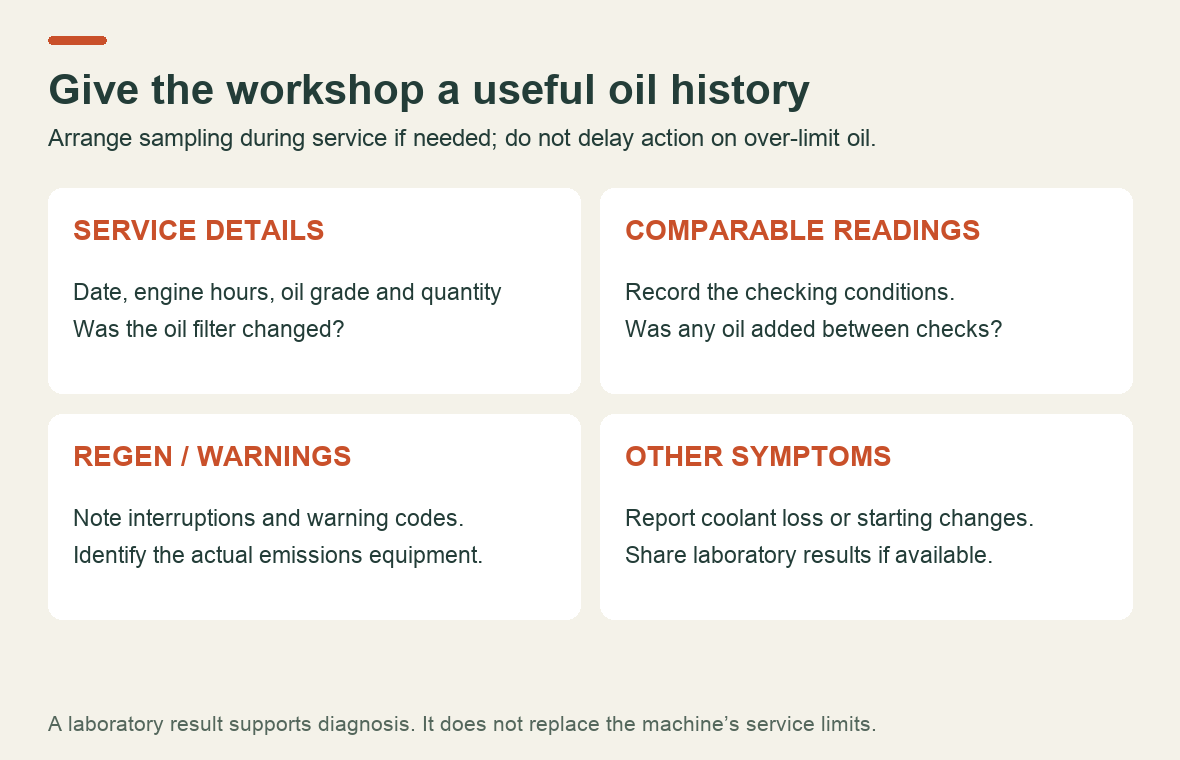
Give the workshop the model and serial number, hours at the last oil change, quantity and grade used, and when the level first increased. Include any warning codes, interrupted regenerations, coolant loss or change in starting behavior. State clearly whether oil was added between readings.
For an SVL75-3, Byte Market lists the RY911-31065 workshop manual. Its model-specific service information is useful when moving from a confirmed symptom to diagnosis. The aim is to establish why the level increased and verify that the cause has been corrected, rather than repeatedly draining the dipstick back to full.
Recent Post
-

Why a Kubota Manual May N...
16 Sep, 2026
-

Kubota Tractor Won’t Star...
16 Sep, 2026
-

Kubota DPF Light Flashing...
18 Sep, 2026
-

Kubota Tractor Overheatin...
21 Sep, 2026
-

Kubota Hydraulic Couplers...
22 Sep, 2026
-

Kubota UDT vs Super UDT2:...
23 Sep, 2026
-

Kubota 3-Point Hitch Won'...
24 Sep, 2026
-

Kubota Excavator Track Te...
25 Sep, 2026
-

New Holland 540 vs 540E P...
28 Sep, 2026
-

Kubota BX Mower Cutting U...
29 Sep, 2026
-

Kubota Excavator Controls...
30 Sep, 2026
-

New Holland DEF Storage:...
01 Oct, 2026
-

Kubota Air Filter: When t...
02 Oct, 2026
-

Kubota SVL Standard vs Hi...
06 Oct, 2026
-

New Holland Water in Fuel...
07 Oct, 2026
-

Kubota Loader Float: What...
08 Oct, 2026
-

Kubota HST Tractor Won't...
09 Oct, 2026
-

Kubota 50-Hour Service Ch...
12 Oct, 2026
-
Kubota 4WD Won't Disengag...
13 Oct, 2026
-
Kubota KX040-4 Final Driv...
14 Oct, 2026
-

Kubota PTO Won't Engage?...
15 Oct, 2026
-

How to Check Hydraulic Oi...
16 Oct, 2026
-

Kubota Battery Light Stay...
19 Oct, 2026
-
Kubota Ran Out of Diesel?...
20 Oct, 2026
-

Kubota SVL75-3 Lift Capac...
21 Oct, 2026
-

What Coolant Does a Kubot...
22 Oct, 2026
-
Kubota Engine Oil Level R...
23 Oct, 2026