Kubota SVL75-2 DPF Light Flashing: Check the Code and Inhibit Switch
Kubota SVL75-2 DPF Light Flashing: Check the Code and Inhibit Switch
A flashing light on an SVL75-2 deserves a more precise description than “it needs a regen.” Identify the symbol, record any code and check whether regeneration has been inhibited before pressing a switch. Those observations help distinguish a missing operating condition from a fault requiring service.
This article uses Kubota's SVL75-2 operator manual V0522-5814-4, English (Australia). Match that edition to your machine before using its values. An SVL75-3 or a Kubota tractor procedure is not an alternative set of instructions for this loader.
Is the DPF regenerating, waiting or reporting a fault?
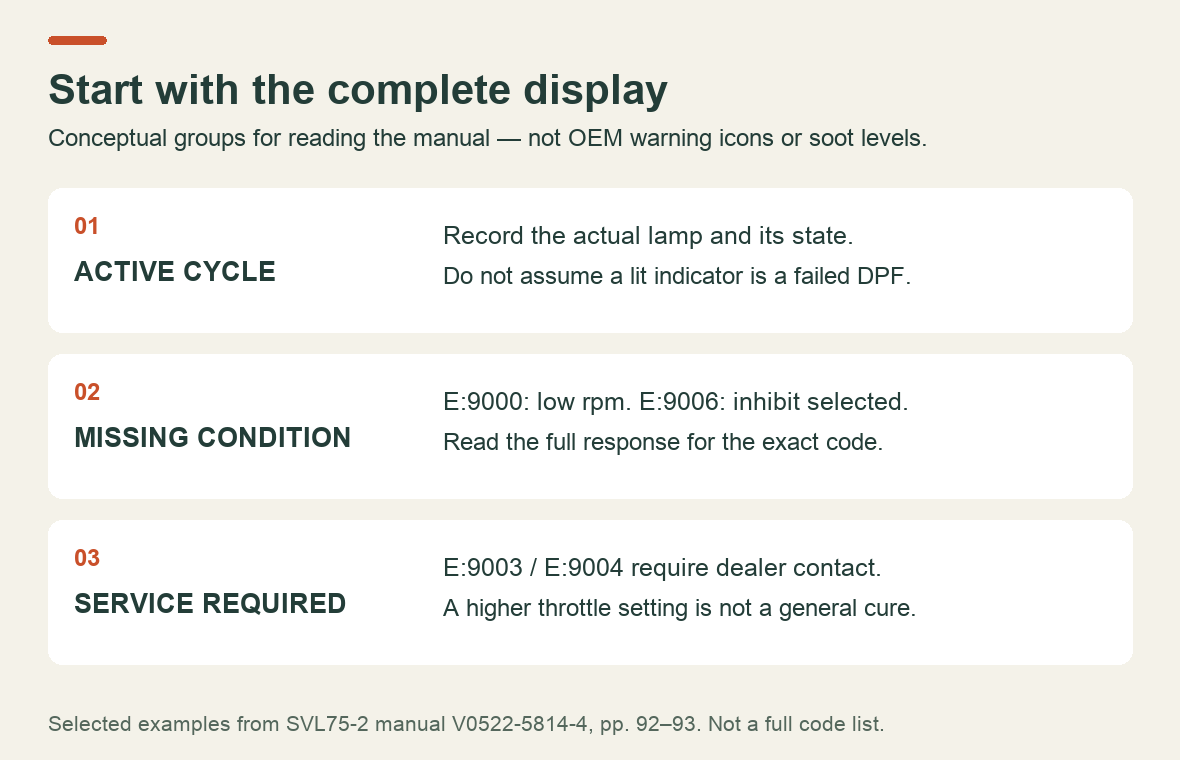
In the cited manual, a steady regeneration indicator accompanies an active cycle. A rev-up warning indicates insufficient engine speed. Record the complete display rather than assuming every flashing symbol is the same lamp.
The following selected entries help you find the relevant instruction in the manual's troubleshooting section, printed pages 92–93. They are not a complete fault-code list.
| Displayed code | What to investigate |
|---|---|
| E:9000 | Low engine speed preventing regeneration |
| E:9006 | The inhibit switch preventing regeneration |
| E:9003 | Regeneration required but unable to start: contact the dealer immediately |
| E:9004 | DPF replacement required: contact the dealer immediately |
Do not apply the E:9000 response to a different code. If a code persists after its prescribed owner action, contact the dealer. Reduced power or additional warnings are reasons to read the complete entry, including its restrictions, before continuing.
What does the DPF button do?
The switch described on printed page 9 is an inhibit switch. It disables automatic regeneration; pressing it again returns to automatic mode.
This is why a remembered “press the regen button” instruction can be misleading. Identify the control by its symbol and description. Do not keep toggling it while watching for a result.
Before allowing a cycle, choose a location clear of people and combustible material: the exhaust and DPF become very hot. Stay with the machine. Follow the manual's environmental precautions and the complete response for the displayed condition.
Why will regeneration not start?
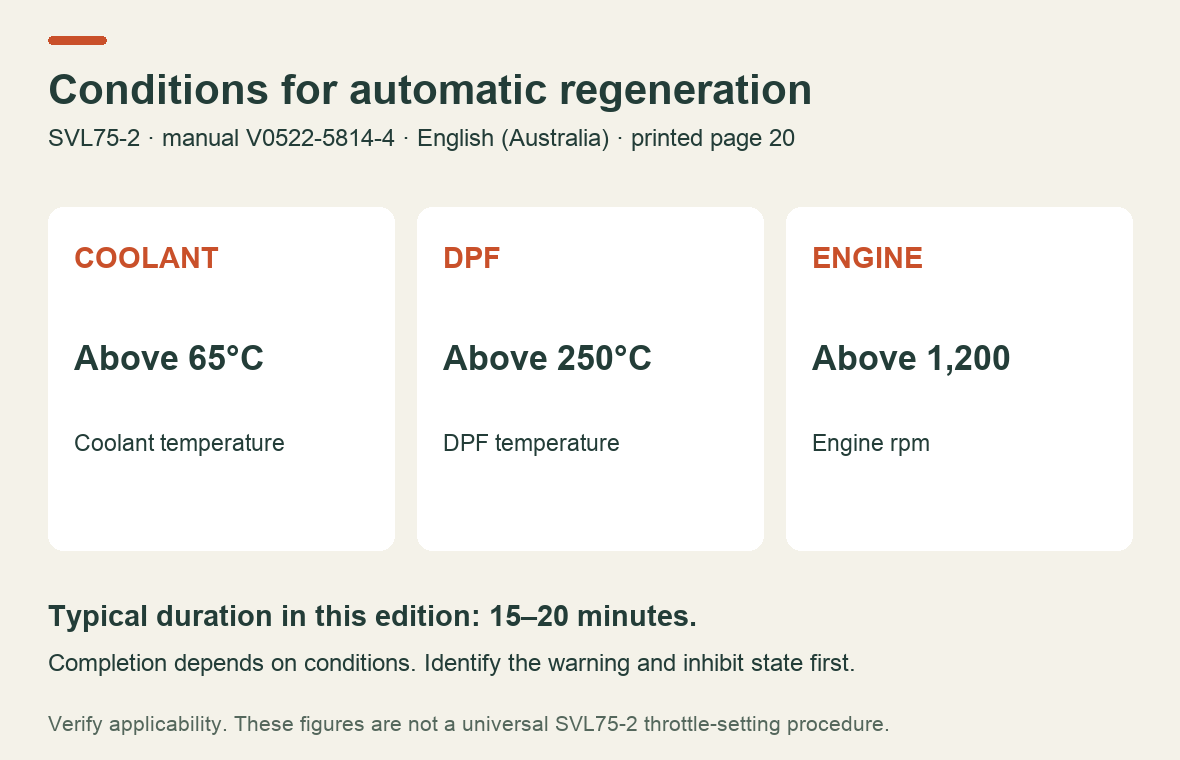
Printed page 20 specifies coolant above 65°C, DPF temperature above 250°C, and engine speed above 1,200 rpm for this edition. Typical duration is 15–20 minutes, with conditions affecting completion. An unmet condition can prevent or interrupt the cycle.
These are documented thresholds, not a universal SVL75-2 throttle setting or a countdown guaranteeing completion. Do not infer DPF temperature from coolant temperature, and do not touch the exhaust to check whether it is warm.
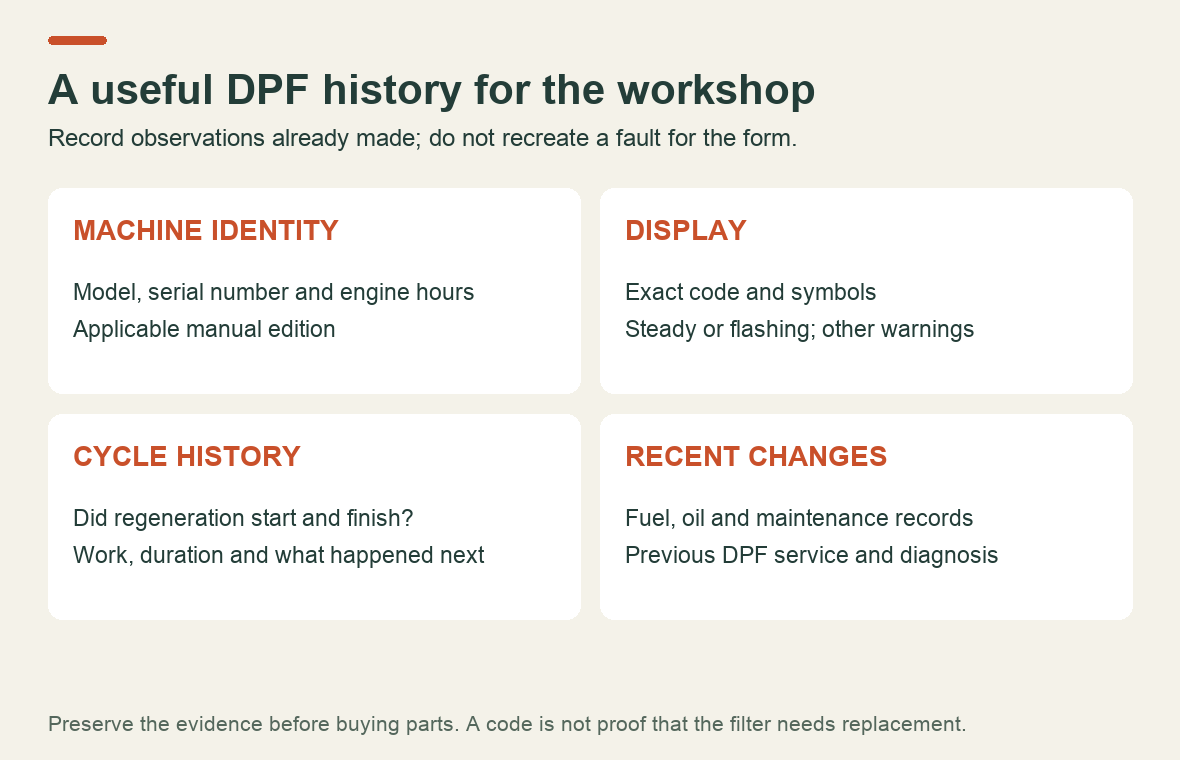
For a machine that repeatedly fails to complete a cycle, preserve the pattern of events: the starting condition, display, work being performed, elapsed time and what happened next. That is more useful to a technician than a list of button combinations tried.
A regen and a DPF cleaning service are different jobs
Kubota's engine glossary explains regeneration as burning accumulated particulate matter so it can leave the system as gas. It separately defines DPF cleaning as removing ash or excess particulate matter using specialist equipment and training.
Kubota Engine America's DPF cleaning program describes the inspection, thermal treatment and pneumatic cleaning involved in servicing a filter. Ash buildup can restrict exhaust flow. That is a reason to investigate the filter's service history, not proof that every warning means it needs replacement.
Ask the workshop to identify the proposed job precisely: an operating regeneration, diagnosis of a failed cycle, off-machine cleaning or replacement. The answers lead to different work, parts and costs. Request the diagnostic finding behind the recommendation; avoid ordering a DPF solely because the search term matches a warning you saw.
Repeated warnings: collect evidence before buying parts
Build a short timeline from events already observed. Do not reproduce a fault just to complete the record.
| Detail | What to record |
|---|---|
| Machine | SVL75-2 identification, serial number, hour reading and manual edition |
| Display | Exact code, symbols and whether each lamp is steady or flashing |
| Sequence | When the warning appeared, whether a cycle started and whether it completed |
| Work and history | Type of work, recent servicing, fuel or oil changes and previous DPF service |
| Workshop outcome | Tests performed, diagnosis, work completed and whether the warning returned |
A photo of the display taken from a safe position can preserve information lost in a description such as “the yellow light.” Distinguish what you saw from what someone suggested might be wrong.
Fuel history can matter too. Kubota Engine America's technical resources specify ultra-low-sulfur fuel for its Tier 4 common-rail engines equipped with aftertreatment and explain the risk from higher sulfur content. If a warning began after refuelling, retain the receipt and product information. Timing alone does not establish the cause.
Can you keep working, or force a parked regen?
A light alone is not enough information to approve either action. Read the response to the actual indicator and code in the applicable manual. Do not treat a dealer-level fault as permission to keep working at higher rpm.
Likewise, do not transplant a tractor's parked-regeneration sequence onto this loader. A search result mentioning parking brakes, a regeneration button and a throttle position may describe a different machine. A forced service procedure, where applicable, belongs to the correct diagnostic documentation and trained service personnel.
For the wider terminology, see Byte Market's general guide to Kubota DPF warnings. Its tractor examples do not override the SVL75-2 instructions discussed here.
Which documentation should you have?
Keep the applicable operator manual available for lamp meanings, operating limits and initial responses. For service planning, Byte Market lists the SVL75-2 workshop manual RY911-30550. Check the model, document details, revisions and contents against the task before buying. Ask about coverage if you need a particular diagnostic procedure.
Prepared by Byte Market Editorial from the linked manufacturer documentation. This is a source-based explanation, not a report of a hands-on diagnosis of your machine.
Recent Post
-
Why a Kubota Manual May N...
16 Sep, 2026
-
Kubota Tractor Won’t Star...
16 Sep, 2026
-
Kubota DPF Light Flashing...
18 Sep, 2026
-
Kubota Tractor Overheatin...
21 Sep, 2026
-
Kubota Hydraulic Couplers...
22 Sep, 2026
-

Kubota UDT vs Super UDT2:...
23 Sep, 2026
-
Kubota 3-Point Hitch Won'...
24 Sep, 2026
-
Kubota Excavator Track Te...
25 Sep, 2026
-
New Holland540 vs 540E PT...
28 Sep, 2026
-
Kubota BX Mower Cutting U...
29 Sep, 2026
-
Kubota Excavator Controls...
30 Sep, 2026
-
New Holland DEF Storage:...
01 Oct, 2026
-
Kubota Air Filter: When t...
02 Oct, 2026
-
Kubota SVL Standard vs Hi...
06 Oct, 2026
-
New Holland Water in Fuel...
07 Oct, 2026
-
Kubota Loader Float: What...
08 Oct, 2026
-
Kubota HST Tractor Won't...
09 Oct, 2026
-
Kubota 50-Hour Service Ch...
12 Oct, 2026
-
Kubota 4WD Won't Disengag...
13 Oct, 2026
-
Kubota KX040-4 Final Driv...
14 Oct, 2026
-
Kubota PTO Won't Engage?...
15 Oct, 2026
-
How to Check Hydraulic Oi...
16 Oct, 2026
-
Kubota Battery Light Stay...
19 Oct, 2026
-
Kubota Ran Out of Diesel?...
20 Oct, 2026
-
Kubota SVL75-3 Lift Capac...
21 Oct, 2026
-
What Coolant Does a Kubot...
22 Oct, 2026
-
Kubota Engine Oil Level R...
23 Oct, 2026
-
Kubota SVL75-2 DPF Light...
26 Oct, 2026