Kubota U55-4 Specs: Weight, Dimensions and Lift Capacity
Kubota U55-4 Specs: Weight, Dimensions and Lift Capacity
By Byte Market Editorial
The Kubota U55-4 is listed at 1,960 mm wide, 2,550 mm high and 5,500 mm long in the manufacturer brochures discussed below. Its weight depends on the cab, tracks, blade and the specification being quoted. For a standard-blade machine on rubber tracks, the U.S. brochure lists 11,915 lb with a canopy and 12,115 lb with a cab.
Australian documents give different weights for the corresponding descriptions. That makes a single “U55-4 specs” table surprisingly easy to misuse. Start with the configuration and document, especially if you are organizing transport or checking a lifting job.
How much does a Kubota U55-4 weigh?
The following comparison keeps the two sources separate. All four rows concern rubber tracks; steel-track figures are outside this table.
| U55-4 configuration | U.S. brochure | Australian brochure |
|---|---|---|
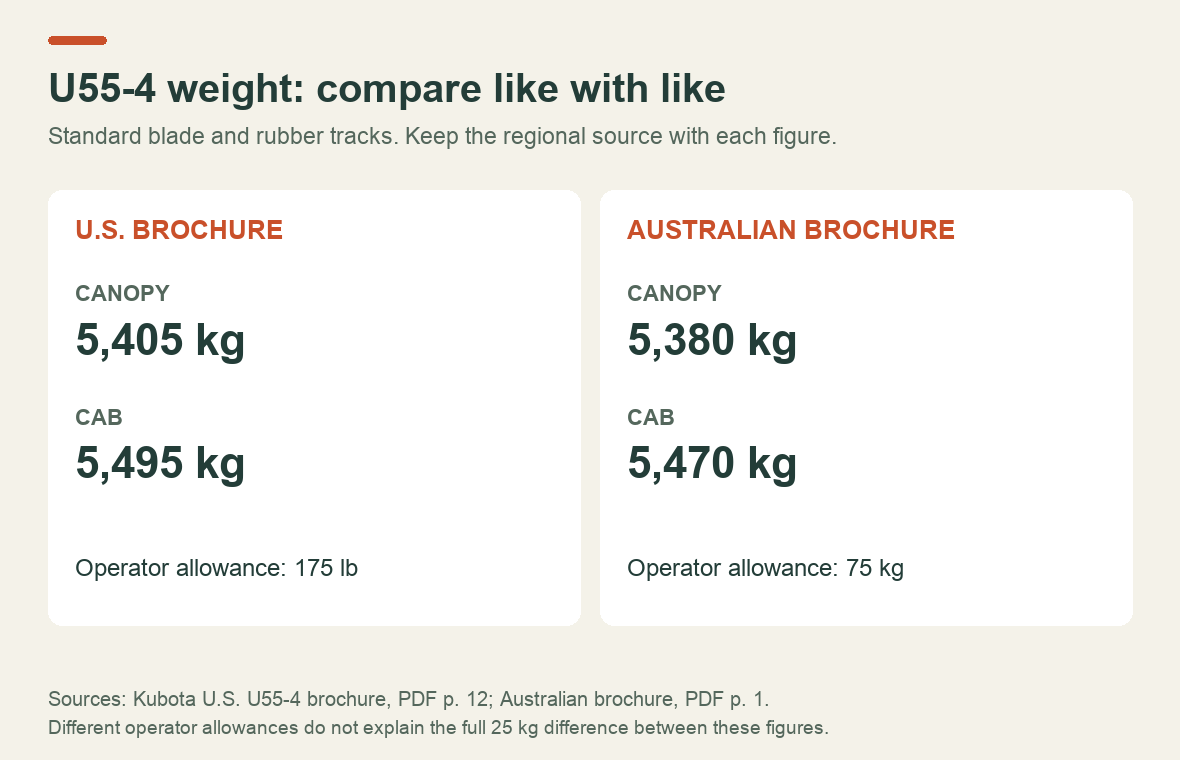
| Standard blade, canopy | 11,915 lb / 5,405 kg | 5,380 kg / about 11,861 lb |
| Standard blade, cab | 12,115 lb / 5,495 kg | 5,470 kg / about 12,059 lb |
| Angle blade, canopy | 12,335 lb / 5,595 kg | 5,570 kg / about 12,280 lb |
| Angle blade, cab | 12,535 lb / 5,685 kg | 5,660 kg / about 12,478 lb |
Sources: Kubota U.S. U55-4 brochure, PDF page 12, and Kubota Australian brochure, PDF page 1. U.S. unit pairs are reproduced as printed. The Australian pound figures are editorial conversions from kilograms, rounded to the nearest pound.
The U.S. weight definition includes a 175 lb operator; the Australian brochure includes a 75 kg operator. Those operator allowances differ by about 4.4 kg, which does not by itself explain the 25 kg difference between the corresponding published kilogram values. The documents do not resolve the remainder, so it should not be presented as a proven equipment change.
For a hauling quote, supply the actual machine's configuration, fitted coupler, bucket, thumb and any additional equipment traveling with it. Establish what the reference weight already includes, then use a measured weight for the finished load. Do not subtract an assumed operator allowance and treat the result as a certified transport weight.
What are the U55-4 transport dimensions?
| Dimension | Metric | U.S. brochure equivalent |
|---|---|---|
| Overall length | 5,500 mm | 18 ft 0.5 in |
| Overall width | 1,960 mm | 6 ft 5.2 in |
| Overall height | 2,550 mm | 8 ft 4.4 in |
These dimensions agree in the cited brochures. They describe the illustrated machine arrangement, not every attachment combination. A quick coupler, a different bucket or the way the attachment is stowed can change the space the machine occupies.
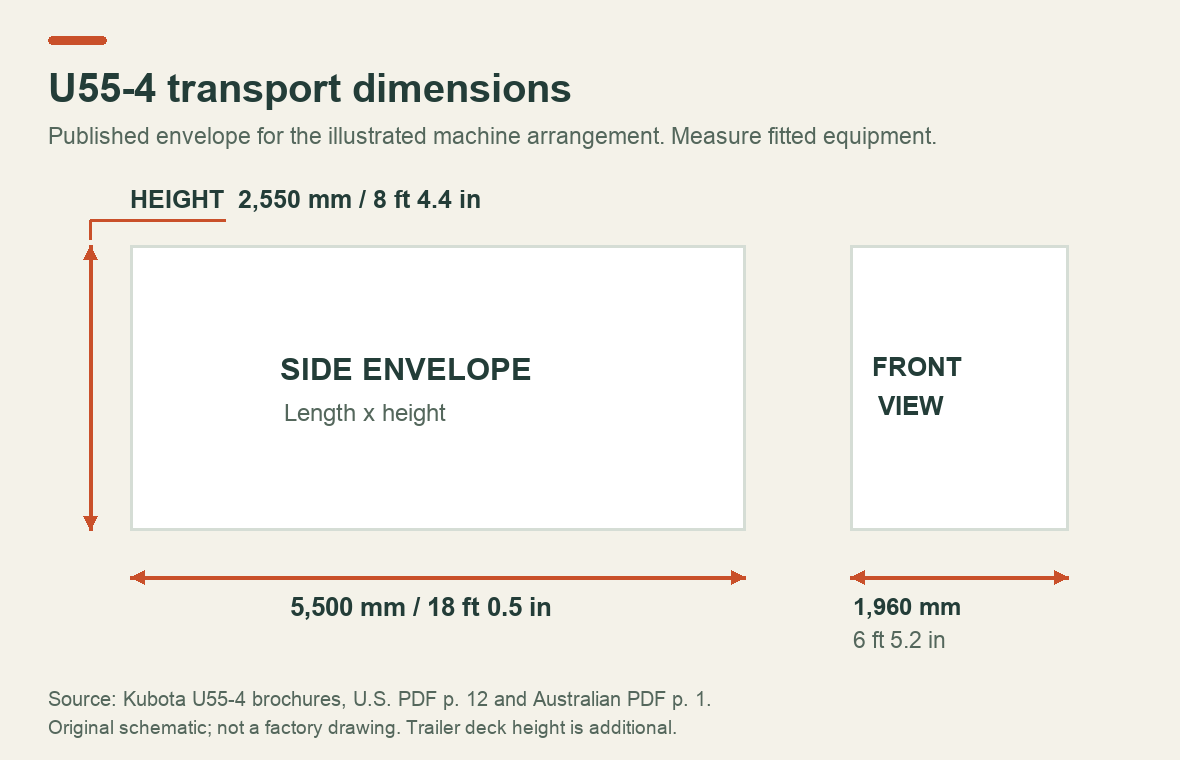
Measure the assembled machine before booking a tight access route or transport slot. For transport height, the deck height is additional to the machine height. Give the carrier both the reference dimensions and the measured arrangement rather than just describing it as a “five-ton excavator.”
Why do the engine specifications differ too?
The U.S. brochure names a V2607-CR-E4 engine. The Kubota Australia U55-4 product page names V2607-DI. Both give 47.6 gross hp, but their net-power entries differ slightly.
A common model badge therefore does not establish that every engine or emissions-related procedure applies. Identify the engine and machine serial numbers before using a service instruction, ordering a component or transferring advice from another owner's machine. This article concerns U55-4; a U55-5 table is not a substitute just because it appears in the same search results.
If two suppliers offer different parts for a machine described only as “U55,” send the full identification rather than choosing by appearance. Our guide to matching a Kubota manual to a machine explains the same problem for documentation.
How much can a Kubota U55-4 lift?
There is no single lift-capacity figure that answers every job. The relevant chart depends on lift-point radius and height, the direction of the load, blade position and machine configuration. Bucket breakout force is a digging-force specification; it is not the permitted weight of a suspended load.
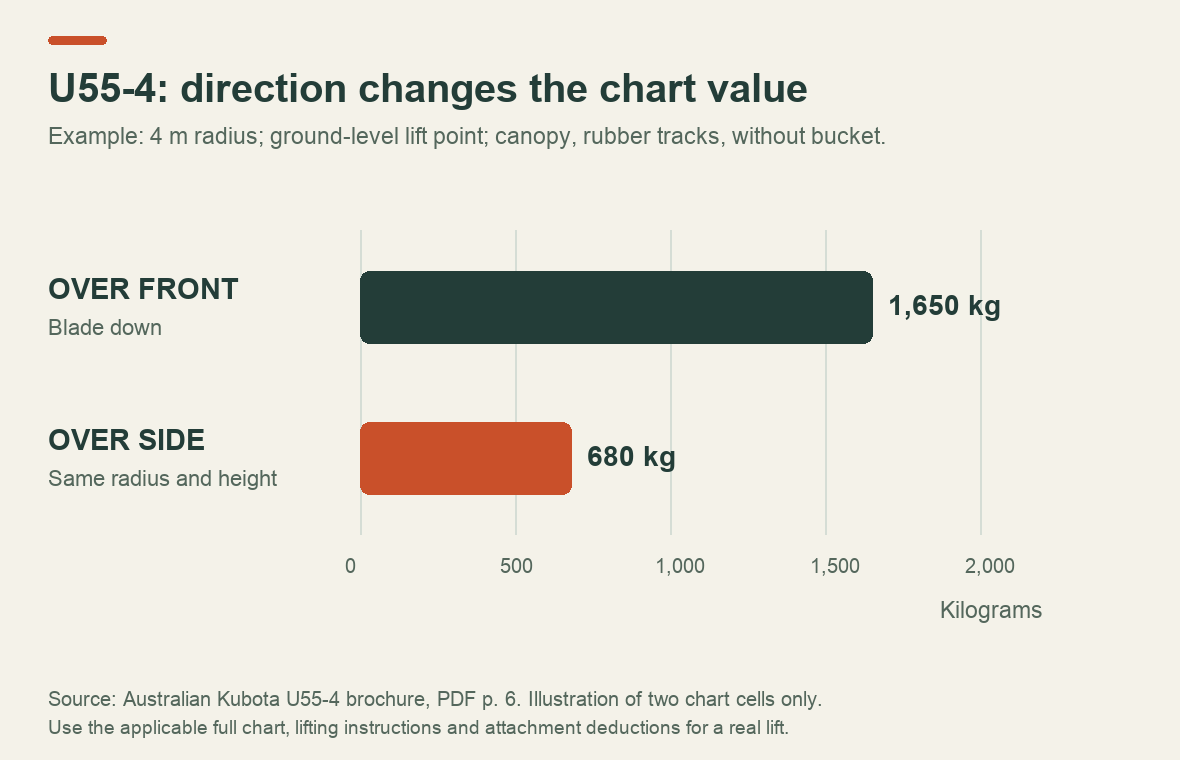
A small extract from the Australian brochure's lifting chart, PDF page 6, shows why direction matters. At 4 m lift-point radius and ground-level lift-point height, it lists:
| Chart position | Published value |
|---|---|
| Over front, blade down | 1.65 metric tonnes / 1,650 kg |
| Over side | 0.68 metric tonnes / 680 kg |
The chart specifies a canopy machine with rubber tracks, without a bucket. These two cells illustrate how to read that document; they are not a lifting plan for an unidentified U55-4. The chart's tonne values should not be read as U.S. short tons.
For the operating conditions, read the Kubota KX057-4/U55-4 Australian operator manual, printed page 92. It limits its chart values to even, hard ground and requires the bucket's weight to be subtracted when the bucket is fitted. Hooks, slings and other lifting accessories must also be accounted for. Use the chart and instructions applicable to the actual machine and approved lifting arrangement before planning a lift.
Notice what changes when a load moves: the lift point can move outward, upward and around the machine. Checking only the starting position misses the later part of the path. Record the conditions throughout the proposed movement, not just the most favorable number in the table.
Which hydraulic-flow number belongs in an attachment enquiry?
Kubota Australia's current product table lists AUX1 at 75 L/min and AUX2 at 37 L/min. These are different entries from the hydraulic pumps' combined specification. Send the attachment supplier the relevant circuit, the actual machine equipment and its operating requirements; do not substitute a sum of pump outputs for the auxiliary flow.
A breaker, auger or other hydraulic attachment also brings pressure, return-flow and coupling requirements. The machine and attachment documentation need to agree. If the immediate difficulty is connecting the hoses, our hydraulic-coupler guide addresses that separate question.
What information should you keep with the machine?
A short identification sheet is more useful than an unlabeled screenshot of a specification table. Record the machine serial number, engine identification, cab or canopy, track type, blade type, coupler and working attachment. Add the publication number of the operator manual and the source of any weight used for planning.
For control familiarization, see our ISO versus SAE excavator-controls guide. The installed selector and applicable instructions determine the actual pattern.
For diagnostic and repair work, Byte Market lists the U48-4/U55-4 workshop manual, RY911-20534. Check the edition and machine coverage before buying. Keep the applicable operator manual for operating restrictions and lifting charts; the presence of a workshop manual does not establish an approved lifting setup.
Prepared from the linked Kubota publications. Unit conversions and explanatory graphics are editorial work. No weighing or lifting test was performed, and differences between documents are not assigned an unverified cause.
Recent Post
-
Why a Kubota Manual May N...
16 Sep, 2026
-
Kubota Tractor Won’t Star...
16 Sep, 2026
-

Kubota DPF Light Flashing...
18 Sep, 2026
-
Kubota Tractor Overheatin...
21 Sep, 2026
-
Kubota Hydraulic Couplers...
22 Sep, 2026
-

Kubota UDT vs Super UDT2:...
23 Sep, 2026
-
Kubota 3-Point Hitch Won'...
24 Sep, 2026
-
Kubota Excavator Track Te...
25 Sep, 2026
-
New Holland540 vs 540E PT...
28 Sep, 2026
-
Kubota BX Mower Cutting U...
29 Sep, 2026
-
Kubota Excavator Controls...
30 Sep, 2026
-

New Holland DEF Storage:...
01 Oct, 2026
-
Kubota Air Filter: When t...
02 Oct, 2026
-
Kubota SVL Standard vs Hi...
06 Oct, 2026
-
New Holland Water in Fuel...
07 Oct, 2026
-
Kubota Loader Float: What...
08 Oct, 2026
-
Kubota HST Tractor Won't...
09 Oct, 2026
-

Kubota 50-Hour Service Ch...
12 Oct, 2026
-
Kubota 4WD Won't Disengag...
13 Oct, 2026
-
Kubota KX040-4 Final Driv...
14 Oct, 2026
-
Kubota PTO Won't Engage?...
15 Oct, 2026
-
How to Check Hydraulic Oi...
16 Oct, 2026
-
Kubota Battery Light Stay...
19 Oct, 2026
-
Kubota Ran Out of Diesel?...
20 Oct, 2026
-
Kubota SVL75-3 Lift Capac...
21 Oct, 2026
-
What Coolant Does a Kubot...
22 Oct, 2026
-

Kubota Engine Oil Level R...
23 Oct, 2026
-
Kubota SVL75-2 DPF Light...
26 Oct, 2026
-
Kubota U55-4 Specs: Weigh...
30 Oct, 2026