Kubota M7060 Specs: Weight, PTO Power and Loader Capacity
Kubota M7060 Specs: Weight, PTO Power and Loader Capacity
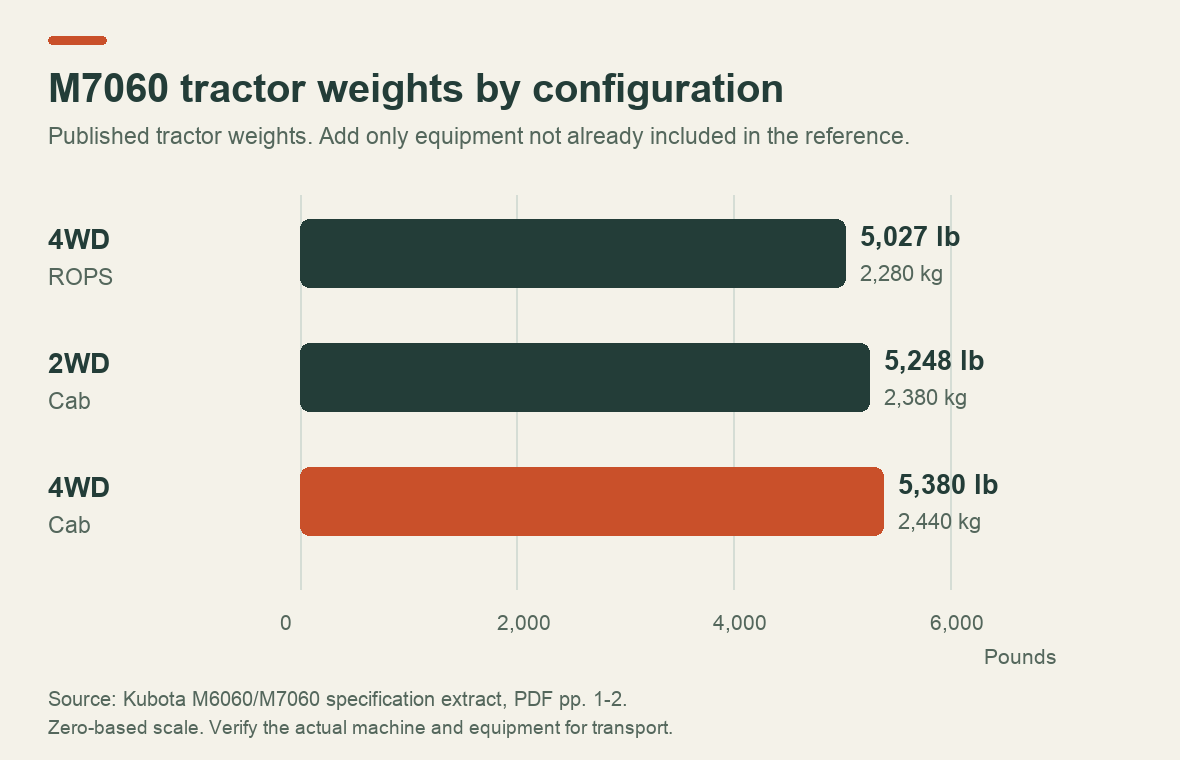
A 4WD Kubota M7060 is listed at 5,027 lb (2,280 kg) with ROPS or 5,380 lb (2,440 kg) with a cab in the manufacturer specification extract below. PTO power needs an extra check: different Kubota documents give 60, 62 or 64 hp.
That matters when buying a used tractor for a mower, baler or loader job. A listing that says “M7060, 4WD, loader” still leaves out information that can change the match. Here is how to read the main numbers without combining incompatible specifications.
Why is M7060 PTO horsepower listed as 60, 62 or 64?
Kubota's M6060/M7060 U.S. brochure, PDF page 16, lists 71 net engine hp and 64 PTO hp for M7060. Those figures also appear in the manufacturer's public specification extract.
However, Kubota cab operator manual 3C631-9972-4, printed page 3, hosted by Garton Tractor, gives the following:
| M7060 configuration in that cab manual | Net engine power | PTO power |
|---|---|---|
| 2WD | 68.8 hp / 51.3 kW | 62 hp / 46.2 kW |
| 4WD, F8/R8 transmission | 68.8 hp / 51.3 kW | 62 hp / 46.2 kW |
| 4WD, F12/R12 transmission | 68.8 hp / 51.3 kW | 60 hp / 44.7 kW |
The documents establish a difference, but do not explain it sufficiently to assign the change to a production year or a particular serial number here. Do not average the figures or choose the highest one. Match the manual to the tractor, then ask the dealer to resolve any disagreement with the sales description.
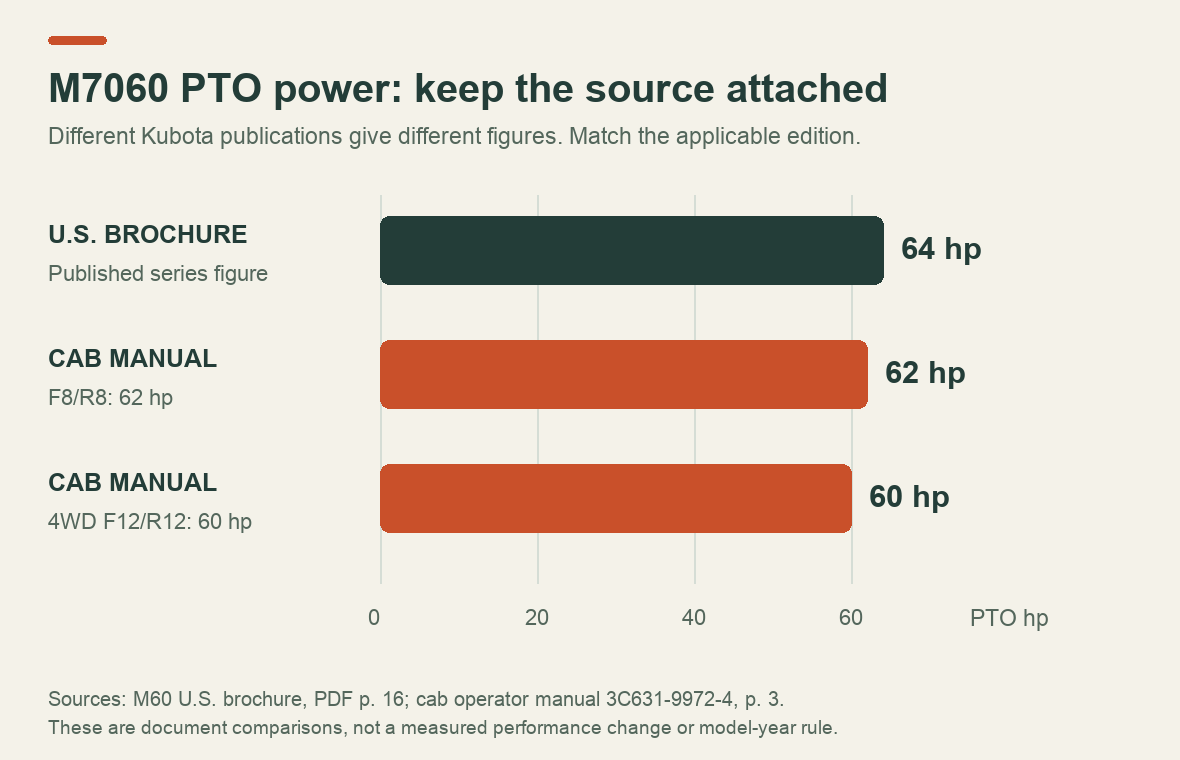
Suppose a prospective implement requires at least 63 PTO hp. The 64 hp brochure figure appears sufficient; the cab manual's 60 or 62 hp does not. That is a reason to confirm the pairing before purchase. Even a rating above the minimum would not settle hitch compatibility, implement weight or hydraulic requirements.
How much does a Kubota M7060 weigh?
The Kubota specification extract, PDF pages 1–2, separates these tractor configurations:
| M7060 version | Published tractor weight |
|---|---|
| 4WD, ROPS | 5,027 lb / 2,280 kg |
| 2WD, cab | 5,248 lb / 2,380 kg |
| 4WD, cab | 5,380 lb / 2,440 kg |
These are not ready-to-haul weights for every used M7060. A loader, attachment, liquid tire ballast, wheel weights and rear implement can change the actual total. For a transport quote, describe the entire machine as it will be carried and obtain its actual weight.
Ask a seller whether the rear tires contain liquid and whether wheel weights stay with the tractor. A photograph rarely answers either question reliably. Record whether a loader's quoted weight includes its bucket before adding the two together.
How much can the M7060 loader lift?
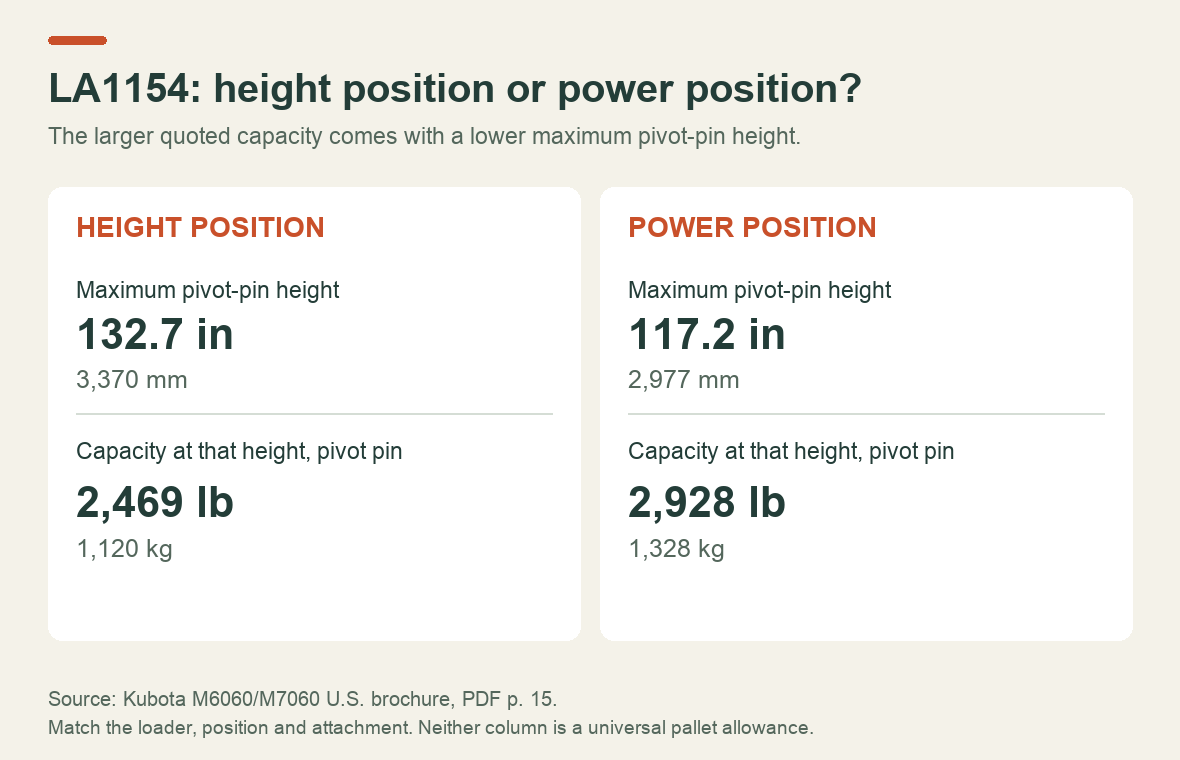
Identify the loader first. For the LA1154, the Kubota brochure's loader table, PDF page 15, distinguishes two boom-cylinder fulcrum positions:
| LA1154 specification | Height position | Power position |
|---|---|---|
| Maximum pivot-pin height | 132.7 in / 3,370 mm | 117.2 in / 2,977 mm |
| Lift capacity at pivot pin, to maximum height | 2,469 lb / 1,120 kg | 2,928 lb / 1,328 kg |
| Lift capacity at bucket center | 2,326 lb / 1,055 kg | 2,536 lb / 1,150 kg |
Power position gives the larger quoted lift figure while giving up 15.5 inches of maximum pivot-pin height. That difference, calculated from the table, can matter at a truck side or storage stack. Neither position's maximum figure is a universal pallet-fork or bale-handling allowance.
When comparing a load with a loader rating, write down the attachment and where the load sits. A bale spear and a material bucket do not put their loads in the same place. Confirm the applicable attachment limits and ballast instructions. A change of fulcrum position is a setup procedure for the loader manual, not something to improvise from this comparison.
What is the M7060 three-point hitch capacity?
The same manufacturer specification extract lists 4,189 lb (1,900 kg) at the lifting points and 3,307 lb (1,500 kg) 24 inches behind them. The latter is the figure commonly seen in M7060 summaries. These are rear-hitch specifications, separate from the LA1154 table.
A rear implement's center of gravity matters as well as its total weight. A long tool can place its load farther behind the tractor than a compact one. Keep the applicable implement limitations and front-ballast requirements beside the capacity figure when evaluating a combination.
Does the transmission choice affect anything besides travel speeds?
Yes. In the cited specification extract, F8/R8 and F12/R12 models have different hydraulic pump capacities: 11.0 versus 16.2 US gpm (41.6 versus 61.5 L/min). The same document differentiates their PTO speed arrangements. Check the fitted equipment before accepting a seller's broad “12-speed specification” description.
Pump flow is not a complete statement of what an attachment receives. The number and type of remote valves, return arrangement, required pressure and attachment instructions still need to match. Keep flow and lift capacity in separate columns: one describes oil delivery, while the other concerns a load under specified conditions.
For PTO work, compare the implement's required shaft speed and power with the tractor's applicable instructions. If the problem is that the shaft will not engage, use our Kubota PTO troubleshooting guide to organize the initial observations rather than treating horsepower as the diagnosis.
What should you request before buying a used M7060?
Ask for photographs of the tractor identification, transmission controls, loader plate and attachments, plus the manual publication number. Then make a short specification record:
- 2WD or 4WD; ROPS or cab; F8/R8 or F12/R12.
- The applicable engine and PTO ratings, with the document they came from.
- Loader model, fulcrum position and attachment—not merely “loader included.”
- Ballast, fitted remotes and the equipment you expect the tractor to operate.
This gives the seller or dealer specific questions to answer. It also leaves a useful record when someone later replaces an attachment or quotes a different specification.
Where does the workshop manual fit?
The operator manual covers use and operating limits; the loader and implement need their own instructions. If you are investigating a fault or planning repairs, Byte Market lists the M6060/M7060 workshop manual, 9Y111-08268. Check its coverage and edition for the actual tractor and task.
For servicing questions beyond these specifications, our UDT versus Super UDT2 guide explains how to read fluid recommendations. A general fluid comparison does not replace the M7060's own maintenance instructions.
Document differences are reported explicitly rather than assigned to an unverified model year. Illustrations show published specifications, not results from a dynamometer or lifting test.
Recent Post
-
Why a Kubota Manual May N...
16 Sep, 2026
-
Kubota Tractor Won’t Star...
16 Sep, 2026
-
Kubota DPF Light Flashing...
18 Sep, 2026
-
Kubota Tractor Overheatin...
21 Sep, 2026
-
Kubota Hydraulic Couplers...
22 Sep, 2026
-

Kubota UDT vs Super UDT2:...
23 Sep, 2026
-
Kubota 3-Point Hitch Won'...
24 Sep, 2026
-
Kubota Excavator Track Te...
25 Sep, 2026
-
New Holland540 vs 540E PT...
28 Sep, 2026
-
Kubota BX Mower Cutting U...
29 Sep, 2026
-
Kubota Excavator Controls...
30 Sep, 2026
-

New Holland DEF Storage:...
01 Oct, 2026
-

Kubota Air Filter: When t...
02 Oct, 2026
-
Kubota SVL Standard vs Hi...
06 Oct, 2026
-
New Holland Water in Fuel...
07 Oct, 2026
-
Kubota Loader Float: What...
08 Oct, 2026
-
Kubota HST Tractor Won't...
09 Oct, 2026
-
Kubota 50-Hour Service Ch...
12 Oct, 2026
-
Kubota 4WD Won't Disengag...
13 Oct, 2026
-
Kubota KX040-4 Final Driv...
14 Oct, 2026
-
Kubota PTO Won't Engage?...
15 Oct, 2026
-
How to Check Hydraulic Oi...
16 Oct, 2026
-
Kubota Battery Light Stay...
19 Oct, 2026
-
Kubota Ran Out of Diesel?...
20 Oct, 2026
-
Kubota SVL75-3 Lift Capac...
21 Oct, 2026
-
What Coolant Does a Kubot...
22 Oct, 2026
-
Kubota Engine Oil Level R...
23 Oct, 2026
-
Kubota SVL75-2 DPF Light...
26 Oct, 2026
-
Kubota U55-4 Specs: Weigh...
30 Oct, 2026
-
Kubota M7060 Specs: Weigh...
02 Nov, 2026