Kubota L2501 Specs: Weight, Horsepower and Loader Capacity Explained
Kubota L2501 Specs: Weight, Horsepower and Loader Capacity Explained
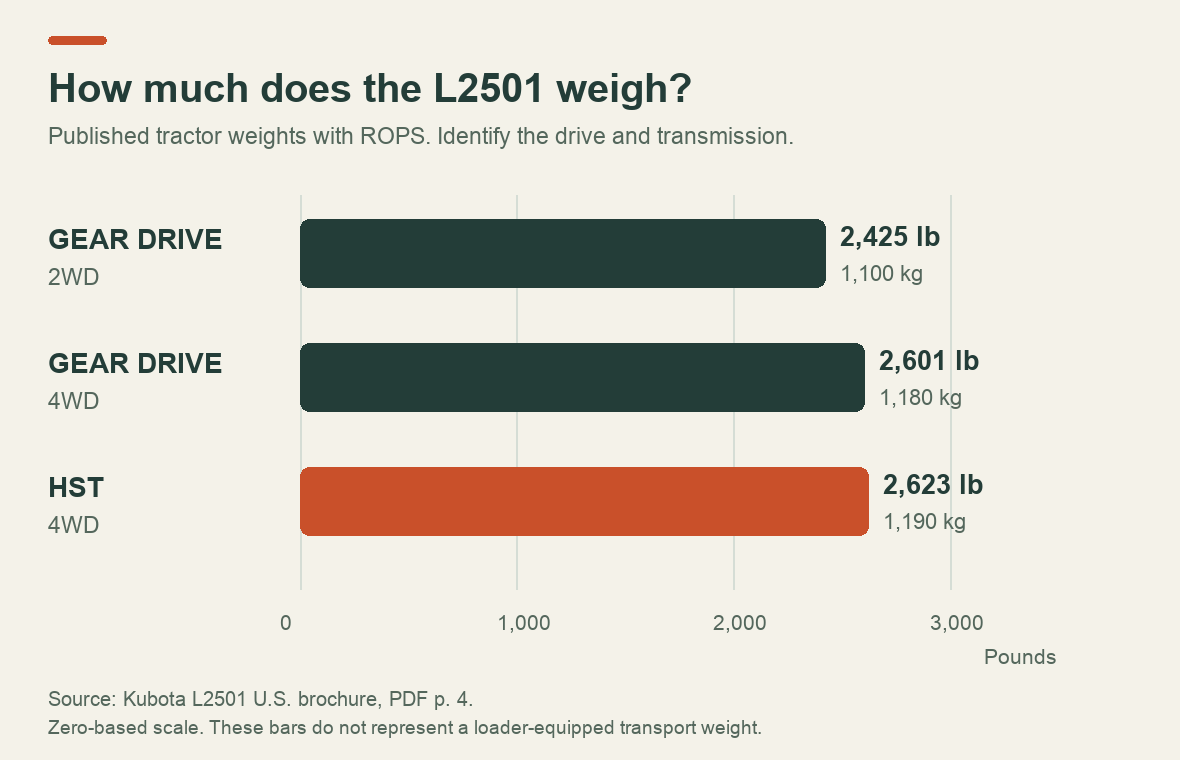
The Kubota L2501 has a 24.8 hp engine and a published tractor weight of 2,425–2,623 lb (1,100–1,190 kg), depending on the transmission and drive configuration. Those are tractor figures. They do not describe the weight of a loader-equipped machine, and engine horsepower does not tell you how much a bucket or pallet fork can lift.
The most useful specifications are the ones that match the tractor in front of you. The U.S. documents below distinguish gear-drive and HST models—and reveal a disagreement about LA525 loader capacity that is easy to miss when copying a specification list.
Kubota L2501 specifications: gear drive versus HST
| Specification | Gear drive, 2WD | Gear drive, 4WD | HST, 4WD |
|---|---|---|---|
| Engine gross power | 24.8 hp / 18.5 kW | 24.8 hp / 18.5 kW | 24.8 hp / 18.5 kW |
| PTO power | 20.5 hp / 15.3 kW | 20.5 hp / 15.3 kW | 19.0 hp / 14.2 kW |
| Transmission | 8 forward, 4 reverse | 8 forward, 4 reverse | Hydrostatic, 3 ranges |
| Weight with ROPS | 2,425 lb / 1,100 kg | 2,601 lb / 1,180 kg | 2,623 lb / 1,190 kg |
Source: Kubota L2501 U.S. brochure, PDF page 4. Its engine rating is gross power under SAE J1995. The weight row specifies ROPS. Treat this table as a reference for those configurations, then check the edition and equipment supplied with your machine.
How much does an L2501 weigh with a loader?
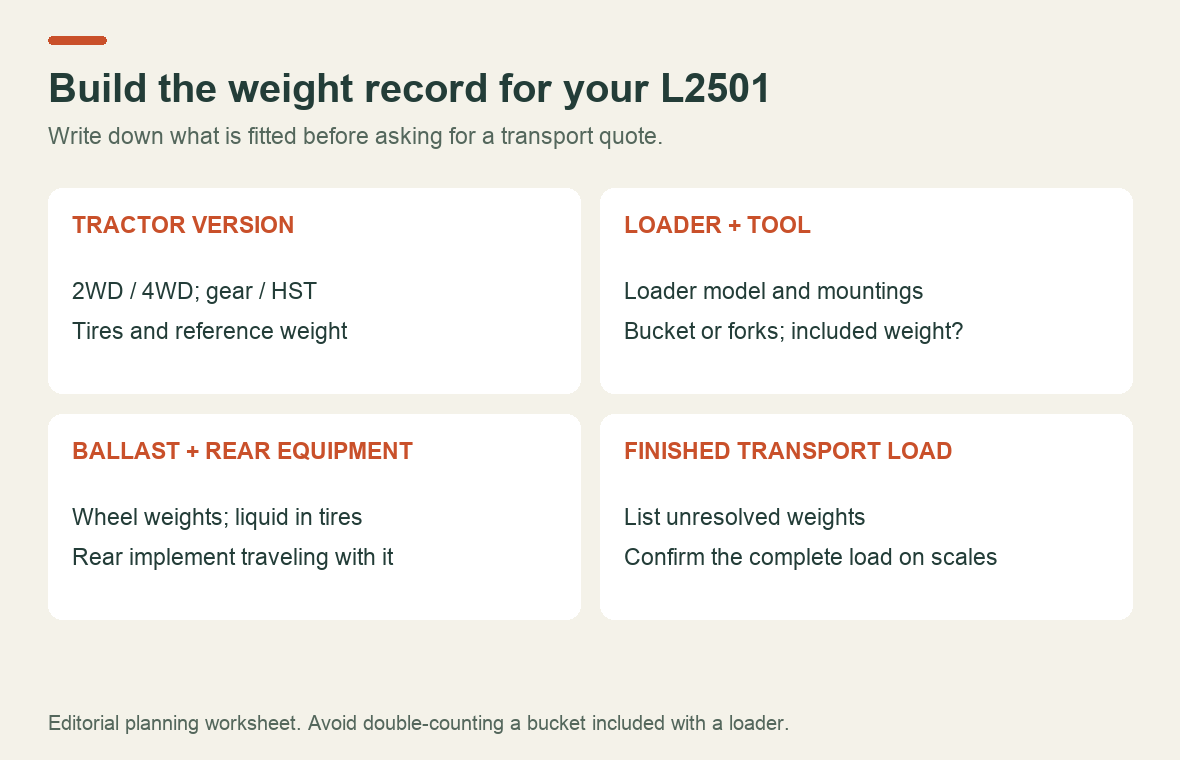
There is no single useful answer without identifying the equipment. The tractor weights above are a starting point, not a complete transport weight. Record the loader, bucket or forks, mounting equipment, wheel weights, tire ballast and any rear implement that will travel with it.
A parts listing can also create a double count. A loader weight might include its bucket; another listing might cover only the loader assembly. Keep an “included already?” column beside every item. If you cannot establish what a quoted weight includes, leave it unresolved until the supplier confirms it.
| Item to identify | What to record |
|---|---|
| Tractor | Exact version, tires and the definition of the published weight |
| Loader assembly | Model, mounting equipment and whether its stated weight includes a bucket |
| Attachment | The actual bucket, fork frame or other tool fitted for transport |
| Ballast and rear equipment | Wheel weights, liquid ballast and any implement carried with the tractor |
Use the finished inventory to arrange a scale check of the actual outfit. When planning transport, trailer payload is only one limit: vehicle, trailer, axle, tire and coupling ratings must also suit the loaded combination. A catalogue total is useful preparation for that check, not a substitute for it.
How much can the L2501 lift?
First identify which end of the tractor you mean. Kubota's L2501 detailed specifications, PDF page 3, give rear three-point hitch ratings of 1,918 lb (870 kg) at the lift points and 1,389 lb (630 kg) 24 inches behind them. Neither is a loader rating.
For the front loader, the separate Winter 2017 Kubota loader specification sheet, L2501/LA525 table, gives:
| LA525 on L2501 | Published capacity |
|---|---|
| At the bucket pivot pin, maximum height | 1,082 lb / 491 kg |
| 500 mm forward of the pivot pin, maximum height | 820 lb / 372 kg |
| At the bucket pivot pin, 1,500 mm lift height | 1,431 lb / 649 kg |
The sheet lists a maximum pivot-pin height of 94.3 inches (2,394 mm). The larger capacity at a lower height illustrates why a number without its measuring position is incomplete.
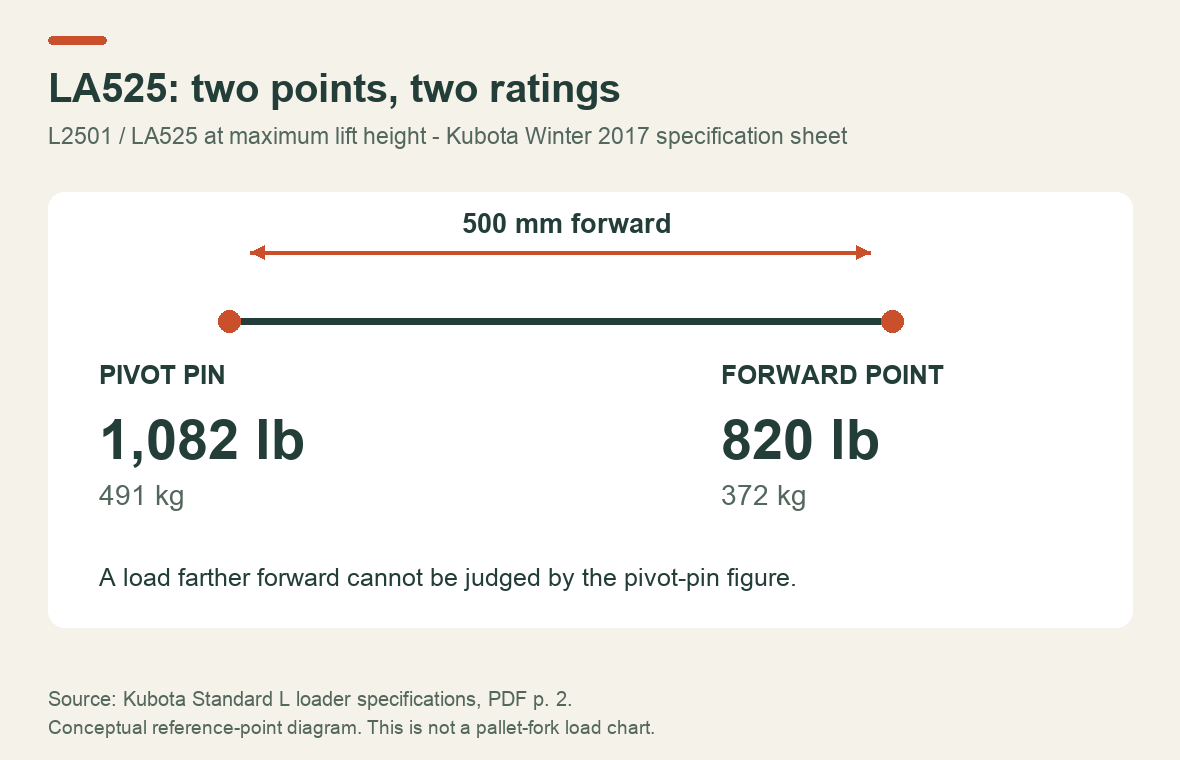
A pallet's load center can sit farther forward than the reference point, and the fork attachment has its own weight. These ratings therefore do not promise that the tractor can safely handle a pallet of the same stated weight. Match the load, attachment, ballast and operating conditions to the applicable loader instructions. Do not use breakout force as a payload figure.
Why do other L2501 pages say 1,131 lb?
That figure is not simply an internet invention. The 2014 L2501 brochure, PDF page 3, advertises 1,131 lb at the pivot pin. The later detailed loader sheet separates L2501 from L3301/L3901: it assigns 1,082 lb to L2501 and 1,131 lb to the larger tractors.
The documents do not establish why the earlier L2501 claim differs. It would be a guess to attribute it to a pressure setting, a revision or a particular bucket. For comparison, use the table explicitly naming L2501; for operation, confirm the applicable loader manual against the tractor and loader identification. Do not adjust hydraulic pressure to make the machine reach a number found online.
Which horsepower figure matters for an implement?
An implement that specifies PTO horsepower needs to be compared with the PTO rating. An advertisement saying “25 hp tractor” is too imprecise for a marginal match. The gear-drive and HST figures in the opening table are different even though both machines have the same published engine gross power.
For example, if an implement lists a 20 PTO-hp minimum, the published gear-drive figure clears that numerical threshold, while the HST figure does not. This arithmetic is only the first check, not approval of the combination. Implement weight, hitch requirements, driveline compatibility and the work being done can still rule it out. Ask the equipment supplier to verify the complete pairing.
If your HST tractor already has a movement problem, that calls for diagnosis rather than a specification comparison. See our checks for a Kubota HST tractor that will not move.
Which manual should you use next?
Keep three questions separate: operating the tractor, using the attachment and repairing a fault. The tractor operator manual and loader operator manual establish operating instructions and restrictions. Kubota's My Kubota support page explains how to find available machine and attachment resources.
For repair planning, Byte Market lists the Kubota L2501 workshop manual, 9Y111-11210. Check the product details and applicability before buying; a tractor workshop manual should not be assumed to include the separate LA525 operating instructions.
If the next job is maintenance, our 50-hour service guide explains how to separate oil changes, filter changes and inspections. Its worked examples are for other named models, so use your L2501 schedule to decide what is actually due.
Prepared from the manufacturer documents linked beside the relevant figures. The illustrations are original explanatory graphics; no machine weighing or lifting test was performed for this article.
Recent Post
-

Why a Kubota Manual May N...
16 Sep, 2026
-
Kubota Tractor Won’t Star...
16 Sep, 2026
-

Kubota DPF Light Flashing...
18 Sep, 2026
-
Kubota Tractor Overheatin...
21 Sep, 2026
-
Kubota Hydraulic Couplers...
22 Sep, 2026
-

Kubota UDT vs Super UDT2:...
23 Sep, 2026
-
Kubota 3-Point Hitch Won'...
24 Sep, 2026
-
Kubota Excavator Track Te...
25 Sep, 2026
-
New Holland540 vs 540E PT...
28 Sep, 2026
-
Kubota BX Mower Cutting U...
29 Sep, 2026
-
Kubota Excavator Controls...
30 Sep, 2026
-

New Holland DEF Storage:...
01 Oct, 2026
-

Kubota Air Filter: When t...
02 Oct, 2026
-
Kubota SVL Standard vs Hi...
06 Oct, 2026
-

New Holland Water in Fuel...
07 Oct, 2026
-
Kubota Loader Float: What...
08 Oct, 2026
-
Kubota HST Tractor Won't...
09 Oct, 2026
-

Kubota 50-Hour Service Ch...
12 Oct, 2026
-
Kubota 4WD Won't Disengag...
13 Oct, 2026
-
Kubota KX040-4 Final Driv...
14 Oct, 2026
-
Kubota PTO Won't Engage?...
15 Oct, 2026
-
How to Check Hydraulic Oi...
16 Oct, 2026
-

Kubota Battery Light Stay...
19 Oct, 2026
-
Kubota Ran Out of Diesel?...
20 Oct, 2026
-
Kubota SVL75-3 Lift Capac...
21 Oct, 2026
-
What Coolant Does a Kubot...
22 Oct, 2026
-

Kubota Engine Oil Level R...
23 Oct, 2026
-
Kubota SVL75-2 DPF Light...
26 Oct, 2026
-
Kubota U55-4 Specs: Weigh...
30 Oct, 2026
-
Kubota M7060 Specs: Weigh...
02 Nov, 2026
-
Kubota L2501 Specs: Weigh...
03 Nov, 2026