Kubota D1105 Oil Capacity: Check the Engine Version and Oil Pan
Kubota D1105 Oil Capacity: Check the Engine Version and Oil Pan
Kubota lists 5.1 litres (about 5.4 US quarts) for a D1105-E with the standard oil pan. If you are servicing a B2601HSD tractor, its own manual specifies 3.1 litres (3.3 US quarts) with a filter change for the installed D1105-E4-D32. Both quantities come from Kubota. Which one belongs on your service sheet depends on the engine version and the machine it powers. 05 Series engine manual, printed p. 15 · B2601 tractor manual, printed p. 47.
Find the oil capacity that applies to your machine
| What you can identify | Published engine-oil quantity | Where to check |
|---|---|---|
| D1105-E or D1105-TE with the standard pan in the cited 05 Series manual | 5.1 L / 1.35 US gal (about 5.4 US qt) | Engine oil quantity table, printed p. 15. The table specifies standard pans. |
| B2601HSD tractor with D1105-E4-D32 | 3.1 L / 3.3 US qt with filter | Tractor specification table, printed p. 2, and lubricant table, p. 47. |
| A D1105 in another machine, or an engine with an uncertain pan or dipstick | Confirm from its application documentation | Record the engine serial number and equipment model before buying oil and a filter. |
Think of the owner who buys a five-litre container. It holds more than the B2601’s listed refill, but it falls just short of the 5.1-litre standard-pan entry. Using the engine name alone to plan that purchase can leave the owner with too little oil on the shelf or too much in the crankcase. The two documented examples differ by a full two litres.
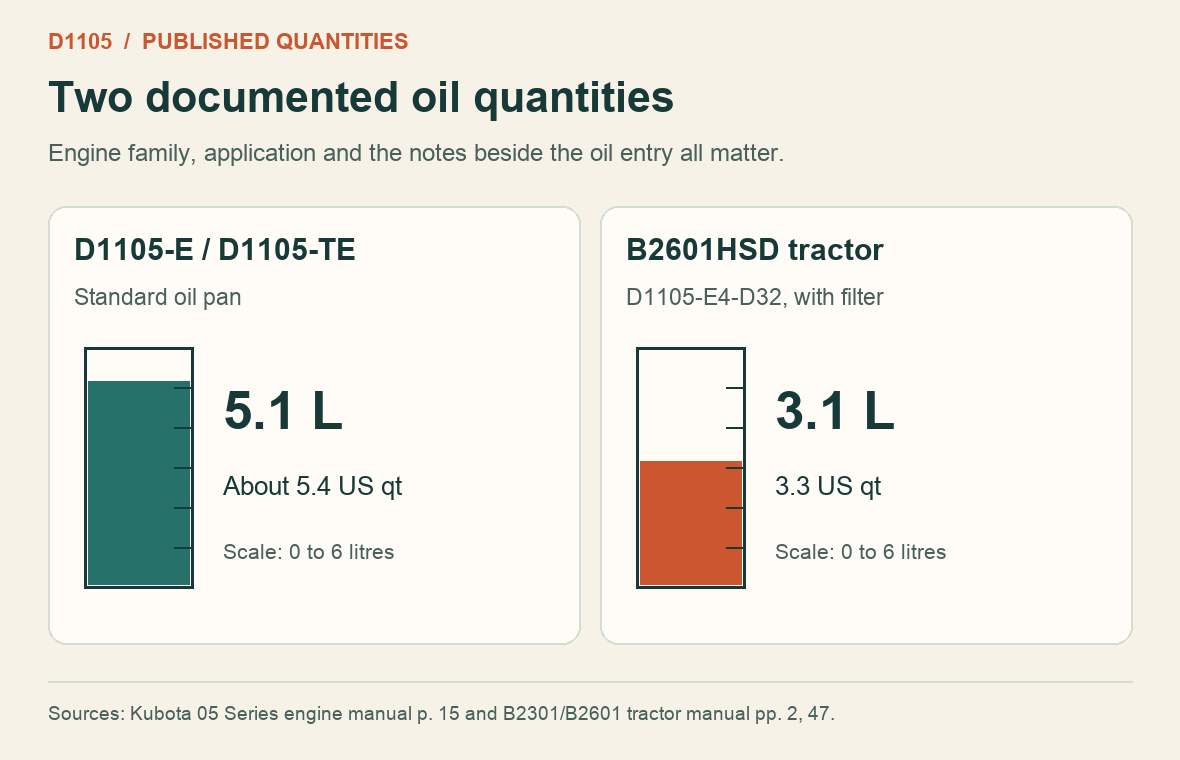
Keep the units when copying a figure. The engine manual prints 1.35 U.S. gallons. A U.S. gallon contains four U.S. quarts. Writing just “1.35” or assuming the gallon is Imperial changes the quantity materially. Litres are a convenient common unit if the manual and your measuring jug use different systems.
Where to find the full engine identification
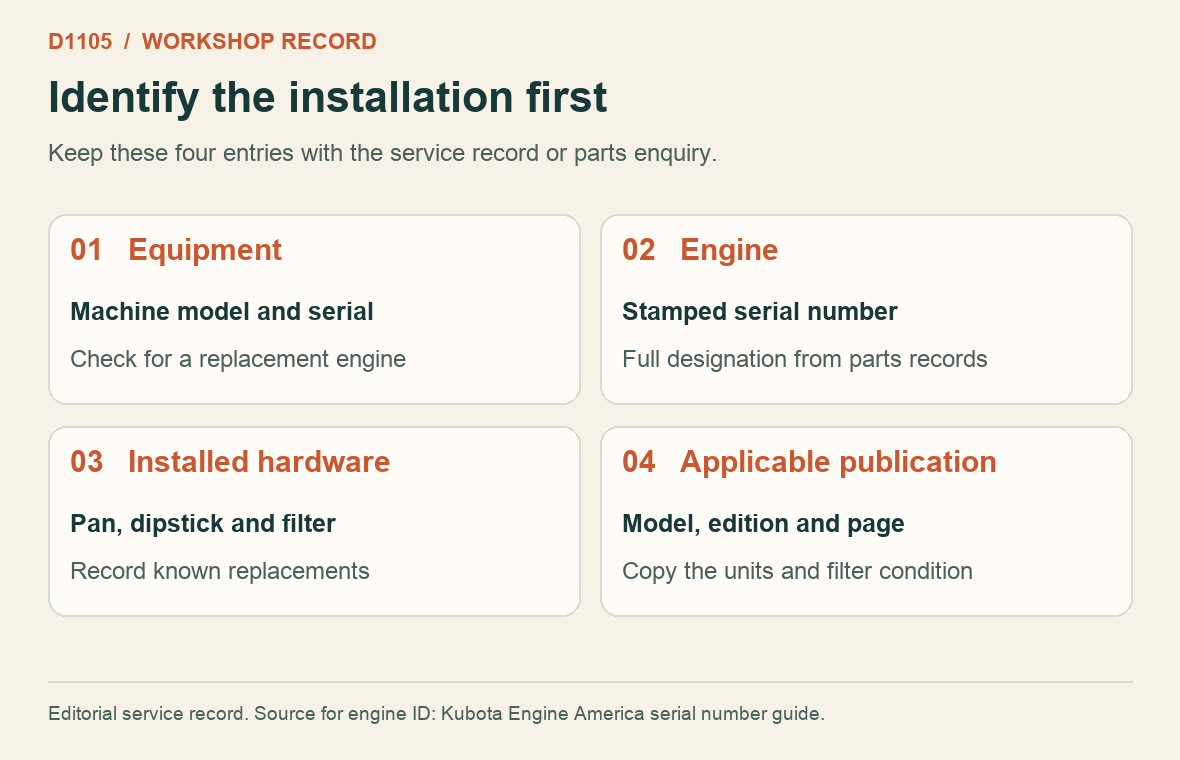
Start with the equipment model and serial number. Then find the stamped engine serial number. Kubota Engine America shows the 05 Series locations below the exhaust manifold and above the crankcase toward the flywheel. Its identification guide includes photographs and points to the illustrated parts list for the full engine model name. An emissions sticker alone will leave out information a parts desk needs. Kubota engine serial number locations and model identification.
For a used machine, note whether the engine has been replaced. The equipment manual may describe its original engine perfectly while the engine now in the frame carries a different identification. If the pan or dipstick has also been changed, give the dealer or engine supplier the serial number, the machine details and clear photographs of the installed parts. Matching the pieces matters more than choosing the most common result for “D1105 oil capacity.”
What if the oil pan looks different?
The 05 Series manual limits its quantity table to standard oil pans. Elsewhere it identifies an optional shallow pan when discussing oil-change intervals. That tells you why pan identification is worth the trouble. The interval table does not give you a replacement refill figure for every pan. The B2601 tractor manual supplies its own figure for a named installation. The cited documents do not attribute the entire two-litre difference to pan depth alone. 05 Series maintenance notes, printed p. 10 · B2601 engine identification and capacity, printed p. 2.
Measuring the outside of the pan with a ruler cannot tell you how much oil remains after draining, where the pickup sits or which dipstick is fitted. When the machine manual, installed hardware and dipstick disagree, resolve the mismatch before running the engine. The quantity that drained out is also a poor way to reconstruct an unknown service specification. The previous fill could already have been high or low.
Choose the oil and filter for the application
Capacity answers how much to buy. The oil must also meet the viscosity and performance requirements for the machine. For example, the B2601 manual’s table for ambient temperatures between −10 and 25 °C (14–77 °F) lists 10W-30 and 15W-40 among its viscosity options. The following page addresses oil performance classification and fuel. A viscosity grade on a bottle answers only the first of those questions. Check the applicable edition and any manufacturer guidance on a current replacement oil. B2601 lubricant tables, printed pp. 47–48.
Use the equipment parts list or the engine serial number and application to confirm the oil-filter part number. Keep the verified number in the service record. A familiar-looking spin-on filter on a secondhand engine is a lead to check. It is weak evidence for buying the same part again. How Kubota uses engine serial numbers for parts identification.
Use the dipstick to finish the oil change
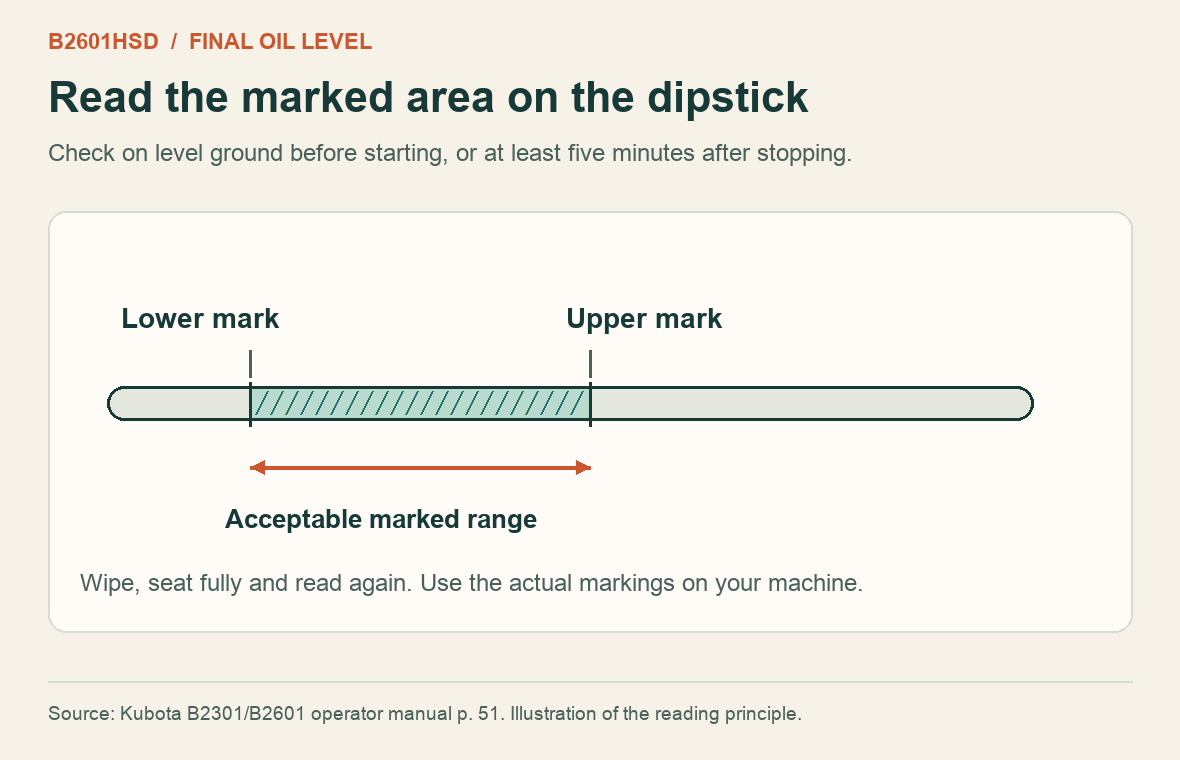
For the B2601HSD, use level ground and stop the engine. Kubota calls for a reading before starting or at least five minutes after stopping. Wipe the dipstick, seat it fully and withdraw it to read the marked range. The oil-change procedure calls for another check after running the engine briefly and stopping it. Check for leakage at the filter and allow the oil to settle before adjusting the level. Follow the procedure and markings for the machine in front of you. B2601 operator manual, printed pp. 51 and 59–60.
Once the level is correct, write down the hours, filter number, oil product and quantity added. A reading that rises over the next few jobs calls for a different investigation from an initially high refill. A dated reading taken under the same conditions helps separate the two. Why the engine oil level can rise after service.
Which D1105 workshop manual do you need?
For an ordinary oil change, start with the operator manual for the equipment. For a lubrication-system fault or an engine repair, match the workshop publication to the full engine designation. Byte Market lists separate editions for the E2 and E4 series. Check the covered model and job in the listing before choosing a file. D1105-E2B and E2BG workshop manual 9Y011-02754 · 05-E4B and 05-E4BG workshop manual 9Y111-07841.
Recent Post
-
Why a Kubota Manual May N...
16 Sep, 2026
-

Kubota Tractor Won’t Star...
16 Sep, 2026
-

Kubota DPF Light Flashing...
18 Sep, 2026
-
Kubota Tractor Overheatin...
21 Sep, 2026
-
Kubota Hydraulic Couplers...
22 Sep, 2026
-

Kubota UDT vs Super UDT2:...
23 Sep, 2026
-

Kubota 3-Point Hitch Won'...
24 Sep, 2026
-
Kubota Excavator Track Te...
25 Sep, 2026
-
New Holland540 vs 540E PT...
28 Sep, 2026
-
Kubota BX Mower Cutting U...
29 Sep, 2026
-
Kubota Excavator Controls...
30 Sep, 2026
-
New Holland DEF Storage:...
01 Oct, 2026
-
Kubota Air Filter: When t...
02 Oct, 2026
-
Kubota SVL Standard vs Hi...
06 Oct, 2026
-
New Holland Water in Fuel...
07 Oct, 2026
-

Kubota Loader Float: What...
08 Oct, 2026
-
Kubota HST Tractor Won't...
09 Oct, 2026
-
Kubota 50-Hour Service Ch...
12 Oct, 2026
-
Kubota 4WD Won't Disengag...
13 Oct, 2026
-
Kubota KX040-4 Final Driv...
14 Oct, 2026
-
Kubota PTO Won't Engage?...
15 Oct, 2026
-
How to Check Hydraulic Oi...
16 Oct, 2026
-

Kubota Battery Light Stay...
19 Oct, 2026
-
Kubota Ran Out of Diesel?...
20 Oct, 2026
-

Kubota SVL75-3 Lift Capac...
21 Oct, 2026
-
What Coolant Does a Kubot...
22 Oct, 2026
-
Kubota Engine Oil Level R...
23 Oct, 2026
-
Kubota SVL75-2 DPF Light...
26 Oct, 2026
-
Kubota U55-4 Specs: Weigh...
30 Oct, 2026
-
Kubota M7060 Specs: Weigh...
02 Nov, 2026
-
Kubota L2501 Specs: Weigh...
03 Nov, 2026
-

Kubota BX23S Specs: Weigh...
05 Nov, 2026
-
Kubota D1105 Oil Capacity...
06 Nov, 2026