Kubota MX5400 vs MX6000: Specs, PTO Power and Loader Capacity
Kubota MX5400 vs MX6000: Specs, PTO Power and Loader Capacity
The main reason to choose a Kubota MX6000 over an MX5400 is additional power. In Kubota's U.S. MX brochure, the MX6000 produces 63.4 gross engine hp and 51.8 PTO hp. The MX5400 is listed at 55.5 gross hp with gear drive or 57.0 with HST, and 46.5 PTO hp. Both models share the brochure's 9.5 US gpm main hydraulic-pump rating and 2,310 lb rear-hitch rating at 24 inches behind the lift points. Kubota U.S. MX brochure, printed page 16.
That makes the comparison more useful than a simple horsepower ranking. Someone shopping for a PTO implement may value the extra output. Someone buying mainly for bucket or pallet work needs to look closely at the loader fitted to each tractor.
MX5400 and MX6000 specs compared
| Specification | MX5400 gear drive | MX5400 HST | MX6000 HST |
|---|---|---|---|
| Gross engine hp | 55.5 | 57.0 | 63.4 |
| PTO hp | 46.5 | 46.5 | 51.8 |
| Transmission | 8 forward / 8 reverse | Three-range HST | Three-range HST |
| Drive configurations in the table | 2WD or 4WD | 4WD | 4WD |
The comparison uses the dedicated U.S. MX brochure. The operator's manual linked by Kubota Canada also lists 46.5 PTO hp across its MX5400 columns and 51.8 for the MX6000. Its specification table identifies both as 2.434-litre, four-cylinder turbocharged diesels. MX brochure, MX operator's manual, printed page 25.
These are North American document references. An Australian reader considering an imported machine should confirm its original market and equipment before applying the figures. The MX name alone does not identify the transmission, cab or loader.
What does the extra PTO horsepower buy you?
The difference between the quoted PTO ratings is 5.3 hp, or approximately 11.4%. This is a comparison of published ratings, not a measured increase in field output. The amount of work completed also depends on the implement, material, ground conditions and operating speed.
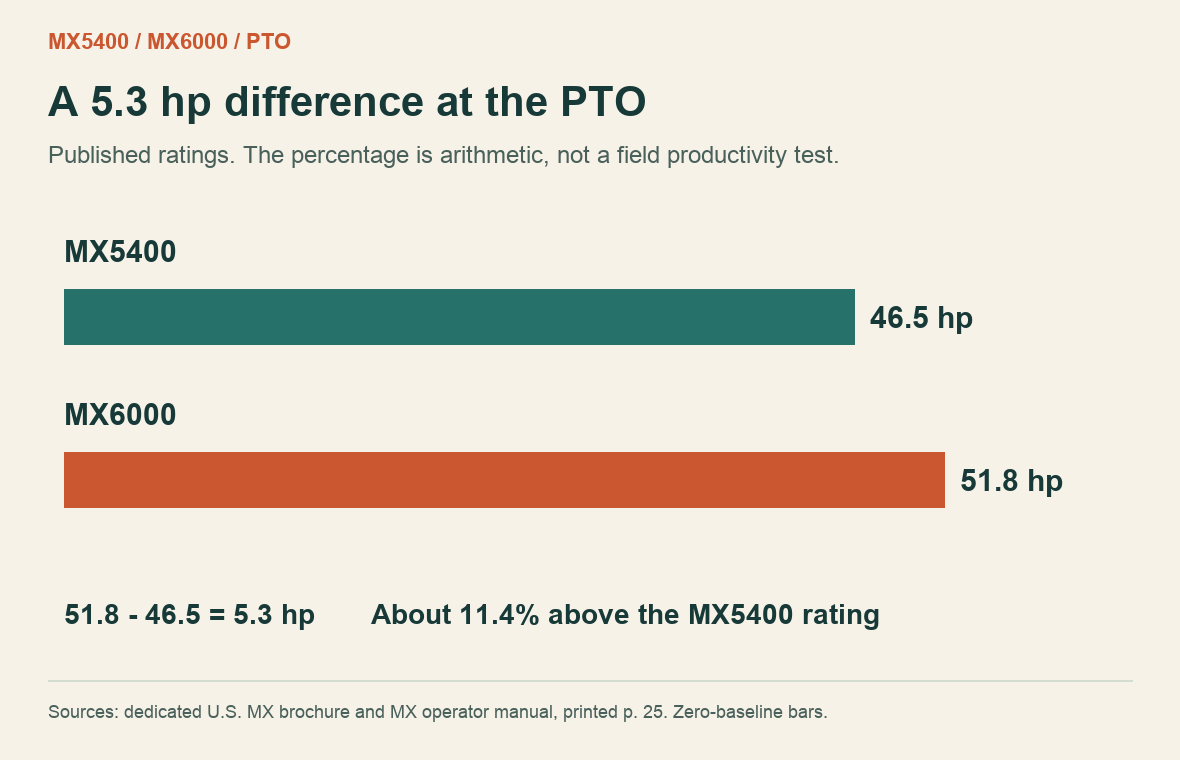
Suppose a particular implement requires at least 50 PTO hp. On these figures, the MX5400 is below that threshold and the MX6000 is above it. That would justify checking the MX6000 combination further. It would not yet settle implement weight, hitch category, hydraulic needs or the implement manufacturer's other limits.
If every implement you own is comfortably within the MX5400's approved range, price the benefit against your actual workload. There is little value in paying for a larger engine to solve a problem caused by an unsuitable attachment or an undersized trailer.
Does an MX6000 lift more with the front loader?
The current dedicated MX brochure lists the LA1065A for both tractors. Kubota Canada's separate LA1065 page also includes both MX5400 and MX6000 among its matching tractors. Keep those loader names distinct when ordering parts or looking up a procedure. LA1065A table, Kubota Canada LA1065 page.
For the LA1065, the Canadian table gives the following ratings. Read the load point and lift height together.
| LA1065 measuring condition | Published lift capacity |
|---|---|
| Pivot pin at maximum height | 2,275 lb / 1,032 kg |
| 500 mm forward at maximum height | 1,691 lb / 767 kg |
| Pivot pin at 1,500 mm height | 2,864 lb / 1,299 kg |
The page assigns these ratings to the loader, without separate higher figures for an MX6000 installation. For a pallet or bale job, obtain the rating that matches the fitted loader, attachment, load centre and height. A larger engine badge by itself is insufficient evidence of greater lift capacity. LA1065 specifications.
Hydraulic flow and available connections
Kubota lists 9.5 US gpm for the MX5400's main pump and 4.9 US gpm for power steering on its Canadian product page. The page lists up to three optional remote valves. These are separate pieces of information. A pump-output figure does not tell you which valves or couplers are installed on a used tractor. Kubota Canada MX5400 specifications.
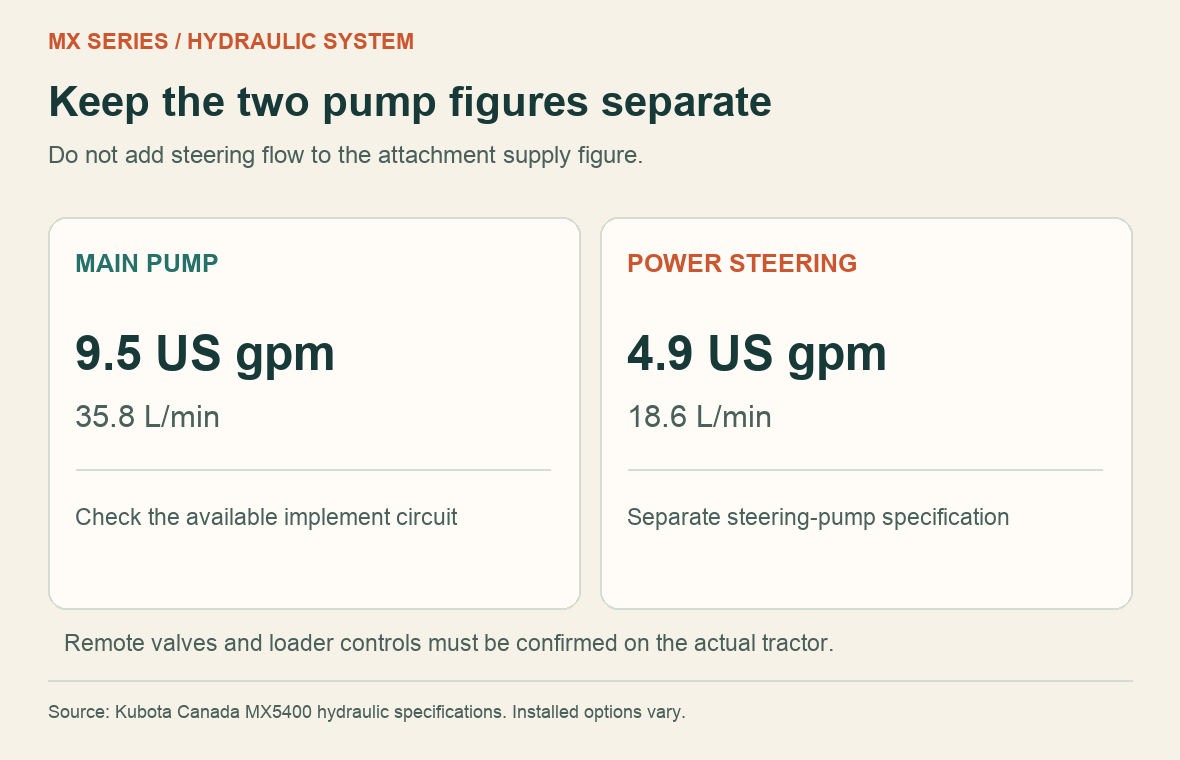
For a powered attachment, start with its required flow range, pressure and return arrangement. Then confirm the tractor's available circuit and controls. Do not add the steering-pump figure to the main-pump figure and present the total as available attachment flow. A seller's photograph of the rear couplers and loader control can help establish what needs checking before a viewing.
Weight depends more on configuration than the model number
The operator's manual lists the same tractor weights for the MX5400 HST and MX6000 HST. Each is 3,734 lb (1,694 kg) with ROPS or 4,268 lb (1,936 kg) with a cab. In that comparison, the cab adds 534 lb (242 kg). These entries do not provide the loaded transport weight of a tractor with a loader and implements. Operator's manual, printed page 26.
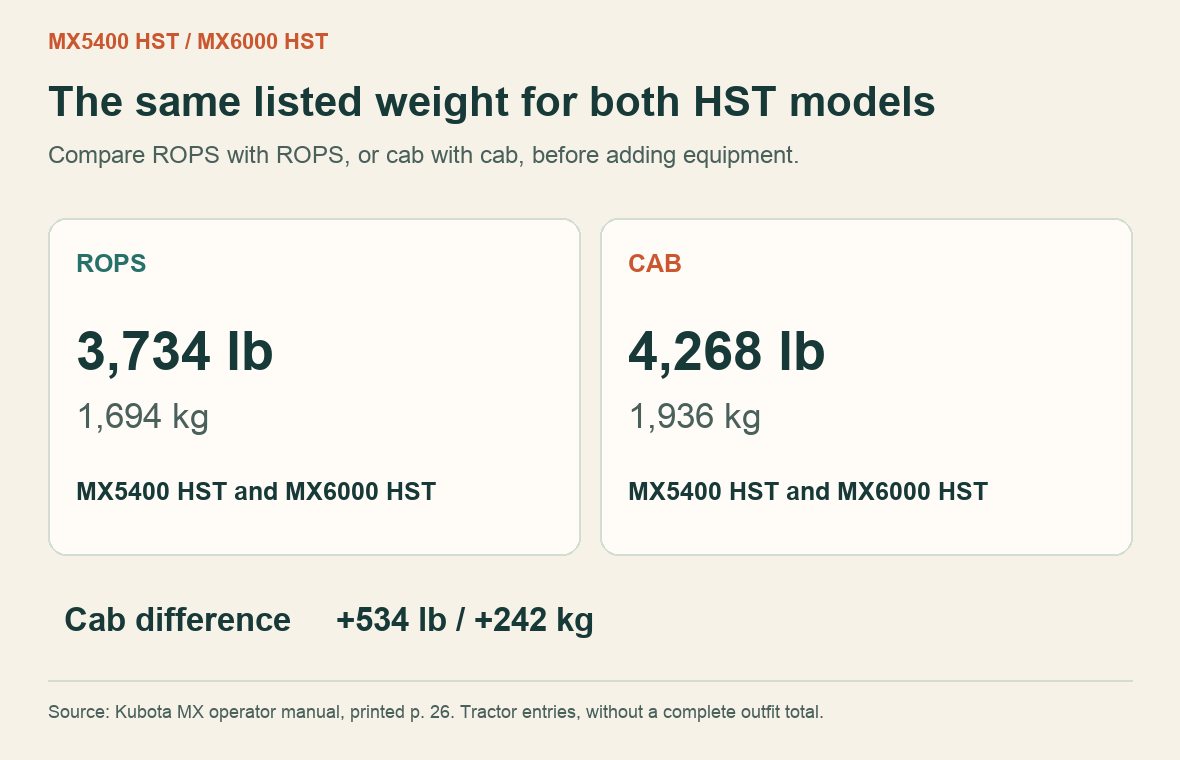
When comparing two listings, make a record of cab or ROPS, transmission, loader model, bucket or forks, rear ballast and tire fill. Price the complete equipment you need. For transport, measure or weigh that complete outfit and check the trailer and towing vehicle ratings with the person handling the move.
Which one makes sense for your work?
- A PTO implement near the MX5400's limit. The MX6000's additional published PTO power deserves consideration, followed by a full compatibility check.
- Mostly loader work. Compare the loader and attachment specifications on the two actual tractors, along with condition and ballast provisions.
- A preference for gear drive. The cited range offers that choice on the MX5400. The MX6000 is HST.
- Year-round work in a cab. Compare the cab equipment, visibility and complete machine weight as part of the purchase.
For service planning, the MX5400/MX6000 workshop manual, 9Y111-21166 lists transmission, hydraulic, engine and electrical coverage. Check its publication identity and contents against the tractor before buying. For a basic explanation of a loader control you may encounter during a demonstration, see how Kubota loader float works.
Recent Post
-
Why a Kubota Manual May N...
16 Sep, 2026
-
Kubota Tractor Won’t Star...
16 Sep, 2026
-

Kubota DPF Light Flashing...
18 Sep, 2026
-
Kubota Tractor Overheatin...
21 Sep, 2026
-
Kubota Hydraulic Couplers...
22 Sep, 2026
-

Kubota UDT vs Super UDT2:...
23 Sep, 2026
-
Kubota 3-Point Hitch Won'...
24 Sep, 2026
-
Kubota Excavator Track Te...
25 Sep, 2026
-
New Holland540 vs 540E PT...
28 Sep, 2026
-
Kubota BX Mower Cutting U...
29 Sep, 2026
-
Kubota Excavator Controls...
30 Sep, 2026
-

New Holland DEF Storage:...
01 Oct, 2026
-

Kubota Air Filter: When t...
02 Oct, 2026
-
Kubota SVL Standard vs Hi...
06 Oct, 2026
-
New Holland Water in Fuel...
07 Oct, 2026
-
Kubota Loader Float: What...
08 Oct, 2026
-
Kubota HST Tractor Won't...
09 Oct, 2026
-

Kubota 50-Hour Service Ch...
12 Oct, 2026
-
Kubota 4WD Won't Disengag...
13 Oct, 2026
-
Kubota KX040-4 Final Driv...
14 Oct, 2026
-
Kubota PTO Won't Engage?...
15 Oct, 2026
-
How to Check Hydraulic Oi...
16 Oct, 2026
-
Kubota Battery Light Stay...
19 Oct, 2026
-
Kubota Ran Out of Diesel?...
20 Oct, 2026
-
Kubota SVL75-3 Lift Capac...
21 Oct, 2026
-
What Coolant Does a Kubot...
22 Oct, 2026
-
Kubota Engine Oil Level R...
23 Oct, 2026
-
Kubota SVL75-2 DPF Light...
26 Oct, 2026
-
Kubota U55-4 Specs: Weigh...
30 Oct, 2026
-
Kubota M7060 Specs: Weigh...
02 Nov, 2026
-
Kubota L2501 Specs: Weigh...
03 Nov, 2026
-

Kubota BX23S Specs: Weigh...
05 Nov, 2026
-
Kubota D1105 Oil Capacity...
06 Nov, 2026
-
Kubota U17 and U17-3 Spec...
09 Nov, 2026
-
Kubota MX5400 vs MX6000:...
11 Nov, 2026