Kubota U35-4 Specs: Weight, Width, Digging Depth and Lift Capacity
Kubota U35-4 Specs: Weight, Width, Digging Depth and Lift Capacity
A Kubota U35-4 is approximately 1.7 metres (66.9 inches) wide. Kubota Canada's specification page lists a 4,749 mm overall length and 2,470 mm height. Its published operating weight starts at 8,129 lb (3,687 kg) in the U.S. brochure's standard-blade, rubber-track canopy configuration. A cab, steel tracks and the angle-blade option change that weight. Kubota Canada dimensions, U.S. U35-4 brochure.
For owners arranging transport or choosing a machine for a confined site, those configuration details matter more than the familiar “3.5-ton class” description. The following checks help turn a specification sheet into a useful conversation with a seller, rental company or operator.
How much does a U35-4 weigh?
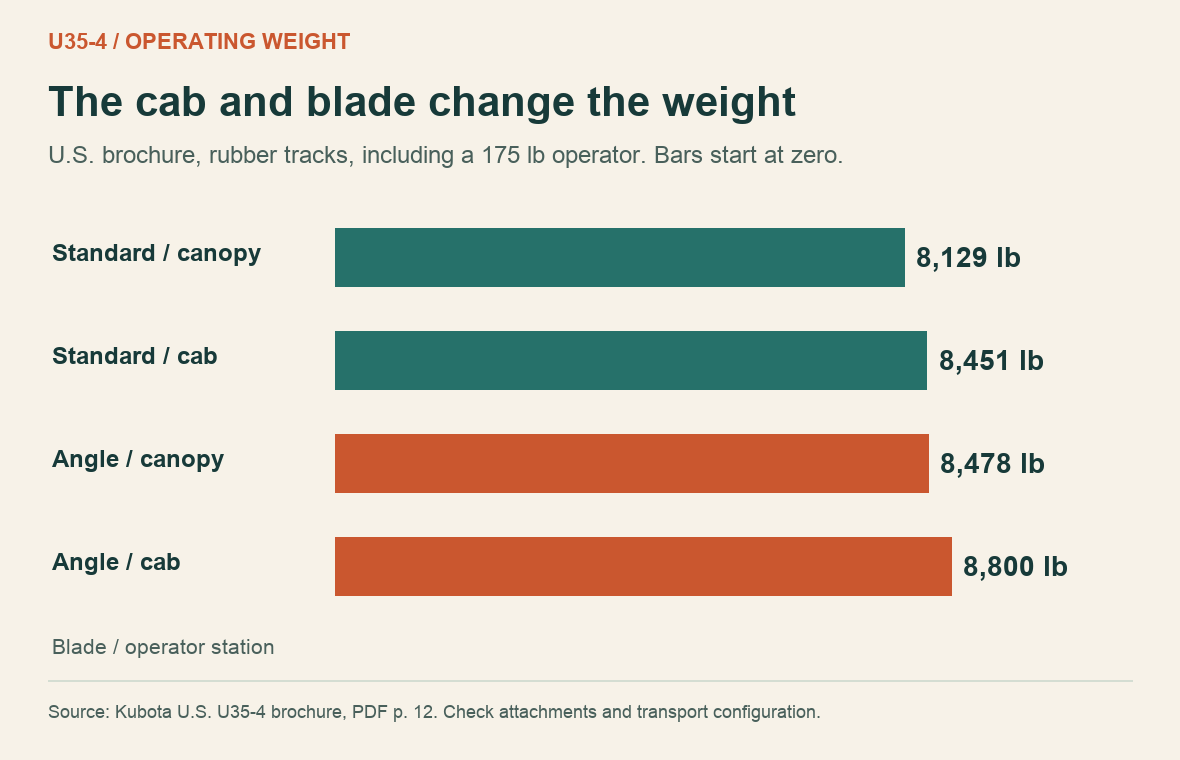
These four combinations are from the same U.S. brochure. All use rubber tracks, and the published operating weights include a 175 lb operator.
| U35-4 configuration | Operating weight |
|---|---|
| Standard blade, canopy | 8,129 lb / 3,687 kg |
| Standard blade, cab | 8,451 lb / 3,833 kg |
| Angle blade, canopy | 8,478 lb / 3,845 kg |
| Angle blade, cab | 8,800 lb / 3,991 kg |
The range between the first and last rows is 671 lb (304 kg), before considering a different fitted attachment. Steel-track configurations have separate entries in the source. U.S. brochure, PDF page 12.
Kubota Australia's product page gives 3,690 kg for a canopy machine and 3,830 kg for a cab machine. Keep these Australian entries attached to their source rather than merging them into the U.S. table. A seller should identify the machine's equipment and applicable specification. Kubota Australia U35-4 specifications.
A brochure weight is a starting point for transport planning. Record the quick coupler, bucket, thumb, any additional tools and the fuel condition. Establish what the reference weight includes, then weigh the complete transport load when its actual mass is needed. A trailer's gross rating also includes the trailer itself, so comparing that rating directly with an excavator figure misses part of the calculation.
Width, digging depth and space to work
The Australian specification lists a maximum digging depth of 3,010 mm and a ground-level digging radius of 5,170 mm. The U.S. brochure's digging-depth entry is 2,970 mm. The operator's manual linked by Kubota Canada gives 3,007 mm in a dimensions diagram explicitly based on a quick-coupler bucket. These documents show why a quoted digging depth should stay with its bucket and configuration notes. Australian specifications, U.S. working range, operator's manual, printed page 90.
A maximum-depth figure alone will not tell you whether the excavator can complete a trench from a particular position. The operator also needs the working distance from the machine, required trench profile and room for spoil or a truck. Give the operator a sketch of the job with dimensions and obstacles before selecting the machine.
Is the U35-4 zero tail swing?
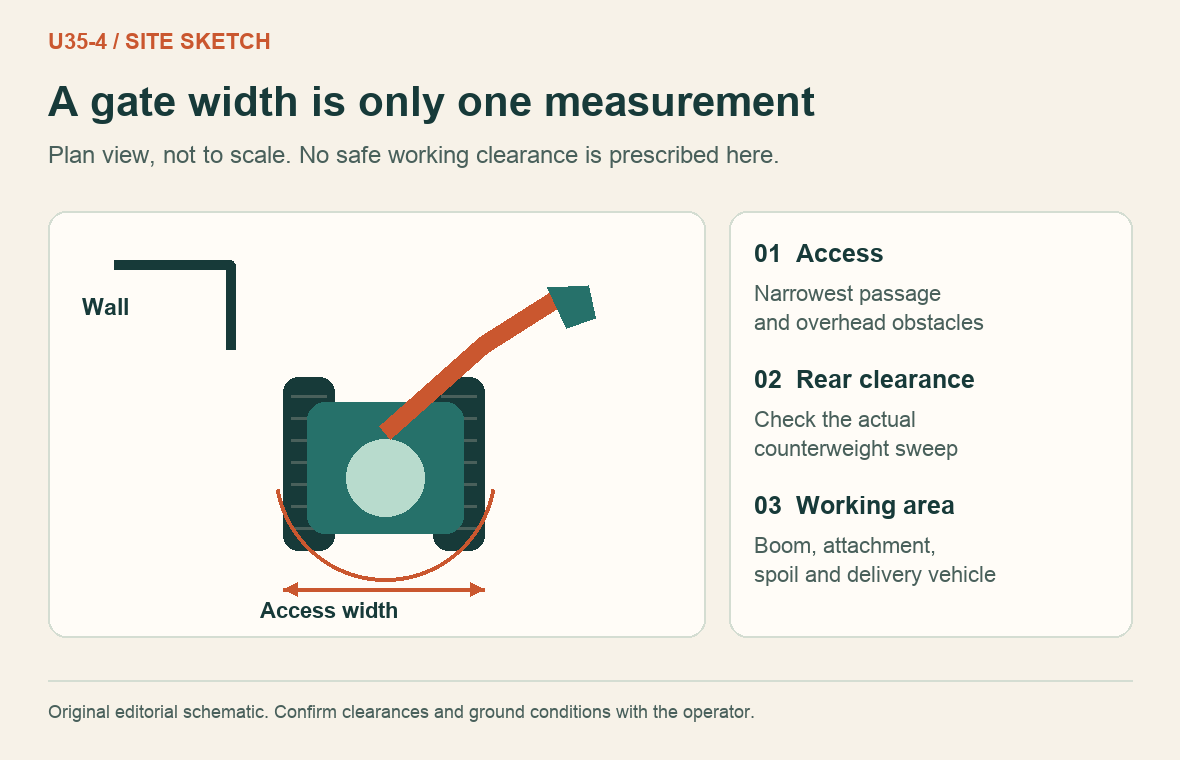
Kubota's Australian page describes the U35-4 as zero tail swing. Kubota's U.S. selection guide places it in the tight or reduced tail-swing group, and the Canadian page describes approximately 1.9 inches of counterweight protrusion. Use the actual machine clearance for site planning rather than treating the marketing label as a promise that the rear can never extend beyond the tracks. Kubota Australia, Kubota USA excavator guide, Kubota Canada U35-4.
A passage wide enough for the tracks may still leave inadequate space for a turn or a working swing. Include walls, fence posts, eaves, parked vehicles and the attachment envelope in the site sketch. The diagram above is a planning aid, without a scale or a prescribed safe clearance.
How much can a U35-4 lift?
There is no single useful lifting-capacity number without a radius, height and direction. At ground level, the U.S. brochure's canopy/rubber-track chart gives 1,840 lb over the side at an 8 ft radius and 1,020 lb at 12 ft. The chart describes a machine without a bucket. U.S. lifting chart, PDF page 11.
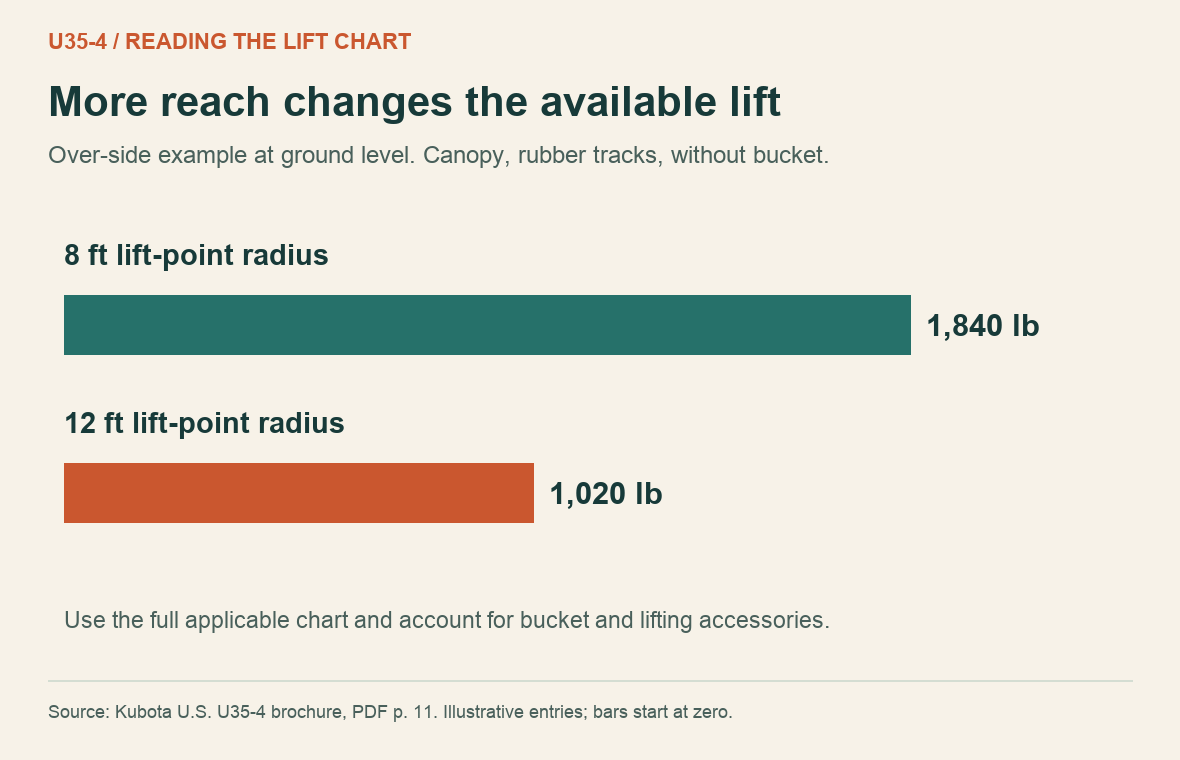
The operator's manual says its chart values apply on even, hard ground and requires subtraction of bucket weight when a bucket is fitted. Hooks, slings and other lifting accessories must also be accounted for. A lift should be planned from the applicable complete chart and instructions for the actual configuration. These two brochure entries only illustrate how strongly reach changes the answer. U35-4 operator's manual, printed page 91.
For example, moving a delivery vehicle farther away may make access easier but require the excavator to handle the same object at a longer radius. Record the proposed pick and placement positions, load weight and attachment arrangement for the operator. Do not interpolate an improvised limit or use bucket breakout force as a lifting rating.
Will a hydraulic attachment work on it?
The Australian U35-4 specification lists 60 L/min auxiliary flow, approximately 15.8 US gpm. The Canadian page describes adjustable auxiliary-flow settings. A flow setting is only one part of the match. The attachment's pressure requirement, return circuit, couplers, mounting geometry and carrier-weight range also need checking. Australian auxiliary-flow specification, Canadian auxiliary-control description.
Ask for the attachment's complete model identification. Two tools sold under the same broad description, such as “three-tonne excavator auger,” can have different requirements. Keep the tool's manual beside the excavator's instructions when confirming the pairing.
Which manual do you need?
The operator's manual supplies the operating instructions, applicable lifting tables and routine checks. For hydraulic or electrical diagnosis, Byte Market lists the U35-4 workshop manual, RY911-21846. Its published contents include hydraulic diagrams, pressure-test material, wiring diagrams and connector information. Check the contents and applicability against your machine before purchasing.
If you are assessing a used machine, the separate guides to Kubota track-tension checks and excavator control patterns cover two issues that deserve attention before a demonstration.
Recent Post
-
Why a Kubota Manual May N...
16 Sep, 2026
-
Kubota Tractor Won’t Star...
16 Sep, 2026
-

Kubota DPF Light Flashing...
18 Sep, 2026
-
Kubota Tractor Overheatin...
21 Sep, 2026
-
Kubota Hydraulic Couplers...
22 Sep, 2026
-

Kubota UDT vs Super UDT2:...
23 Sep, 2026
-
Kubota 3-Point Hitch Won'...
24 Sep, 2026
-
Kubota Excavator Track Te...
25 Sep, 2026
-
New Holland540 vs 540E PT...
28 Sep, 2026
-
Kubota BX Mower Cutting U...
29 Sep, 2026
-
Kubota Excavator Controls...
30 Sep, 2026
-
New Holland DEF Storage:...
01 Oct, 2026
-
Kubota Air Filter: When t...
02 Oct, 2026
-
Kubota SVL Standard vs Hi...
06 Oct, 2026
-
New Holland Water in Fuel...
07 Oct, 2026
-
Kubota Loader Float: What...
08 Oct, 2026
-
Kubota HST Tractor Won't...
09 Oct, 2026
-
Kubota 50-Hour Service Ch...
12 Oct, 2026
-
Kubota 4WD Won't Disengag...
13 Oct, 2026
-
Kubota KX040-4 Final Driv...
14 Oct, 2026
-
Kubota PTO Won't Engage?...
15 Oct, 2026
-
How to Check Hydraulic Oi...
16 Oct, 2026
-
Kubota Battery Light Stay...
19 Oct, 2026
-
Kubota Ran Out of Diesel?...
20 Oct, 2026
-
Kubota SVL75-3 Lift Capac...
21 Oct, 2026
-
What Coolant Does a Kubot...
22 Oct, 2026
-
Kubota Engine Oil Level R...
23 Oct, 2026
-
Kubota SVL75-2 DPF Light...
26 Oct, 2026
-
Kubota U55-4 Specs: Weigh...
30 Oct, 2026
-
Kubota M7060 Specs: Weigh...
02 Nov, 2026
-
Kubota L2501 Specs: Weigh...
03 Nov, 2026
-

Kubota BX23S Specs: Weigh...
05 Nov, 2026
-

Kubota D1105 Oil Capacity...
06 Nov, 2026
-
Kubota U17 and U17-3 Spec...
09 Nov, 2026
-
Kubota MX5400 vs MX6000:...
11 Nov, 2026
-
Kubota B2601 Specs: Weigh...
12 Nov, 2026
-
Kubota U35-4 Specs: Weigh...
13 Nov, 2026