Kubota L3901 Specs: Weight, PTO Power and Loader Capacity

Kubota L3901 Specs: Weight, PTO Power and Loader Capacity
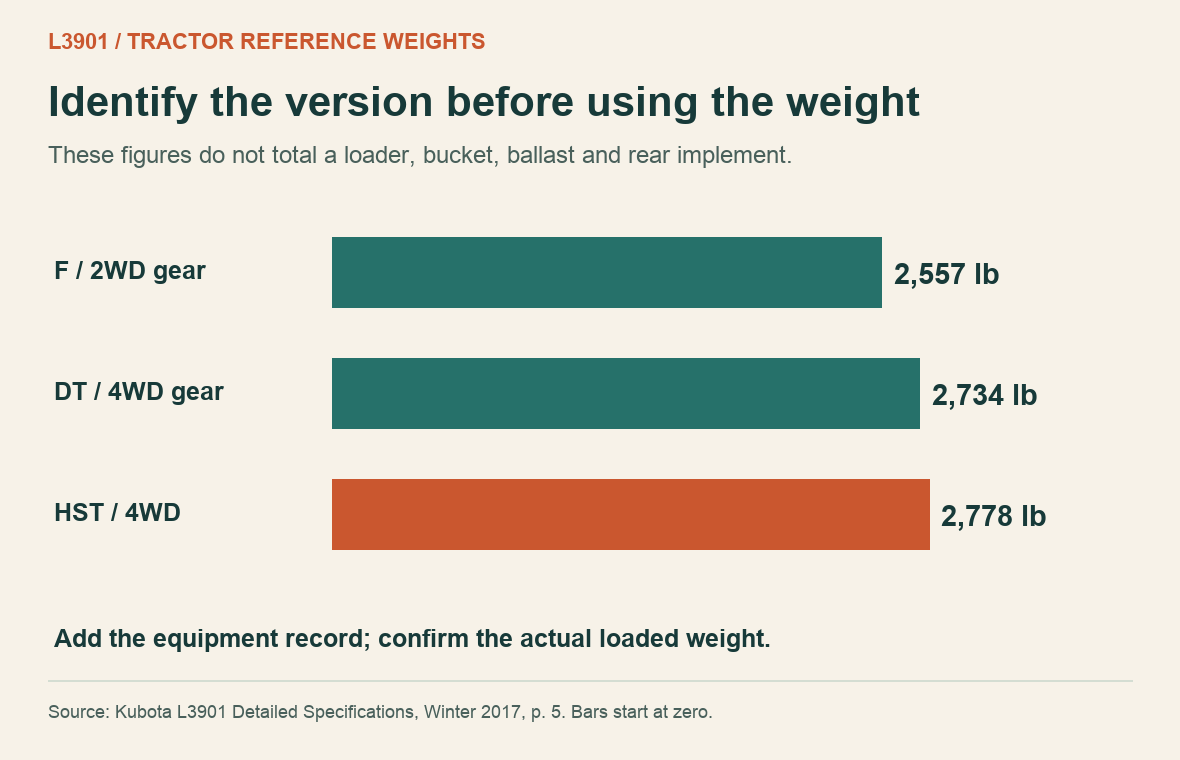
The Kubota L3901 has 37.5 gross engine hp. PTO output is 32.1 hp on the gear models and 30.6 hp on the HST, while base weight ranges from 2,557 to 2,778 lb. The transmission and drive version explain those differences.
For a mower or tiller purchase, start with the PTO rating. For transport, start with the tractor version and add the equipment fitted to it. The figures below cover the U.S. L3901 F, DT and HST.
L3901 F, DT and HST specifications
| Version | Drive and transmission | PTO power | Base weight |
|---|---|---|---|
| L3901F | 2WD, gear | 32.1 hp | 2,557 lb (1,160 kg) |
| L3901DT | 4WD, gear | 32.1 hp | 2,734 lb (1,240 kg) |
| L3901HST | 4WD, three-range hydrostatic | 30.6 hp | 2,778 lb (1,260 kg) |
Sources: Kubota L3901 Detailed Specifications, Winter 2017, pages 3–5, and the Standard L brochure. Weights are for the tractor; calculate a separate total for the loader, bucket, ballast and rear implement.
Ask which version a seller has before using an advertised weight. A loader and rear ballast can also account for a difference between the brochure figure and a scale ticket.
Is the L3901 a 39 hp tractor?
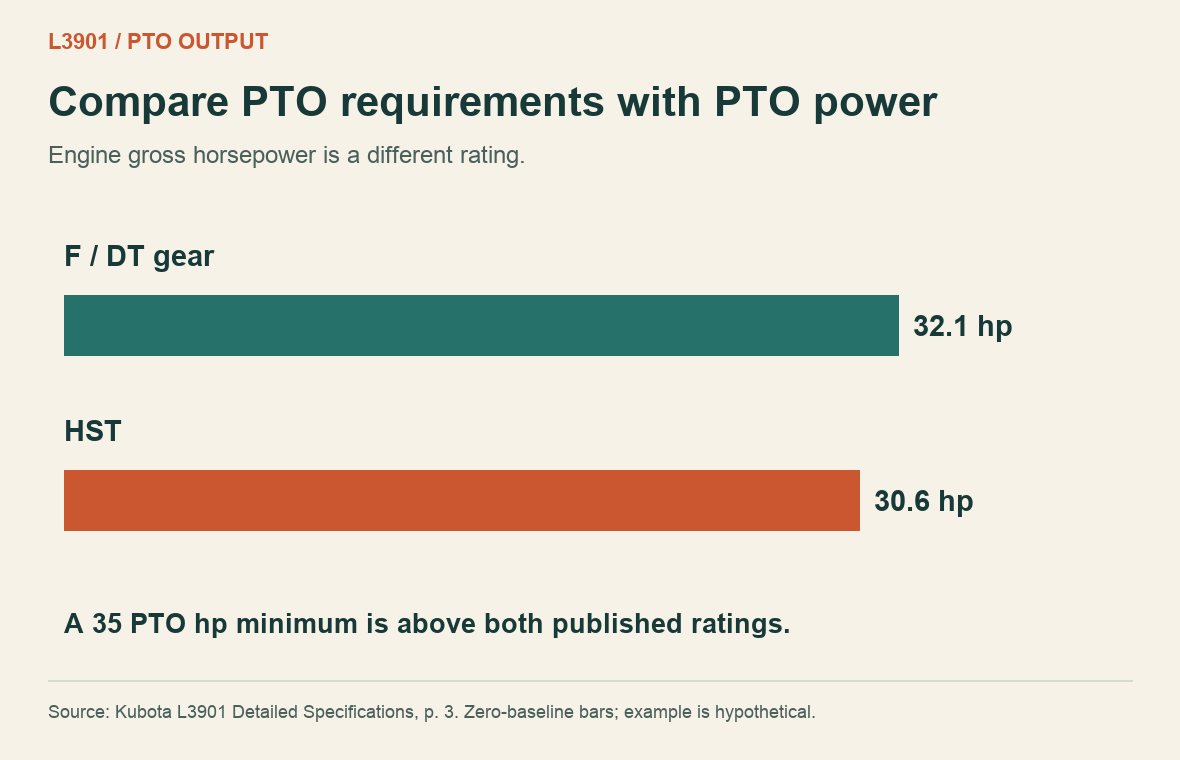
The engine ratings are 37.5 gross hp and 36.3 net hp. For a PTO-driven implement, use 32.1 hp for the gear versions or 30.6 hp for HST. Kubota gives the ratings and rated speeds on page 3 of its L3901 specification sheet.
Suppose a cutter requires at least 35 PTO hp. Both L3901 versions fall below that requirement, even though gross engine power exceeds it. Compare the implement's minimum with the tractor's PTO output.
Once power is matched, check implement weight, hitch fit and driveline requirements. Working speed will also depend on the vegetation, terrain and the implement's operating instructions.
Loader capacity and rear-hitch capacity
The rear three-point hitch is rated at 1,874 lb at the lift points and 1,433 lb at 24 inches behind them in the detailed tractor sheet.
At the front, the LA525 is the loader paired with the L3901. Kubota's L01 implement-limitations sheet gives 1,131 lb for the L3901 front-loader lift limit at maximum height.
For a pallet-fork job, check the loader chart for the attachment, load centre and height you need. Raising a pallet off the ground and placing it on a truck involve different lift positions. The rear-hitch figures have no bearing on that front-loader calculation.
Kubota's documents disagree on the rear lift-point figure: the implement-limitations sheet gives 1,985 lb, while the detailed tractor sheet gives 1,874 lb. Neither explains the difference. Confirm the applicable limit in the machine's operator manual or with a Kubota dealer before using it to size an implement.
Can an L3901 run a six-foot rotary cutter?
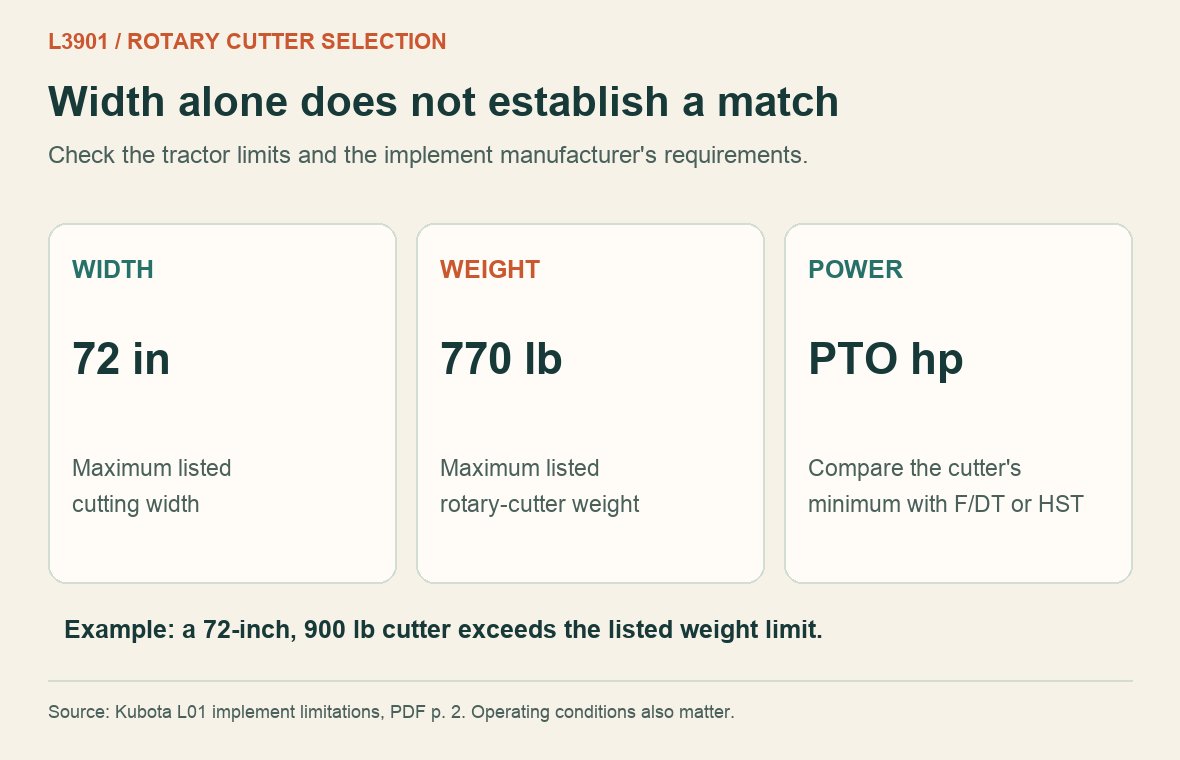
The implement-limitations table specifies a maximum rotary-cutter width of 72 inches and maximum weight of 770 lb for the L3901. It also notes that implement size may vary with soil and operating conditions.
For example, a 72-inch cutter weighing 900 lb exceeds the weight limit. A lighter model still needs a suitable PTO requirement, hitch and driveline. Check the cutter's own specifications alongside the tractor limits before buying.
What is the L3901 engine oil capacity?
Kubota's U.S. specification sheet gives 7.1 US qt, approximately 6.7 litres, for engine oil. For an oil change, follow the operator manual's draining, filter-replacement and level-check instructions. The specification row does not state how much will drain from an individual engine.
When ordering a service kit, confirm its filter numbers and fluid specifications for your tractor version. Keep the engine-oil and transmission/hydraulic-fluid requirements separate on the order.
Before viewing a used L3901
Ask the seller for:
- A photograph of the tractor identification and the hour-meter reading.
- The loader model and a list of buckets, forks and rear implements included.
- Tire sizes and details of wheel weights or liquid ballast.
- Service records showing dates, hours, fluids and filters used.
- The operator manuals supplied with the tractor and its attachments.
If the seller reports a fault, ask when it occurs and which function is affected. “The loader feels weak” is a starting point; the fitted attachment, load and operating conditions give a workshop more to investigate.
L3901 workshop information
The L3301/L3901/L4701 Workshop Manual, 9Y111-10123, available from Byte Market, covers electrical troubleshooting, hydraulic testing and service specifications. Review its contents for the repair you need. Keep the operator manual for operation and routine-maintenance instructions.
For a comparison with the smaller model, see the L2501 specification guide. Check both offers against the same implement requirements and include the equipment supplied in each price.
Recent Post
-

Why a Kubota Manual May N...
16 Sep, 2026
-

Kubota Tractor Won’t Star...
16 Sep, 2026
-

Kubota DPF Light Flashing...
18 Sep, 2026
-
Kubota Tractor Overheatin...
21 Sep, 2026
-
Kubota Hydraulic Couplers...
22 Sep, 2026
-

Kubota UDT vs Super UDT2:...
23 Sep, 2026
-

Kubota 3-Point Hitch Won'...
24 Sep, 2026
-
Kubota Excavator Track Te...
25 Sep, 2026
-
New Holland540 vs 540E PT...
28 Sep, 2026
-
Kubota BX Mower Cutting U...
29 Sep, 2026
-
Kubota Excavator Controls...
30 Sep, 2026
-

New Holland DEF Storage:...
01 Oct, 2026
-

Kubota Air Filter: When t...
02 Oct, 2026
-
Kubota SVL Standard vs Hi...
06 Oct, 2026
-

New Holland Water in Fuel...
07 Oct, 2026
-
Kubota Loader Float: What...
08 Oct, 2026
-
Kubota HST Tractor Won't...
09 Oct, 2026
-
Kubota 50-Hour Service Ch...
12 Oct, 2026
-
Kubota 4WD Won't Disengag...
13 Oct, 2026
-
Kubota KX040-4 Final Driv...
14 Oct, 2026
-
Kubota PTO Won't Engage?...
15 Oct, 2026
-
How to Check Hydraulic Oi...
16 Oct, 2026
-

Kubota Battery Light Stay...
19 Oct, 2026
-
Kubota Ran Out of Diesel?...
20 Oct, 2026
-

Kubota SVL75-3 Lift Capac...
21 Oct, 2026
-
What Coolant Does a Kubot...
22 Oct, 2026
-

Kubota Engine Oil Level R...
23 Oct, 2026
-

Kubota SVL75-2 DPF Light...
26 Oct, 2026
-
Kubota U55-4 Specs: Weigh...
30 Oct, 2026
-
Kubota M7060 Specs: Weigh...
02 Nov, 2026
-
Kubota L2501 Specs: Weigh...
03 Nov, 2026
-

Kubota BX23S Specs: Weigh...
05 Nov, 2026
-

Kubota D1105 Oil Capacity...
06 Nov, 2026
-

Kubota U17 and U17-3 Spec...
09 Nov, 2026
-
Kubota MX5400 vs MX6000:...
11 Nov, 2026
-

Kubota B2601 Specs: Weigh...
12 Nov, 2026
-

Kubota U35-4 Specs: Weigh...
13 Nov, 2026
-
Kubota KX71-3 Specs: Weig...
17 Nov, 2026
-

Kubota B2650 Specs: Cab W...
18 Nov, 2026
-
Kubota L3901 Specs: Weigh...
19 Nov, 2026