Kubota BX2380 Snow Blower vs. Blade and Winter Setup

Kubota BX2380 Snow Blower vs. Blade and Winter Setup
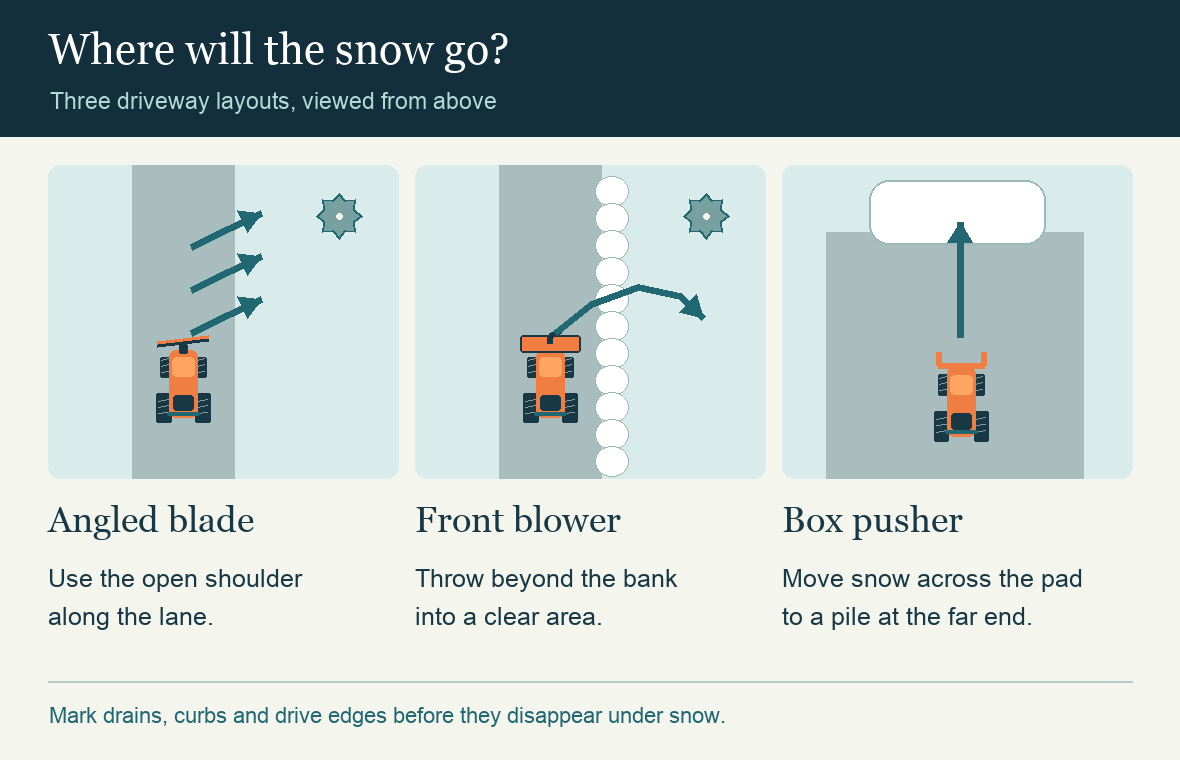
Stand at the garage door and look down your driveway. Where will the snow from the third storm go? If there’s an open shoulder along the whole drive, an angled blade on your Kubota BX2380 can roll snow to that side on each pass. If the drive runs between two banks that already crowd the car, a front snow blower earns its keep by throwing snow beyond the edge. A wide pad with a pile site at the far end calls for a different tool again.
Which snow attachment suits your driveway?
Choose a blade for a lane with room along the sides. An angled plow leaves a ridge, or windrow, beside the cleared strip. It’s a good match for shallow snow and slush on a paved drive. Decide where that ridge can grow over the winter. At the mouth of the drive, a bank that blocks your view of traffic is a poor trade for a few extra feet of clear pavement.
Choose a blower where space for banks runs out. The chute lets you put snow farther away than a blade can push it sideways. That helps on a long drive that narrows after each storm, provided there’s somewhere safe to aim. Walk the route and look for windows, parked cars, walkways and the road. Wind can bring the discharge back across the strip you just cleared. Heavy, wet snow can also plug the chute.
Consider a snow pusher for a pad or parking area. Its side plates hold snow in front of the tractor. Picture pushing straight across a garage apron to a pile on your own property. On a long lane with just one pile site, each trip gets longer, and wet snow gets heavy quickly. Land Pride offers 48- and 60-inch SPL05 pushers for BX loaders. Check the loader coupling on the particular pusher you’re buying. Land Pride’s BX implement guide.
Gravel changes the first pass. Before loose stone disappears under snow, mark the edge of the drive, the culvert and any raised drain covers. A blower can throw gravel through a window. Check whether the implement manual permits gravel use and how to set its skid shoes for clearance. Land Pride, for example, calls for more clearance over crushed rock than over pavement on its SB-series blowers. Use the setting for the blower you own. Land Pride’s skid-shoe guidance.
What fits a BX2380? Check the hitch before buying used
A seller’s photo of an orange 50-inch blower tells you little about what stayed on the seller’s tractor. Ask for a clear photo of the blower’s model and serial plate, then a second photo showing the tractor-side hitch, driveline, guards, mounting hardware and chute controls included in the sale.
Take Kubota’s BX2816, a 50-inch front blower listed for the BX2380. It mounts to the BX2810 front quick hitch. Power reaches it from the tractor’s mid PTO (power take-off) through the BX2811 driveline. The BX2812A 60-inch hydraulic angle blade uses the same hitch and needs no rotating drive. Kubota lists the BX2417A loader valve for either setup if the tractor lacks it. The brochure also calls for removing the mid-mount mower deck and its bracing to install the BX2810 hitch. Kubota’s Snow Implements guide, BX section.
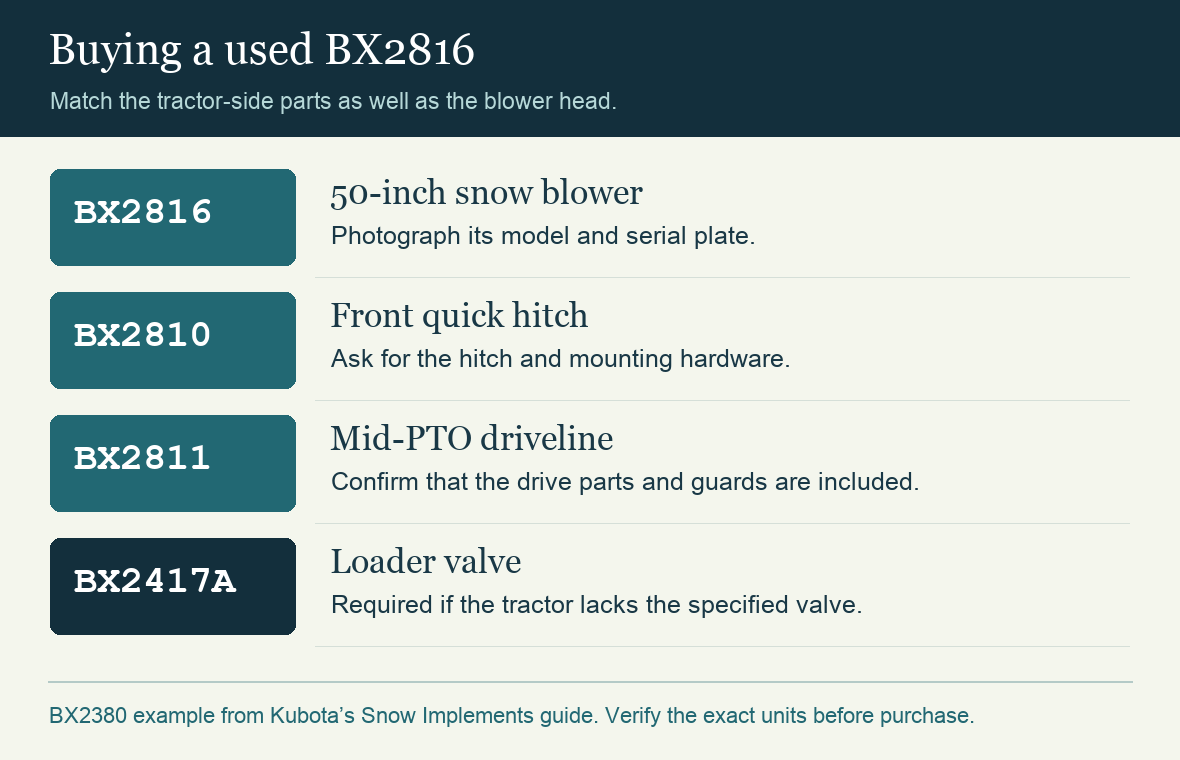
If the ad includes only the BX2816 head, ask a dealer to price the missing pieces against your tractor and attachment serial numbers before agreeing on a price. Ask the seller to show how the chute turns and how its deflector adjusts. Kubota lists manual controls on the base BX2816. A photograph with hydraulic hoses or an electrical harness is a reason to find out which options come with that particular machine.
What to check on the tractor before it snows
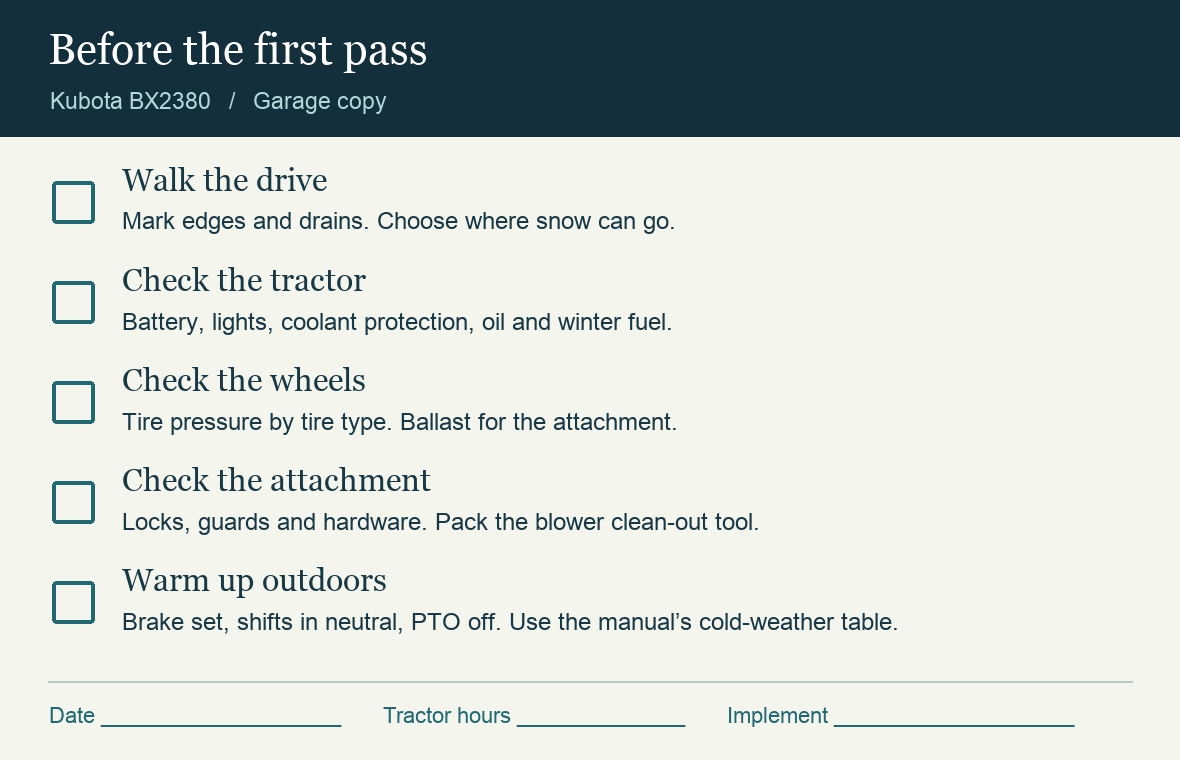
- Battery and lights. Check battery charge and look for loose or corroded terminals while you still have daylight. Switch on the lights you’ll use with the attachment fitted. From the seat, check whether you can see the cutting edge and both sides of the drive.
- Coolant and fuel. With the engine cold, check coolant level and freeze protection against the temperatures you expect. A full reservoir tells you the level only. If the mixture is unknown, measure it with a tester intended for that coolant. Check that the diesel in the tank suits local winter conditions, especially if you last filled up in summer. Kubota coolant types and BX capacities.
- Oil and hydraulics. On level ground, follow the BX manual’s procedure for checking engine oil and transmission fluid. Compare your engine oil grade with the temperature chart in your edition. Look for cracked hoses or fresh oil beneath the parked tractor. Keep hands away from suspected hydraulic leaks.
- Tires, chains and ballast. Read the size and tread type off the tires before looking up the pressure. Kubota gives different pressures for turf and bar tires of the same size. Match ballast to the attachment and respect the tire and axle limits. If you’re shopping for chains, give the dealer the tire size, axle and wheel setup so they can confirm permitted fit and clearance. A chain that fits around the tire may still foul the tractor.
Keep the tractor operator’s manual handy for the tire table and ballast instructions. Kubota also covers the battery, hoses, fuel and other seasonal checks in its winter guidance. BX1880/BX2380/BX2680 Operator’s Manual · Kubota’s seasonal maintenance guide.
The first time you clear snow
At 20°F (about −7°C), hearing the engine fire is only the start. The BX operator’s manual linked above gives a 5–10 minute warm-up for the engine and transmission oil in the 14–32°F range. Follow the warm-up procedure in your edition, outdoors, with the parking brake set, shift levers in neutral and PTO disengaged. The cold transmission oil needs time to circulate before you put the tractor to work. Kubota’s warm-up table, printed page 40.
- Walk the route. Pick up cords, newspapers and toys. Mark obstacles that snow will hide. Choose a pile site or discharge area clear of people, traffic and buildings.
- Inspect the parked setup. With the attachment lowered, engine off and key out, check the hitch locks, retaining hardware and guards against the implement manual. On a blower, have the clean-out tool and the specified spare shear bolts ready.
- Make a short first pass. Keep bystanders clear. Check where the snow lands and whether the edge is catching the surface. Stop if the equipment picks up gravel or develops a new vibration. Secure the tractor before getting off to inspect.
If wet snow plugs the blower, disengage the PTO, lower the implement, set the parking brake, shut off the engine and remove the key. Wait for every moving part to stop. Follow the blower’s clean-out procedure with the proper tool. Never reach into the chute or auger housing, even with the engine off. U.S. Consumer Product Safety Commission snow thrower guidance.
When a check turns up a fault
The attachment manual covers the blower’s shear hardware, guards and chute. If the fault points back to the tractor, Byte Market lists Kubota’s workshop manual 9Y111-16342 for the BX2380. Its contents identify the PTO clutch pressure check on page 224 and hydraulic pump flow checks on page 324. Those references can help a shop locate the right test when the drive or lift still misbehaves after warm-up. See the BX2380 workshop manual and its contents.
Recent Post
-
Why a Kubota Manual May N...
16 Sep, 2026
-
Kubota Tractor Won’t Star...
16 Sep, 2026
-
Kubota DPF Light Flashing...
18 Sep, 2026
-
Kubota Tractor Overheatin...
21 Sep, 2026
-
Kubota Hydraulic Couplers...
22 Sep, 2026
-

Kubota UDT vs Super UDT2:...
23 Sep, 2026
-
Kubota 3-Point Hitch Won'...
24 Sep, 2026
-
Kubota Excavator Track Te...
25 Sep, 2026
-

New Holland540 vs 540E PT...
28 Sep, 2026
-
Kubota BX Mower Cutting U...
29 Sep, 2026
-
Kubota Excavator Controls...
30 Sep, 2026
-
New Holland DEF Storage:...
01 Oct, 2026
-
Kubota Air Filter: When t...
02 Oct, 2026
-
Kubota SVL Standard vs Hi...
06 Oct, 2026
-

New Holland Water in Fuel...
07 Oct, 2026
-
Kubota Loader Float: What...
08 Oct, 2026
-
Kubota HST Tractor Won't...
09 Oct, 2026
-
Kubota 50-Hour Service Ch...
12 Oct, 2026
-
Kubota 4WD Won't Disengag...
13 Oct, 2026
-
Kubota KX040-4 Final Driv...
14 Oct, 2026
-
Kubota PTO Won't Engage?...
15 Oct, 2026
-
How to Check Hydraulic Oi...
16 Oct, 2026
-
Kubota Battery Light Stay...
19 Oct, 2026
-
Kubota Ran Out of Diesel?...
20 Oct, 2026
-

Kubota SVL75-3 Lift Capac...
21 Oct, 2026
-
What Coolant Does a Kubot...
22 Oct, 2026
-
Kubota Engine Oil Level R...
23 Oct, 2026
-
Kubota SVL75-2 DPF Light...
26 Oct, 2026
-

Kubota U55-4 Specs: Weigh...
30 Oct, 2026
-
Kubota M7060 Specs: Weigh...
02 Nov, 2026
-
Kubota L2501 Specs: Weigh...
03 Nov, 2026
-

Kubota BX23S Specs: Weigh...
05 Nov, 2026
-
Kubota D1105 Oil Capacity...
06 Nov, 2026
-

Kubota U17 and U17-3 Spec...
09 Nov, 2026
-
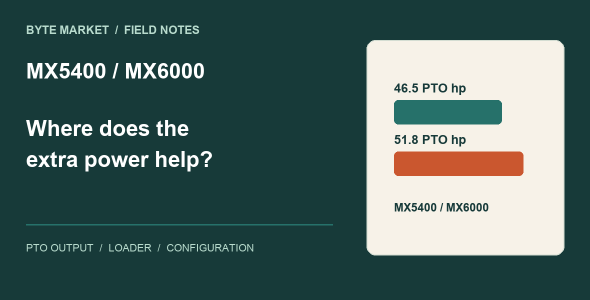
Kubota MX5400 vs MX6000:...
11 Nov, 2026
-

Kubota B2601 Specs: Weigh...
12 Nov, 2026
-

Kubota U35-4 Specs: Weigh...
13 Nov, 2026
-
Kubota KX71-3 Specs: Weig...
17 Nov, 2026
-

Kubota B2650 Specs: Cab W...
18 Nov, 2026
-

Kubota L3901 Specs: Weigh...
19 Nov, 2026
-
Kubota BX2380 Snow Blower...
20 Nov, 2026